

Behavioral health practices have never been busier. Therapists are fully booked. Psychiatric providers have growing waitlists. Intensive Outpatient Programs (IOPs) and Partial Hospitalization Programs (PHPs) continue to expand as demand for mental health services rises nationwide.
Yet many organizations are facing a frustrating reality:
- Patient volume is increasing, but financial performance is not.
- Cash flow remains unpredictable. Denials continue to rise. Accounts receivable are aging. Revenue that should be reaching the bank is getting trapped somewhere inside the billing process.
- The problem is not a lack of patients.
- The problem is revenue leakage.
Across behavioral health, financial success is no longer determined by how many patients are seen. It is determined by how effectively practices manage eligibility verification, prior authorizations, clinical documentation, coding accuracy, denial prevention, and accounts receivable recovery.
In 2026, many practices are discovering that a full schedule does not automatically translate into financial stability. The organizations that thrive are the ones that protect revenue at every stage of the revenue cycle.
This article explores where behavioral health practices lose revenue, why traditional billing workflows are struggling to keep up, and how a structured revenue cycle strategy can transform collections without increasing patient volume.
Why Behavioral Health Practices Feel Busy but Financially Unstable
A full schedule often creates the illusion of financial stability. On the surface, everything appears healthy: appointments are booked, clinicians are active, and patient flow is strong. But billing systems operate independently from clinical operations. Even a high-volume practice can experience revenue loss if payer requirements are not strictly followed.
The gap forms because behavioral health billing depends on multi-layer validation, not just service delivery.
- Eligibility, authorization, documentation, and coding must align perfectly
- A single missing step can stop reimbursement entirely
- Revenue realization is delayed even when care is successfully delivered
This disconnect is why many practices feel “busy but broke” – a pattern increasingly seen across outpatient behavioral health organizations.
The Structural Reality of Behavioral Health Billing
Behavioral health reimbursement is fundamentally condition-driven rather than procedure-driven.
Payment depends on multiple interconnected variables:
- Session duration compliance (time-based CPT rules such as 90834, 90837)
Even small timing discrepancies can change reimbursement levels or trigger denials. - Medical necessity validation
Payers require ongoing proof that treatment is clinically required, not just initiated. - Authorization alignment
Services must strictly match approved units, levels of care, and timelines. - Documentation integrity
Progress notes must reflect measurable clinical progress and treatment justification.
When even one of these elements breaks, claims are delayed or denied – regardless of clinical accuracy.
The Hidden Cost of Revenue Leakage in Behavioral Health Practice
Many behavioral health organizations underestimate how much revenue leakage impacts their bottom line because the losses occur gradually.
A denied claim is easy to identify.
An underpaid claim, missed authorization, expired appeal deadline, or aging account often goes unnoticed.
Over time, these small losses compound into significant financial damage.
Consider a behavioral health practice generating $200,000 in monthly charges.
If only 10% of potential revenue is lost due to denials, underpayments, documentation issues, or unresolved accounts receivable, that represents:
- $20,000 per month
- $240,000 per year
For larger organizations operating multiple locations or higher levels of care, the impact can be substantially greater.
This is why modern behavioral health revenue cycle management focuses not only on claim submission but on identifying and eliminating revenue leakage throughout the entire reimbursement process.
The Silent Revenue Leaks Most Behavioral Health Practices Miss
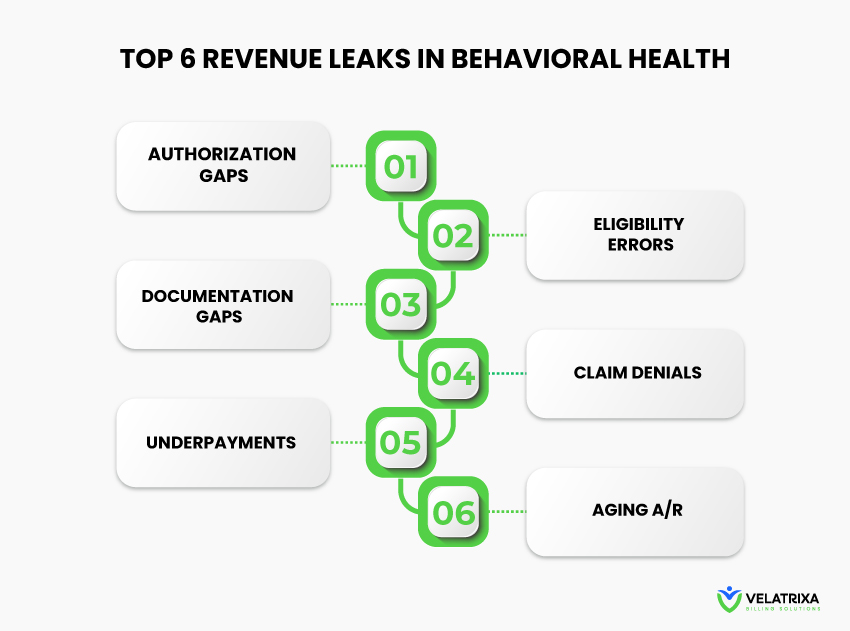
Revenue loss in behavioral health rarely comes from a single catastrophic failure.
Instead, it builds gradually across multiple weak points in the revenue cycle.
Authorization breakdowns that go unnoticed
Many practices obtain initial authorization but fail to track continuation approvals. This leads to services being delivered outside approved units, resulting in avoidable denials.
- Authorization expirations often go unmonitored
Without automated tracking, units expire silently during active treatment cycles. - Level-of-care mismatches create denials
PHP, IOP, and intensive therapy services are especially sensitive to authorization structure.
Eligibility failures at intake
Eligibility errors are one of the earliest and most preventable causes of revenue loss.
Patients may appear active in scheduling systems, but coverage can change between visits or remain incorrectly recorded.
- Insurance details are often entered manually
This increases the risk of errors in payer selection and benefit mapping. - Behavioral health coverage rules vary widely
Medicaid MCOs and commercial plans often have completely different benefit structures.
Documentation gaps affecting medical necessity
In 2026, documentation is no longer just clinical – it is financial validation.
Payers increasingly reject claims when treatment justification is unclear.
- Progress notes must show measurable improvement
Vague documentation often leads to repeated denials even when care is appropriate. - Treatment plans must evolve over time
Static or outdated plans are flagged during audits and reviews.
Underpayments that go completely undetected
Many behavioral health practices focus on denials but ignore underpayments, which often create larger long-term losses.
- Reimbursement mismatches occur frequently
Especially in telehealth parity and time-based CPT billing. - Fee schedule inconsistencies are common
Without contract-level auditing, practices silently lose revenue each month.
Aging accounts receivable that becomes uncollectible
Behavioral health AR deteriorates quickly after 60–90 days.
- Authorization and documentation issues delay resolution
Older claims require significantly more effort to recover. - Appeal timelines expire quickly
Once deadlines pass, revenue recovery becomes nearly impossible.
Behavioral Health Payer Breakdown (2026)
Behavioral health reimbursement varies significantly by payer type, especially in authorization and documentation requirements.
| Payer Type | Authorization Strictness | Denial Risk | Documentation Demand | AR Risk |
| Medicare | Moderate | Medium | High | Medium |
| Medicaid (MCOs) | High | High | Very High | High |
| Commercial Insurance | Very High | High | High | High |
| Behavioral Health Networks | Very High | Very High | Very High | Very High |
Medicaid managed care organizations and behavioral health carve-outs remain the most operationally complex due to frequent policy updates and strict utilization controls.
Where Behavioral Health Practices Lose Revenue
Revenue leakage does not happen in one place; it spreads across the entire care journey.
Before treatment begins (intake stage)
Revenue problems often start at intake when eligibility and authorization steps are rushed or incomplete. This creates downstream billing issues before care even begins.
Small intake errors often lead to:
- Incorrect payer assignment
- missing behavioral health benefits verification
- delayed authorization requests
During treatment (clinical stage)
Clinical documentation directly influences reimbursement outcomes.
- Payers require structured evidence of progress
Without measurable outcomes, claims are frequently questioned. - Treatment consistency must align with authorization
Any mismatch can trigger partial or full denials.
After claim submission
Even properly documented claims face rejection due to billing system gaps.
- Coding mismatches remain common
Especially in multi-session therapy and psychiatry billing. - Claim scrubbing is often inconsistent
Errors pass through when validation systems are not standardized.
After payment (revenue leakage stage)
Revenue loss continues even after claims are paid.
- Underpayments remain undetected
- Denied claims are not reworked
- Patient balances are left uncollected
This is where most hidden revenue loss actually occurs.
Warning Signs Your Behavioral Health Practice May Be Losing Revenue
- Denial rates consistently exceed industry benchmarks
- Accounts receivable over 90 days continue to increase
- Authorizations are tracked manually through spreadsheets
- Telehealth claims are frequently underpaid
- Appeals are submitted inconsistently
- Collections fluctuate despite stable patient volume
- Staff spend excessive time correcting preventable billing errors
If several of these challenges sound familiar, the issue may not be patient demand, it may be revenue leakage occurring throughout the reimbursement process.
Case Study: 22% Revenue Recovery in a Behavioral Health Practice
A mid-sized behavioral health practice came to Velatrixa despite being fully booked with 20+ clinicians and strong patient demand. On the surface, operations looked stable, but revenue performance told a different story.
The practice was experiencing 18–22% denial rates, growing A/R over 90 days, frequent authorization-related rejections, and recurring underpayments, especially in telehealth services. Cash flow was inconsistent, even with high patient volume.
After review, the issue was not isolated billing errors but breakdowns across the revenue cycle. Eligibility was not consistently verified, authorization tracking was fragmented, documentation lacked a payer-specific behavioral health structure, and denial management was reactive rather than preventive.
Velatrixa implemented a structured correction approach focused on control and prevention:
- Eligibility checks were enforced before every visit
- Authorization tracking was centralized to prevent missed approvals
- Documentation workflows were aligned with payer medical necessity standards
- Denials were analyzed by root cause instead of repeated resubmissions
Within 90–120 days, results became clear: denial rates dropped by ~40%, aging A/R improved, and monthly collections increased by 18–22% without increasing patient volume.
The key outcome was simple: the practice finally shifted from reactive billing to a controlled revenue cycle system.
Why Traditional Behavioral Health Billing Teams Struggle
Even strong billing teams in behavioral health are operating under growing pressure. The challenge is no longer skill; it’s system limitations.
Payer rules are becoming more complex, especially across Medicaid MCOs and commercial plans, where requirements vary significantly from one payer to another. At the same time, clinicians are carrying a heavier documentation burden, which directly impacts billing accuracy.
Most practices also deal with disconnected workflows across EHRs, billing platforms, and clearinghouses, making it difficult to track claims end-to-end. On top of that, visibility into aging A/R is often limited, so high-risk claims are not prioritized effectively.
As a result, teams naturally focus on what is new and urgent while older revenue slowly moves further away from recovery.
The Shift from Claim Submission to Revenue Recovery
Behavioral health revenue performance is no longer defined at the point of claim submission; it is defined after submission.
Earlier, success was measured by clean claim rates, faster processing, and fewer rejections. While those metrics still matter, they no longer reflect true financial health.
In 2026, the focus has shifted toward what happens after the claim enters the system:
- How quickly are denials resolved
- How effectively are underpayments identified
- How tightly aging A/R is controlled
- How consistently are authorization rules followed
Submitting claims is only the beginning. The real financial outcome is determined by how well revenue is recovered, protected, and followed through.
Technology’s Growing Role in Behavioral Health Revenue Cycle Management
Technology is no longer simply improving efficiency. It is helping behavioral health practices prevent revenue loss before claims are submitted.
Modern revenue cycle platforms can identify high-risk claims, missing authorizations, documentation inconsistencies, and coding issues before they become denials.
Key areas where automation is improving financial performance include:
- Automated eligibility verification that detects coverage changes before appointments occur
- Authorization tracking systems that monitor approved units, expiration dates, and continuation requests
- Claim validation tools that identify coding inconsistencies and billing errors prior to submission
- Denial analytics that uncover recurring patterns and root causes across payers
- Real-time A/R dashboards that highlight aging accounts before recovery opportunities are lost
Rather than replacing billing teams, these technologies provide greater visibility and control, allowing organizations to address reimbursement risks earlier in the revenue cycle.
For behavioral health practices managing complex payer requirements, automation is becoming an essential component of sustainable financial performance.
Why Specialized Behavioral Health Billing Matters
Behavioral health billing is not interchangeable with general medical billing. It requires deep familiarity with how mental health reimbursement actually works.
Key areas that directly impact revenue include:
- Psychotherapy CPT coding (90832–90838)
- IOP and PHP billing structures
- Substance use disorder billing frameworks
- Telehealth parity and payer-specific rules
- Time-based session documentation requirements
Without this level of specialization, revenue leakage doesn’t appear occasionally; it becomes consistent and system-wide.
How Velatrixa Helps Behavioral Health Practices Improve Financial Performance

Behavioral health billing requires far more than claim submission. Success depends on controlling every stage of the revenue cycle, from intake through final payment recovery.
Our approach is built around identifying where money is being lost and fixing those gaps before they impact cash flow.
- We strengthen eligibility and intake workflows to reduce preventable claim failures
- We manage prior authorizations to ensure services are fully approved before delivery
- We align documentation with behavioral health payer requirements to reduce medical necessity denials
- We apply structured denial management so issues are resolved at the root, not repeatedly resubmitted
- We monitor accounts receivable closely to prevent revenue from aging beyond recovery timelines
The goal is simple: create a predictable, controlled revenue cycle in which practices are not just submitting claims but consistently collecting what they earn.
For many practices, this shift directly improves cash flow stability, reduces administrative pressure, and allows clinical teams to focus more on patient care instead of billing issues.
Conclusion
Behavioral health demand continues to grow, but growth alone does not guarantee financial success.
In 2026, practices are losing revenue through authorization gaps, documentation deficiencies, underpayments, denial trends, and aging accounts receivable often without realizing the true financial impact.
The organizations achieving stronger financial performance are not necessarily seeing more patients. They are protecting more of the revenue they already earn.
Velatrixa helps behavioral health practices reduce revenue leakage, strengthen collections, and build a more predictable reimbursement process through comprehensive revenue cycle management.
If your patient volume is increasing but cash flow remains inconsistent, it may be time to identify where revenue is slipping and implement a strategy that keeps more earned revenue inside your organization.