
In long-term care, accurate documentation connects the care delivered to the clinical and financial record. Point-of-Care (POC) CNA documentation is an important part of that process because certified nursing assistants record daily care activities such as bathing, grooming, feeding, mobility assistance, toileting, and other activities of daily living (ADLs).
When care is documented accurately and close to the time it is provided, facilities have a clearer record of services delivered, patient needs, and changes in functional status. Incomplete, inconsistent, or late documentation can create gaps in the medical record and make billing, care coordination, and audit preparation more difficult.
What Is POC CNA Documentation?
Point-of-Care (POC) CNA documentation records resident care at or near the time it is provided, including ADLs, mobility, feeding, toileting, and personal care. Accurate, timely records support long-term care billing services by helping billing teams verify documented care and identify gaps.
Effective documentation should be:
- Accurate: Reflect what actually occurred.
- Timely: Entered as close to the time of care as practical.
- Complete: Include relevant care activities and observations.
- Consistent: Align with the resident’s care plan and other clinical records.
- Traceable: Identify the caregiver and applicable date or time.
Why Does POC CNA Documentation Matter for Billing?
Accurate billing begins with reliable clinical and operational information. POC CNA documentation provides evidence of the care activities performed and can help support the overall patient record used by clinical, administrative, and billing teams.
For long-term care facilities, quality documentation can help:
- Reduce missing or inconsistent care records.
- Support accurate ADL and functional-status reporting.
- Improve communication between CNAs and nursing staff.
- Identify documentation gaps before claims are submitted.
- Support medical record reviews and audits.
- Provide greater visibility into care delivery.
However, documentation should never be created simply to justify reimbursement. Records must accurately reflect the care actually provided.
How Real-Time CNA Documentation Improves Accuracy
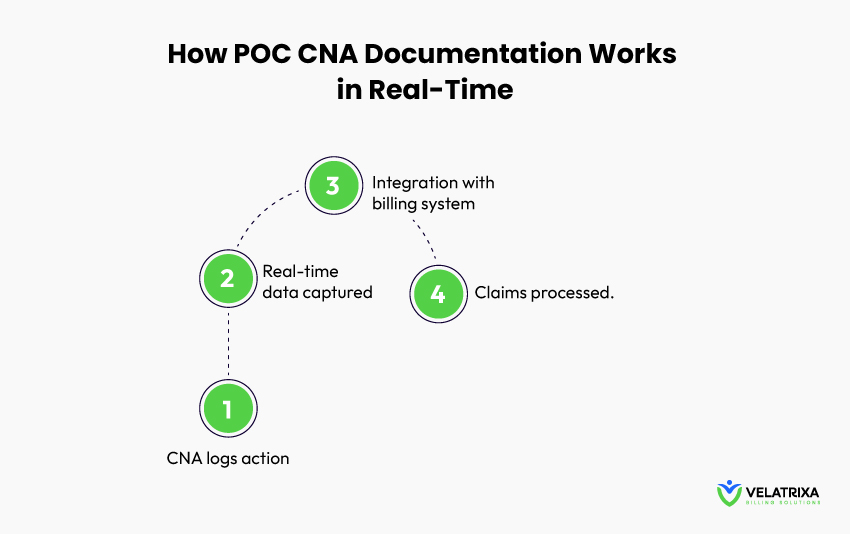
Real-time documentation reduces reliance on memory and minimizes the risk of incomplete or duplicated entries. When CNAs document care at the point of service, information can move more efficiently into the facility’s electronic record.
A well-designed POC workflow can help connect:
Care Delivered → CNA Documentation → Clinical Record → Billing Review
This creates a clearer audit trail and helps billing and clinical teams identify discrepancies before they become larger problems.
Technology’s Role in POC CNA Documentation
Modern long-term care facilities increasingly use tablets, mobile applications, EHR platforms, and point-of-care systems to capture information at the bedside.
Technology can help facilities:
- Capture documentation closer to the time of care.
- Standardize required fields.
- Reduce manual data entry.
- Improve documentation visibility.
- Flag incomplete records.
- Connect POC information with broader clinical workflows.
AI and voice-enabled technologies may further reduce documentation burden, but facilities should use these tools with appropriate human oversight. Technology should improve documentation efficiency without compromising accuracy, privacy, or record integrity.
Training CNAs for Better Documentation
Technology alone cannot solve documentation problems. CNAs need clear training on what to document, when to document it, and how documentation should reflect the care actually provided.
Effective training should cover:
- Facility documentation policies.
- Accurate ADL recording.
- Timely point-of-care entries.
- Corrections and late-entry procedures.
- Care-plan alignment.
- Privacy and security requirements.
- Appropriate use of mobile and EHR systems.
Regular feedback and documentation audits can help identify recurring issues and reinforce good documentation practices.
POC CNA Documentation and Medicare & Medicaid
POC CNA records can contribute to the broader clinical documentation used by long-term care facilities, but they should not be viewed as a standalone mechanism for determining Medicare or Medicaid payment.
For Medicare-covered skilled nursing facility (SNF) services, payment is influenced by the applicable reimbursement methodology and required clinical and administrative data. Under the Patient-Driven Payment Model (PDPM), resident characteristics and clinical information are used to determine payment classifications.
CNA documentation of ADLs and functional status can therefore be an important component of the resident’s overall record. The documentation should be consistent with nursing assessments, therapy records, the care plan, and other supporting documentation.
The key principle is simple: document the care that was actually provided, accurately and consistently.
POC Documentation and Audit Readiness
Complete, timely, and internally consistent documentation gives facilities a stronger foundation when records are reviewed by payers, regulators, or auditors.
Facilities should periodically review POC documentation for:
- Missing entries.
- Inconsistent ADL information.
- Documentation that conflicts with the care plan.
- Unusual patterns or duplicate entries.
- Late or corrected documentation.
- Incomplete caregiver identification.
- Gaps between documented and reported care.
Internal reviews should focus on identifying and correcting process problems not changing documentation to support a predetermined billing outcome.
Using Documentation Data to Improve Operations
POC data can provide more than a record of individual care activities. When analyzed appropriately, it can help long-term care organizations identify operational trends.
Facilities can use documentation data to monitor:
- Documentation completion rates.
- Common documentation gaps.
- Workflow bottlenecks.
- Staffing and workload patterns.
- Changes in resident functional needs.
- Areas requiring additional staff training.
These insights can help clinical and administrative leaders improve workflows while maintaining documentation accuracy and compliance.
Staying Current With Long-Term Care Requirements
Medicare and Medicaid requirements, documentation expectations, assessment processes, and reimbursement policies can change. Facilities should regularly review CMS guidance, state Medicaid requirements, payer policies, and internal documentation procedures.
Rather than relying on outdated workflows, long-term care organizations should establish a process for reviewing regulatory updates and communicating relevant changes to clinical and billing teams.
How Velatrixa Supports POC CNA Documentation and Billing
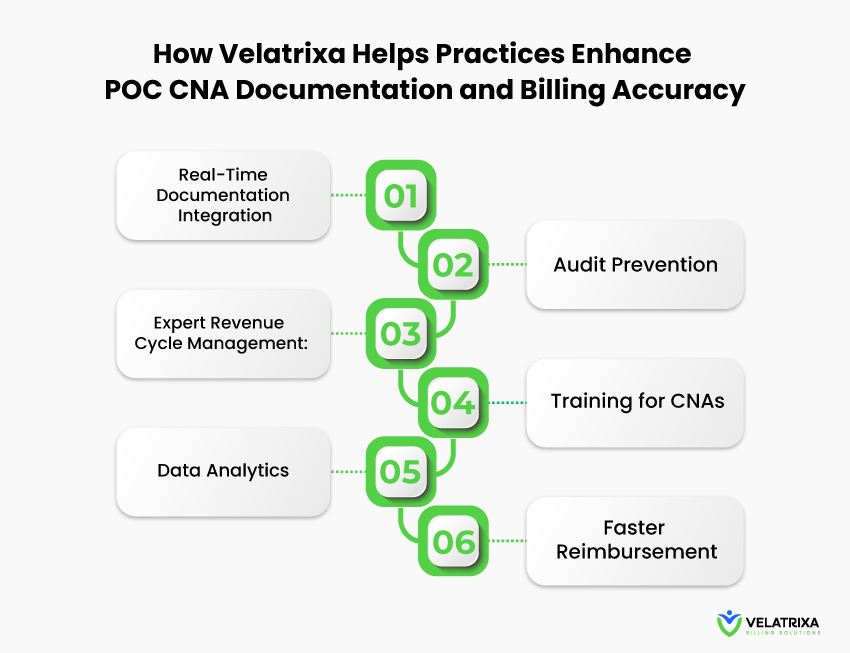
Velatrixa helps long-term care organizations connect documentation quality with stronger revenue-cycle processes. Our team can review POC documentation workflows, identify billing-related documentation gaps, support claims and A/R processes, and provide reporting that helps facilities understand where documentation and revenue-cycle issues occur. By bringing clinical documentation review and revenue-cycle expertise together, facilities gain better visibility into the relationship between care documentation, claim accuracy, denials, and reimbursement.
Conclusion
Point-of-Care CNA documentation is an important component of accurate long-term care records. When documentation is timely, complete, and consistent with the care actually provided, it can support care coordination, billing review, compliance, and audit readiness.
The goal is not to document more simply for billing purposes. The goal is to create an accurate record of care that supports residents, clinical teams, compliance requirements, and responsible revenue-cycle management.
Contact Velatrixa today to streamline your POC CNA documentation and improve your billing accuracy because accurate care deserves accurate billing.