

Out-of-network ER billing has become one of the most compliance-sensitive areas in healthcare revenue cycle management in 2026. With the implementation of the No Surprises Act, emergency billing is no longer centered around patient responsibility alone, it now depends on strict federal rules, payer coordination, and structured reimbursement processes. Emergency departments frequently involve multiple independent providers such as physicians, radiologists, and anesthesiologists, many of whom are not in the same insurance network. This makes billing highly complex and increases the risk of claim delays, denials, and compliance issues if not managed correctly.
For healthcare providers, understanding how out-of-network ER billing works under the NSA is now essential for maintaining both financial stability and regulatory compliance.
What Is Out-of-Network ER Billing?
Out-of-network ER billing refers to charges for emergency services provided by physicians or facilities that do not have a contract with a patient’s insurance plan. This situation is common in emergency departments, where multiple independent providers such as ER physicians, radiologists, or anesthesiologists may be involved in patient care.
| Aspect | Before the No Surprises Act | After the No Surprises Act |
|---|---|---|
| Patient Billing | Patients were often subject to balance billing, paying the difference between provider charges and insurance payments. | Patients are protected from most out-of-network emergency charges and generally only pay in-network cost-sharing amounts. |
| Financial Impact | Unexpected and often high medical bills, even when care was received at in-network hospitals. | Reduced financial uncertainty with more predictable patient costs. |
| Patient Awareness | Patients were often unaware that some providers were out-of-network during treatment. | Greater transparency and protection from surprise billing. |
| Billing Process | Providers could directly bill patients for remaining balances. | Providers now negotiate directly with insurers for reimbursement. |
| Dispute Handling | Frequent billing disputes between patients, providers, and insurers. | Disputes are resolved through a structured Independent Dispute Resolution (IDR) process. |
NSA Rules for Out-of-Network ER Billing Explained
The No Surprises Act (NSA) is a federal law that transformed how out-of-network ER billing is handled across the U.S. healthcare system. Implemented in 2022, its primary goal is to eliminate unexpected medical bills that patients receive during emergencies or at in-network facilities.
Under this law, patients are no longer caught between providers and insurers over payment differences. Instead, the financial responsibility is clearly defined, and disputes are handled through regulated processes. This creates a more transparent and patient-focused billing environment, which is why many medical billing services have updated their workflows to ensure full NSA compliance and reduce claim disputes.
Key NSA Requirements
- No balance billing: Patients cannot be charged beyond in-network cost-sharing for emergency care
- Standard cost-sharing: Patients only pay copays, deductibles, or coinsurance
- Mandatory disclosures: Providers must inform patients of billing protections and rights
- Dispute resolution (IDR): Payment disputes are resolved through a formal process, not patient billing
These rules improve transparency, reduce patient financial burden, and require providers to follow strict compliance-driven billing workflows.
How the No Surprises Act Changed Out-of-Network ER Billing for Providers
The No Surprises Act has reshaped out-of-network ER billing by shifting payment responsibility from patients to structured insurer–provider processes. Billing is now more regulated, documentation-heavy, and compliance-focused.
For providers, this means reduced patient billing involvement and increased reliance on insurer negotiations. Claims now require accurate coding, strong clinical documentation, and complete records to support reimbursement. Providers must also be prepared for formal dispute resolution (IDR) when payment disagreements occur.
Overall, the NSA prioritizes patient protection while making compliance, clean claims, and documentation accuracy essential for timely and reliable payments.
How Out-of-Network ER Billing Works Today Under the NSA
Out-of-network ER billing under the No Surprises Act now follows a structured, compliance-driven process where patients are removed from billing disputes and providers work directly with insurers.
Emergency care is delivered first based on urgency, not insurance status. After treatment, providers submit claims with accurate coding and documentation, and insurers apply in-network cost-sharing rules for the patient. Any remaining payment is settled between providers and payers through standard agreements or dispute resolution (IDR) if needed.
Even with these protections, ER billing remains complex due to frequent out-of-network provider involvement. Success depends on accurate documentation, clean claims, and efficient payer communication to avoid delays and denials.
Why Out-of-Network Billing Still Occurs
Even after the No Surprises Act, out-of-network ER billing still happens due to how emergency care is structured, not billing errors. It is mostly driven by system-level and clinical realities.
Key Reasons
- Hospital network gaps: Hospitals may be in-network, but ER physicians, radiologists, anesthesiologists, and pathologists often bill separately out-of-network
- Emergency nature of care: Patients cannot choose providers during emergencies, leading to unavoidable out-of-network services
- Ambulance services: Ground and air transport are frequently out-of-network
- Geographic limitations: Rural or underserved areas may lack in-network providers
- Specialty care needs: Some treatments or continuity of care require out-of-network specialists
Out-of-network ER billing continues due to access and structural gaps in emergency healthcare, not billing mistakes.
Key Challenges for Providers Under the No Surprises Act
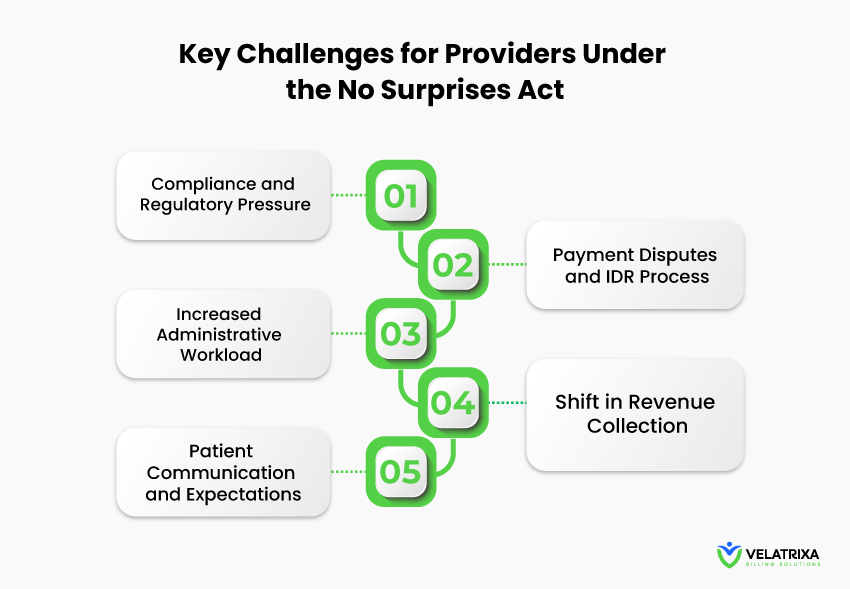
While the No Surprises Act (NSA) has significantly improved patient protection, it has also introduced new operational challenges for healthcare providers. Out-of-network ER billing is no longer just about submitting claims it now requires strict compliance, detailed documentation, and efficient dispute management.
For many providers, the shift has increased administrative workload and changed how revenue is collected and managed. Understanding these challenges is essential for maintaining both compliance and financial performance.
Compliance Pressure
Providers must follow strict federal rules, including accurate billing, proper disclosures, and cost-sharing limits. Even small errors can lead to denials, penalties, or audits.
Payment Disputes (IDR Process)
Reimbursement disagreements must go through the Independent Dispute Resolution (IDR) process, requiring strong documentation and timely submissions. This can delay payments and impact cash flow.
Increased Administrative Workload
Additional requirements like good faith estimates and reporting increase operational burden. Without streamlined workflows, this can slow down billing processes.
Shift in Revenue Collection
Revenue has shifted from patient billing to insurer negotiations, leading to longer payment cycles and less predictable cash flow.
Patient Communication Challenges
Patients may still be confused about billing despite protections. Clear communication about costs, timelines, and rights is essential to avoid disputes.
These challenges have a direct impact on both financial performance and operational efficiency. Without proper systems and processes, providers may face delayed reimbursements, increased claim denials, and compliance risks. Adapting to the NSA requires a proactive approach that includes staff training, workflow improvements, and potentially specialized billing support.
Patient Protections Under the No Surprises Act
The No Surprises Act (NSA) was introduced to protect patients from unexpected medical bills, especially in emergencies where they cannot choose in-network providers. It limits patient responsibility to in-network cost-sharing, even when care is delivered by out-of-network providers, and extends protections to services like radiology, anesthesia, and pathology at in-network facilities unless informed consent is given. The law also requires good faith estimates for uninsured or self-pay patients and establishes the Independent Dispute Resolution (IDR) process to handle payment conflicts between providers and insurers, removing patients from billing disputes. Overall, the NSA improves transparency, reduces financial burden on patients, and creates a more structured, compliance-driven billing environment for providers.
Best Practices for Managing Out-of-Network ER Billing
- Verify insurance early: Confirm eligibility and out-of-network benefits to prevent avoidable denials
- Ensure accurate coding & documentation: Submit complete, error-free claims with strong clinical support
- Maintain billing transparency: Clearly communicate patient responsibility and billing timelines
- Streamline workflows: Standardize processes to reduce errors and speed up claim processing
- Stay updated on regulations: Regularly review NSA and payer policy changes
- Leverage billing expertise: Use specialized Medical Billing Services to handle complex claims and disputes
A consistent, compliance-driven workflow improves reimbursement outcomes while reducing administrative burden and delays.
How Velatrixa Supports Out-of-Network ER Billing
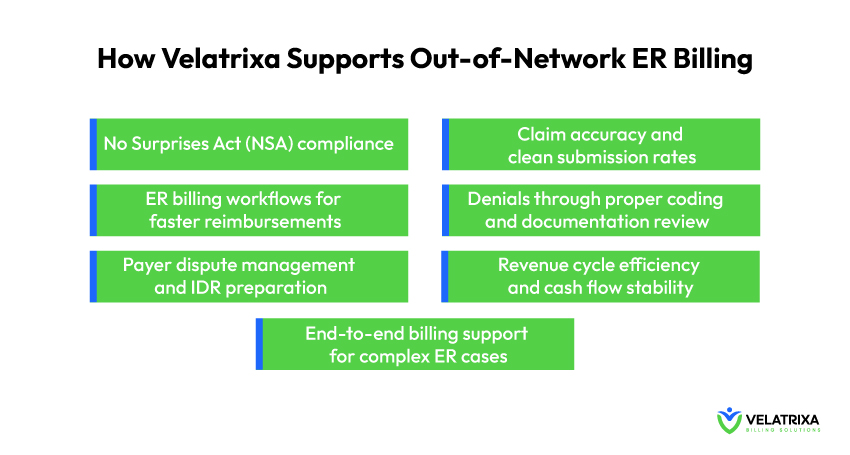
Out-of-network ER billing requires a careful balance between compliance, accurate documentation, and efficient reimbursement management. Velatrixa supports healthcare providers by helping streamline these complex processes while aligning billing workflows with current No Surprises Act requirements. By focusing on claim accuracy, proper documentation, and structured handling of reimbursement and dispute cases, Velatrixa helps reduce denials, improve payment timelines, and minimize administrative burden. This approach allows providers to maintain compliance, strengthen revenue cycle performance, and ensure a more transparent and consistent billing process.
Conclusion
Out-of-network ER billing is now a highly regulated process under the No Surprises Act, shifting from patient-driven billing disputes to structured payer negotiations. While this has improved patient protection and reduced surprise medical bills, it has also increased the importance of accurate documentation, compliance, and efficient revenue cycle management for providers.
In 2026, providers that focus on clean claims, strong coding practices, and streamlined workflows are better positioned to reduce denials and maintain steady cash flow in an increasingly complex billing environment.
Need support with complex ER billing and NSA compliance?
Partner with Velatrixa to simplify your revenue cycle, reduce claim denials, and improve reimbursement performance with confidence.