

Orthopedic medical billing is a headache for small practices. With complex procedures, specialized codes, and high claim denial rates, managing the revenue cycle feels overwhelming. 30% of claims nationwide are denied due to coding errors, leading to delayed reimbursements and cash flow problems. For small orthopedic practices, this challenge is even greater, as 12-15% of claims are denied, putting a serious strain on finances.
But here’s the good news: outsourcing your billing to experts like Velatrixa can simplify the process, speed up reimbursements, and free up your team to focus on what matters most: patient care. Let’s dive into why outsourcing orthopedic billing is the smart, cost-effective choice for small practices.
Key Billing Challenges for Small Orthopedic Practices

Orthopedic practices, especially small ones, face unique billing challenges that can often feel like a never-ending maze. Let’s explore the key obstacles that make orthopedic billing so complex:
- Complex Codes and Procedures
Orthopedic procedures are highly specialized, ranging from joint replacements to spinal surgeries and physical therapy. Each requires precise coding using ICD-10, CPT, and HCPCS codes. A simple mistake in coding could lead to claim denials, causing unnecessary delays in reimbursement. - High Denial Rates
For small practices, dealing with claim denials is an unfortunate reality. Nationally, orthopedic practices face denial rates as high as 40%; many of these denials are due to coding mistakes or missing documentation. These issues not only delay payments but can also increase your administrative workload and strain cash flow. - Insurance Reimbursement Variability
Insurance policies vary greatly by provider and location, adding another layer of complexity to billing. Small practices often struggle to track these differences, resulting in underpayments or payment delays. Keeping up with insurance rules and requirements is a constant challenge. - Regulatory Compliance
The healthcare landscape is continuously evolving, with new regulations around HIPAA, CMS, and the Affordable Care Act. Small practices must stay on top of these changes to avoid penalties, audits, and reimbursement complications.
In-House Billing vs. Outsourced Billing: Making the Right Choice
As a small orthopedic practice, you might be deciding whether to manage your billing in-house or outsource it. Both approaches come with their own pros and cons, but when it comes to maximizing efficiency and reducing costs, outsourcing billing has a clear advantage.
In-House Billing: The Full Control Approach
Pros:
- Full control over billing operations.
- Direct oversight of your billing team.
Cons:
- Higher costs for staffing, training, and maintaining technology.
- Increased administrative workload leaves your team less time to focus on patient care.
- Greater risk of errors and claim denials, especially if your team is undertrained.
- Ongoing need for compliance training to stay up-to-date with regulations.
Outsourced Billing: Efficiency and Cost-Effectiveness
Pros:
- Lower costs: No need to hire, train, or maintain in-house billing staff.
- Faster reimbursements due to specialized expertise and automation.
- Reduced administrative burden: Let your team focus on patient care while the experts handle the billing.
- Regulatory compliance is ensured by a specialized provider, keeping your practice on track with the latest changes in laws and regulations.
Cons:
- Less control over the billing process.
- Relies on external systems and procedures, which may not be as customizable as in-house processes.
How Velatrixa Helps Optimize Your Orthopedic Billing
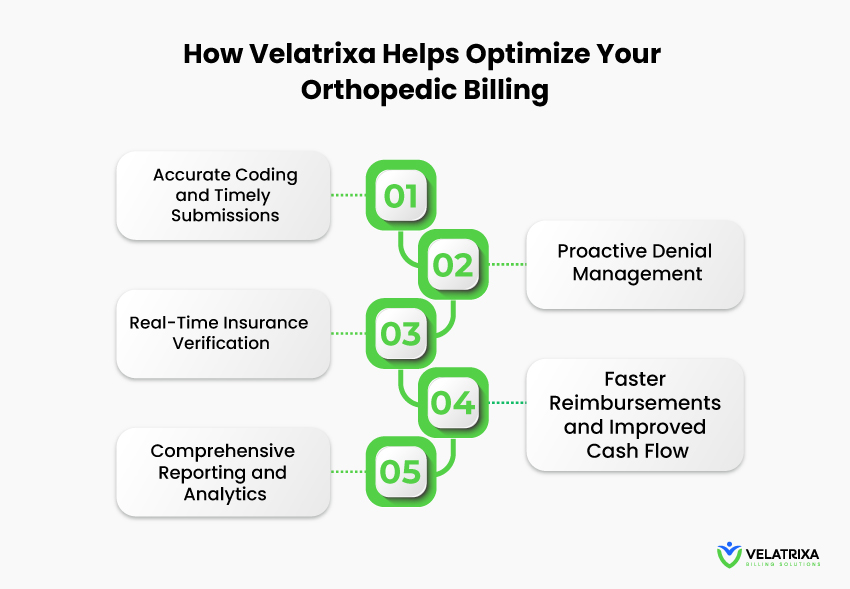
At Velatrixa, we understand the unique billing challenges orthopedic practices face. Here’s how we help optimize your billing process:
1. Accurate Coding and Timely Submissions
We ensure that your practice uses the most up-to-date ICD-10, CPT, and HCPCS codes for every procedure. By staying current with coding changes, we help reduce errors and prevent claim denials.
2. Proactive Denial Management
Denial management is at the core of our service. We proactively address the causes of denials and ensure that claims are submitted correctly the first time. If a claim is denied, we resolve the issue quickly to minimize delays.
3. Real-Time Insurance Verification
We verify patient insurance information in real-time to avoid errors in coverage and eligibility. This reduces the likelihood of claim rejections, speeding up the reimbursement process.
4. Faster Reimbursements and Improved Cash Flow
By streamlining the billing process and automating claim submissions, we reduce the time it takes to receive payment. This helps your practice maintain healthy cash flow and financial stability.
5. Comprehensive Reporting and Analytics
Our detailed reports give you insights into important metrics such as denial rates, accounts receivable aging, and clean claim rates. This allows you to track your billing performance and make data-driven decisions for improvement.
Why Proper Documentation is Crucial for Orthopedic Billing
Accurate documentation is one of the most important elements of orthopedic billing. Properly documenting all procedures, treatments, and patient interactions ensures that claims are submitted with the necessary support. This minimizes errors and claim denials, allowing your practice to receive the appropriate reimbursement for services rendered. Comprehensive and precise documentation also serves as proof for insurance claims and protects your practice during audits.
Reducing Claim Denials: Best Practices
Claim denials are a significant issue for orthopedic practices, but with the right strategies, they can be minimized. Follow these best practices to reduce denials:
- Ensure accurate coding: Double-check all codes before submitting claims.
- Review patient insurance details: Verify insurance information before rendering services to avoid coverage issues.
- Attach necessary documentation: Ensure all required paperwork, such as procedure notes and patient history, is included with claims.
- Proactive follow-ups: Address rejected claims quickly to resolve issues and prevent further delays.
The Power of Automation in Orthopedic Billing
Automating your billing processes not only reduces errors but also speeds up the entire cycle. With Velatrixa’s automated systems, key tasks like insurance verification, claim submission, and denial tracking are handled with minimal human intervention. This reduces the risk of mistakes, shortens the time to payment, and improves overall financial performance. Automation frees your practice from administrative overload, ensuring more time for patient care.
Conclusion
Orthopedic billing doesn’t have to be a headache for small practices. Whether you choose to handle it in-house or outsource to an expert provider like Velatrixa, the key is to find a solution that streamlines your operations, reduces errors, and maximizes reimbursements.
By outsourcing your billing, you gain access to specialized expertise, automated systems, and compliance assurance, allowing you to focus more on patient care and less on administrative tasks. With Velatrixa’s orthopedic billing solutions, your practice can improve its revenue cycle, reduce claim denials, and ensure long-term financial health.
Contact Velatrixa today to learn how we can optimize your orthopedic billing and help your practice thrive.