
Hyperbaric Oxygen Therapy (HBOT) is a high-value specialty service that treats chronic wounds, diabetic foot ulcers, radiation injuries, and decompression sickness. Yet, despite its clinical benefits, HBOT billing remains complex, and even minor errors can result in denied claims, delayed payments, and lost revenue. Studies indicate that 20–30% of HBOT claims are denied on first submission, costing practices thousands of dollars annually.
Effective HBOT billing goes beyond simply submitting claims; it requires structured workflows, accurate documentation, proactive prior authorization management, and strategic denial prevention. Practices that optimize HBOT billing experience:
- Higher clean claim acceptance rates and fewer denials
- Faster reimbursements and reduced billing cycles
- Improved cash flow, enabling predictable budgeting
- Operational efficiency, allowing staff to focus on patient care
In 2026, HBOT billing is not just an administrative function; it is a strategic revenue lever. Clinics leveraging technology, automation, and payer-specific insights recover more revenue, reduce errors, and maintain financial stability.
Understanding HBOT Billing Complexity
HBOT billing is unique due to session-based therapy, variable treatment durations, and stringent payer requirements. Complexity has grown in 2026 because of:
- Evolving Payer Rules: Commercial payers and Medicare increasingly enforce prior authorizations, detailed documentation, and medical necessity criteria.
- High-Frequency Treatments: Treatment plans often include 20–40 sessions per patient, requiring precise time-based billing.
- Multiple Place-of-Service Codes: Services delivered in offices, hospitals, or outpatient centers are reimbursed differently.
- Intense Claim Scrutiny: Payers audit HBOT claims closely due to their high reimbursement per session.
Even small errors in CPT codes, missing documentation, or expired authorizations can trigger denials and delay revenue collection.
Essential HBOT Billing Codes and Documentation Standards
Accurate coding is the foundation of clean HBOT claims. Errors here account for most denials. Key codes include:
| Code Type | Code | Description | Notes |
|---|---|---|---|
| CPT | 99183 | Physician or qualified professional supervision per session | Document clinical supervision and patient vitals |
| HCPCS | G0277 | HBOT per 30-minute interval (facility) | Bill in exact increments, based on session duration |
| ICD-10 | E11.621 | Diabetic foot ulcer | Must match payer-approved indications |
| POS | 11 / 22 | Office / Hospital outpatient | Correct POS ensures accurate reimbursement |
Common errors: unsupported diagnosis, incorrect units, and mismatched POS codes.
Strategies for Effective Prior Authorization (PA) in HBOT Billing
Prior authorization remains one of the most critical and time-intensive aspects of HBOT billing, and mismanagement can significantly delay reimbursement or trigger claim denials. Clinics that implement structured PA workflows consistently achieve faster approvals, higher reimbursement rates, and fewer administrative setbacks.
Effective strategies begin with pre-visit verification, where staff confirm patient eligibility, coverage limits, and payer-specific PA requirements before treatment begins. Submissions must be comprehensive, including documentation of failed conservative therapies, the physician’s rationale for HBOT, and detailed records of wound progression or clinical indicators supporting medical necessity.
Leveraging automated tracking systems is another key step. Digital tools can log submission dates, monitor follow-up actions, and alert staff to upcoming PA expirations, reducing the risk of missed deadlines. Additionally, assigning dedicated coordinators, whether in-house or through outsourced RCM partners, ensures consistent oversight and timely communication with payers, preventing unnecessary delays.
Without confirmed prior authorization, treatments, particularly those billed to commercial payers, are frequently denied or reimbursed at lower rates, emphasizing the importance of a proactive, organized approach. Clinics that integrate these strategies into their workflow not only reduce de
Enhancing Patient Experience Through Billing Transparency
Transparent billing practices are a cornerstone of effective HBOT revenue management. When patients clearly understand their coverage, costs, and treatment requirements, clinics experience fewer disputes, faster payments, and stronger compliance with documentation requirements.
Effective strategies include pre-treatment financial counseling, clear communication about prior authorization needs, and outlining potential co-pays or deductibles. Encouraging patients to provide timely documentation and consent forms ensures claims are submitted accurately, reducing delays and denials.
Technology can further improve transparency. Patient portals, automated notifications, and digital statements allow patients to track insurance approvals, treatment schedules, and outstanding balances in real time. Clinics using these tools report improved patient satisfaction and a measurable reduction in claim disputes, translating directly into healthier cash flow.
Prioritizing billing transparency is not only a patient-centric approach but also a revenue-protecting strategy. Educated patients are more engaged in their care process, which supports compliance, minimizes claim rejections, and strengthens overall financial performance.
Financial Consequences of HBOT Billing Errors
Billing errors in hyperbaric oxygen therapy (HBOT) can have an immediate and measurable impact on a clinic’s revenue. Even small mistakes incorrect coding, missing documentation, or unverified prior authorizations can result in delayed payments, claim denials, and reduced reimbursement rates.
- Denied Claims Delay Cash Flow
Claims submitted with incomplete documentation or unsupported medical necessity are frequently denied, pushing payments into high-risk aging categories. Each denied claim requires staff follow-up, rework, and resubmission, increasing operational workload while slowing cash inflows. Practices that fail to address denials promptly can see revenue backlog accumulate, sometimes by 10–20% of total monthly billings. - Downcoding Reduces Expected Reimbursement
Using incorrect CPT or HCPCS codes or mismatched diagnosis codes can trigger downcoding. In HBOT, where per-session charges often exceed hundreds of dollars, downcoding across multiple sessions compounds losses, significantly impacting profitability. - Underpayments Accumulate Over Time
Even partially paid claims, if untracked or unreconciled, quietly erode revenue. Small underpayments across dozens of patients can add up to tens of thousands of dollars per month. Without a robust tracking system, these losses often go unnoticed until financial reviews reveal gaps in revenue. - Operational and Compliance Risks
Beyond financial impact, billing errors can increase audit exposure and payer scrutiny. Repeated denials or inconsistencies in documentation may trigger external audits, delaying reimbursements further and requiring additional administrative resources to resolve compliance issues.
Accurate coding, thorough documentation, and proactive claim monitoring are essential to protect revenue in HBOT practices. Clinics that implement standardized billing workflows, automated verification, and staff training consistently see higher first-pass claim acceptance, faster reimbursements, and reduced financial risk.
Essential HBOT Billing Codes and Documentation Standards
Accurate coding and comprehensive documentation are the backbone of successful HBOT billing. Mistakes in this area are among the most common causes of claim denials, delayed reimbursements, and revenue loss. Clinics that master coding and documentation standards maximize reimbursement, minimize denials, and maintain regulatory compliance.
| Code Type | Code | Description | Documentation Requirements / Best Practices |
|---|---|---|---|
| CPT | 99183 | Physician or qualified professional supervision of HBOT per session | Document supervision time, clinical rationale, and session notes. Ensure each session is supported by medical necessity. |
| HCPCS | G0277 | Hyperbaric oxygen therapy per 30-minute interval (facility) | Record exact session duration, oxygen levels, and compression cycles. Bill correct units based on actual treatment time. |
| ICD-10 | E11.621 | Diabetic foot ulcer | Include failed conservative therapy documentation, wound progression notes, and physician justification. Use payer-approved indications only. |
| ICD-10 | T79.A | Traumatic injury with tissue damage | Provide detailed injury description, treatment history, and objective outcome measures. Ensure consistency with HBOT indication. |
| POS | 11 | Office-based service | Verify payer rules for facility vs. non-facility billing. Ensure accurate entry to prevent rejections. |
| POS | 22 | Outpatient hospital | Record service location accurately, matching documentation and billing software entries. |
Key Takeaways:
- Accurate CPT/HCPCS coding tied to correct ICD-10 diagnoses is critical for first-pass claim acceptance.
- POS codes must reflect the treatment setting to comply with payer rules.
- Detailed documentation of medical necessity, session details, and progress tracking reduces denials and maximizes reimbursement.
Common HBOT Billing Denials
- Lack of Prior Authorization – Claims submitted without confirmed PA are frequently denied or reimbursed at reduced rates.
- Incorrect CPT/HCPCS Coding – Using wrong or mismatched procedure codes (e.g., G0277, 99183) leads to automatic rejections.
- Unsupported Diagnosis – ICD-10 codes that don’t align with payer-approved indications trigger denials.
- Incomplete Documentation – Missing physician notes, wound progression, or failed conservative therapy documentation delays approvals.
- Incorrect Units or Session Totals – Billing for more or fewer sessions than performed can cause claim adjustments or denials.
- POS/Location Errors – Submitting an incorrect Place of Service (e.g., POS 11 vs. POS 22) can result in claim rejection.
- Expired Authorizations – PA approvals that lapse before treatment completion are a common cause of denials.
Avoiding HBOT Denials in 2026: Best Practices to Improve Reimbursement and Reduce Claim Rejections
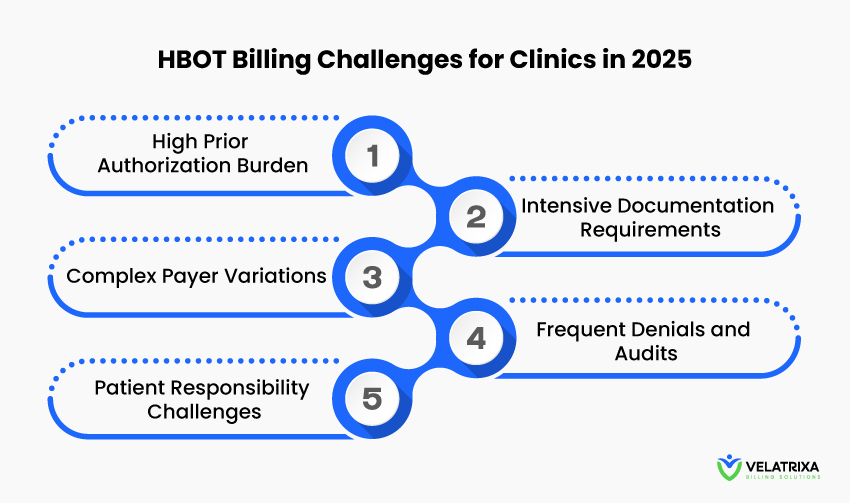
In 2026, avoiding denials in HBOT billing requires a proactive and structured approach. With high-value claims, strict payer scrutiny, and evolving compliance requirements, even minor gaps in medical billing documentation, coding, or prior authorization can result in delayed payments or lost revenue. Clinics that implement optimized revenue cycle management (RCM) workflows consistently achieve higher clean claim rates, faster reimbursements, and improved cash flow.
To reduce HBOT claim denials and strengthen your billing performance, focus on these proven best practices:
- Verify Medical Necessity Before Claim Submission
Establishing medical necessity is critical in hyperbaric oxygen therapy billing. Ensure documentation clearly supports failed conservative therapy, wound severity, and clinical justification aligned with payer guidelines. Claims without strong medical necessity are among the top causes of denials in medical billing. - Ensure Accurate Time-Based Billing and Unit Reporting
HBOT services are billed in 30-minute increments using HCPCS codes like G0277, making accurate time tracking essential. Errors in unit calculation or session duration often lead to underpayments, downcoding, or claim rejections, directly impacting reimbursement. - Maintain Complete and Compliant Clinical Documentation
Detailed documentation including physician supervision, wound measurements, treatment logs, and patient progress is essential for clean claim submission. Incomplete or inconsistent records are a leading contributor to insurance claim denials and audit risks. - Strengthen Prior Authorization (PA) Management Workflows
Efficient prior authorization in medical billing is key to avoiding delays. Verify coverage, track authorization limits, and monitor expiration dates throughout the treatment cycle. Missing or expired authorizations are one of the most common reasons for HBOT billing denials, especially with commercial payers. - Implement Coding Accuracy and Pre-Submission QA Checks
Validate CPT codes (99183), HCPCS codes (G0277), ICD-10 diagnosis codes, and POS codes before claim submission. A strong internal quality assurance process improves first-pass claim acceptance rates and reduces costly rework in the billing cycle. - Stay Updated on Payer Policies and Billing Guidelines
Payer requirements for HBOT billing and coding continue to evolve. Regular staff training, policy monitoring, and updates on Medicare and commercial payer guidelines help maintain compliance and prevent avoidable denials.
By implementing these HBOT billing best practices, clinics can significantly reduce denial rates, accelerate reimbursement timelines, and optimize their overall healthcare revenue cycle management. A well-structured billing workflow not only improves financial performance but also ensures long-term sustainability in a high-complexity specialty like hyperbaric oxygen therapy.
How Technology Is Transforming HBOT Billing Efficiency in 2026
In 2026, technology is no longer optional in HBOT billing and coding it’s a critical driver of accuracy, efficiency, and revenue optimization. As payer requirements become more complex and claim volumes increase, relying on manual processes leads to errors, delays, and revenue leakage. Clinics that leverage advanced healthcare revenue cycle management (RCM) tools consistently achieve faster reimbursements, lower denial rates, and improved operational efficiency.
Modern technology solutions are reshaping how HBOT billing is managed:
- EHR Integration for Accurate Documentation
Integrated Electronic Health Record (EHR) systems automatically capture treatment details such as session duration, wound measurements, and physician notes. This ensures accurate medical billing documentation, reduces manual entry errors, and strengthens medical necessity support for HBOT claims. - Automated Claim Submission and Real-Time Tracking
Advanced billing platforms streamline claim submission in medical billing by automatically validating data before submission. Real-time tracking allows clinics to monitor claim status, identify delays, and take immediate action, reducing accounts receivable (AR) days. - AI-Powered Coding and Denial Prevention
Artificial intelligence is transforming medical coding accuracy by analyzing past claims, identifying coding patterns, and flagging potential errors before submission. AI-driven tools help reduce HBOT claim denials, improve first-pass acceptance rates, and optimize reimbursement outcomes. - Real-Time RCM Dashboards and Analytics
Data-driven dashboards provide visibility into key performance indicators such as denial rates, reimbursement trends, and payer behavior. These insights enable clinics to make informed decisions, optimize workflows, and strengthen overall revenue cycle performance. - Automation in Prior Authorization Workflows
Automated systems simplify prior authorization management by tracking submissions, monitoring approval status, and sending alerts for expirations. This reduces missed approvals, minimizes delays, and ensures compliance with payer requirements.
By adopting these technologies, HBOT clinics can significantly reduce administrative burden, improve billing accuracy, and accelerate cash flow. In an increasingly complex billing environment, leveraging automation and AI is essential for maintaining a competitive and financially stable practice.
The Future of HBOT Billing in 2026: Key Trends Shaping Revenue Cycle Performance
HBOT billing is evolving rapidly, driven by technology, stricter payer oversight, and changing reimbursement models. Clinics that adapt to these trends are better positioned to reduce denials, accelerate reimbursements, and protect revenue.
Here are the most impactful HBOT billing trends in 2026:
1. AI-Driven Billing & Denial Prevention
Artificial intelligence is transforming medical billing workflows by identifying coding errors, predicting denials, and automating claim scrubbing before submission. AI-enabled systems can reduce denial rates by up to 40–45% and significantly improve clean claim rates.
2. Stricter Documentation & Medical Necessity Requirements
Payers are tightening clinical documentation standards, requiring detailed proof of medical necessity, treatment progression, and diagnosis alignment. Incomplete or inconsistent records remain the leading cause of HBOT claim denials, especially for high-value therapies.
3. Rising Denial Rates & Payer Scrutiny
Across healthcare, denial rates continue to rise due to evolving payer rules and automated audits. HBOT claims are particularly vulnerable because of high reimbursement values and multi-session treatment plans, with denial rates often exceeding 20% without optimized workflows.
4. Expansion of Telehealth & Hybrid Care Models
Telehealth is now a permanent part of care delivery, impacting billing workflows, POS coding, and documentation requirements. Incorrect modifiers, POS codes, or eligibility verification in hybrid care models are major contributors to denials in 2026.
5. Shift Toward Value-Based & Data-Driven Billing
Healthcare is gradually moving from fee-for-service to value-based reimbursement models, requiring stronger alignment between clinical outcomes, documentation, and billing accuracy. Practices leveraging analytics and KPI tracking outperform others in revenue recovery and AR management.
HBOT billing is no longer just about coding correctly, it’s about leveraging technology, ensuring airtight documentation, and staying ahead of payer changes. Clinics that embrace these trends can reduce denials, improve cash flow, and build a more resilient revenue cycle in 2026.