
Dialysis revenue loss is not primarily caused by payer complexity; it is driven by repeated internal billing errors. After analyzing 1,000 dialysis claims, a clear pattern emerged: most revenue leakage is systemic, predictable, and rooted in workflow inconsistencies across the revenue cycle.
In dialysis care, billing is not occasional; it is continuous. Patients receive treatment multiple times per week, meaning claims are generated repeatedly for the same patient. This creates a high-volume, high-risk billing environment where even the smallest inaccuracy compounds rapidly. A missed modifier, outdated insurance, or incomplete documentation doesn’t just affect one claim; it impacts every subsequent claim in the treatment cycle.
Over time, these repeated inefficiencies lead to chronic claim denials, delayed reimbursements, increased administrative workload, and significant, often unnoticed, revenue leakage. The real issue isn’t complexity, it’s consistency. Read more to discover the most common dialysis billing errors, their financial impact, and how to fix workflow gaps that cause recurring revenue loss.
What Are Dialysis Billing Errors?
Dialysis billing errors are recurring mistakes in eligibility verification, ESRD coding, documentation, and claim submission that lead to repeated denials, delayed reimbursements, compliance risks, and long-term revenue loss in high-frequency treatment environments.
These errors are rarely one-time events. Because dialysis billing operates on a recurring cycle, even minor process failures tend to repeat across multiple claims, amplifying their financial impact.
Why Dialysis Billing Is So Complex
Dialysis billing is one of the most operationally demanding and error-sensitive revenue cycles in healthcare, primarily due to the structure of ESRD reimbursement and the frequency of services provided.
Unlike other specialties where services are episodic, dialysis care is continuous. This means billing teams must maintain accuracy not just once, but consistently across every treatment session.
Several factors contribute to this complexity:
- ESRD Bundled Payment System (PPS): Requires accurate reporting of services within a bundled structure, leaving little room for coding variation
- Frequent Treatment Cycles: Patients typically receive dialysis 2–3 times per week, increasing claim volume and repetition
- Medicare Primary with Secondary Payers: Coordination of Benefits (COB) must be handled precisely to avoid payment discrepancies
- Strict Documentation Requirements: Clinical documentation must fully support treatment frequency, medical necessity, and billed services
- Modifier Dependency: Missing or incorrect modifiers can directly impact reimbursement accuracy
Because of these factors, dialysis billing demands a high level of process discipline, consistency, and cross-team coordination.
What 1,000 Dialysis Claims Reveal
A comprehensive analysis of 1,000 dialysis claims provides a clear and actionable insight: Most billing failures originate before the claim reaches the payer. Front-end processes such as insurance verification, patient demographic accuracy, and intake documentation have a direct and measurable impact on claim outcomes. The data also highlights a critical operational flaw: Errors are rarely isolated. Instead, they are repeated across multiple claims due to:
- Lack of standardized workflows
- Inconsistent execution between staff members
- Inadequate validation checkpoints before submission
- Limited use of denial analytics for process improvement
Additionally, claims containing multiple minor issues are significantly more likely to be rejected or delayed. This not only extends the revenue cycle but also increases the cost of rework and appeals. In short, dialysis billing inefficiencies are not random; they are pattern-driven and preventable.
Most Common Dialysis Billing Errors (Data Breakdown)
The following breakdown highlights the most frequent dialysis billing errors identified and how they directly impact financial performance:
| Error Category | % of Affected Claims | Impact on Revenue | Common Cause |
| Coding Errors (CPT/HCPCS) | 28% | Underpayments, rejections | Incorrect codes, missing modifiers |
| Eligibility Verification Issues | 22% | Denials, delays | Wrong payer, inactive coverage |
| Documentation Gaps | 18% | Payment delays, audits | Missing clinical records |
| Claim Submission Errors | 15% | Rejections, filing denials | Data entry errors, late filing |
| Coordination of Benefits (COB) | 10% | Partial payments | Payer confusion |
| Authorization Issues | 7% | Denials | Missing/expired approvals |
Common Dialysis Billing Errors That Cause Revenue Loss
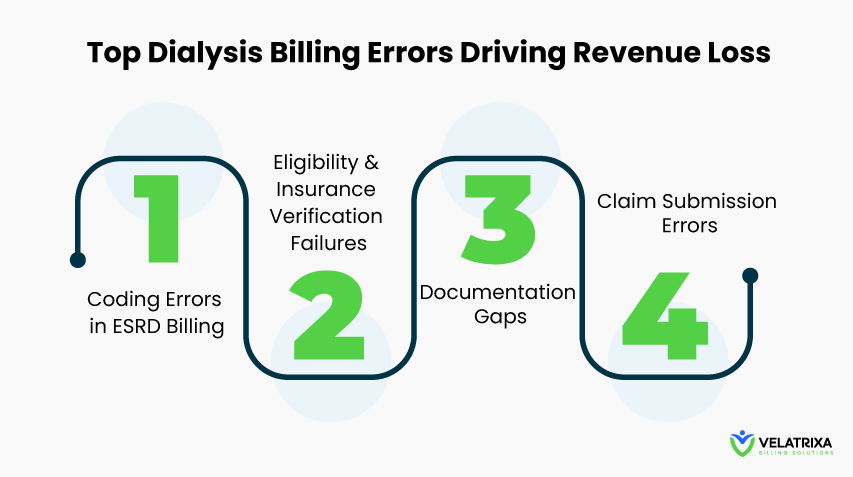
Dialysis revenue loss is rarely caused by a single issue. It results from repeated billing errors that occur across the revenue cycle and multiply with every treatment session.
1. Coding Errors in ESRD Billing
Dialysis coding demands strict accuracy in CPT/HCPCS codes, modifiers, and bundled services. Missing modifiers, incorrect coding, or inconsistencies across sessions often lead to underpayments and claim rejections. Over time, these errors also increase compliance and audit risks.
2. Eligibility & Insurance Verification Failures
Eligibility errors are a leading cause of dialysis claim denials. Outdated insurance details, incorrect payer sequencing, and failure to re-verify coverage across treatment cycles disrupt reimbursement. Even small verification gaps can result in repeated denials and payment delays.
3. Documentation Gaps
Incomplete or unclear documentation weakens claim validity. When clinical notes don’t support services, treatment frequency is unclear, or medical necessity is not justified, claims become vulnerable to denials, delays, and audits.
4. Claim Submission Errors
Small data entry mistakes in high-volume environments create major issues. Incorrect patient details, duplicate claims, or missed deadlines lead to immediate rejections. These errors increase rework and slow down the entire revenue cycle.
The Financial Impact of Dialysis Billing Errors
Dialysis billing errors don’t just affect individual claims; they disrupt the entire financial ecosystem of a practice.
Because services are recurring, billing issues compound over time. A single unresolved error can impact multiple claims across multiple treatment sessions.
Even a 5–10% error rate can result in:
- Extended accounts receivable (AR) cycles
- Unpredictable cash flow
- Increased denial rates
- Higher operational costs due to rework
- Reduced staff productivity
Over time, this creates a cycle of inefficiency where more resources are spent fixing problems than preventing them.
Where Dialysis Claims Break in the Revenue Cycle
Dialysis billing breakdowns consistently occur at four critical points:
- Intake & Eligibility Verification
Errors at this stage include outdated insurance details, incorrect payer selection, and incomplete patient data. These issues often go unnoticed until claims are denied.
- ESRD Coding & Compliance
Variability in coding practices and lack of adherence to ESRD guidelines lead to inconsistent claim outcomes and reimbursement issues.
- Claim Submission
Submission-stage failures include incorrect data entry, duplicate claims, and missed deadlines, all of which result in immediate claim rejection.
- Accounts Receivable (AR) Follow-Up
Without structured denial tracking and timely follow-up, denied claims age quickly, reducing the likelihood of successful recovery.
Why Dialysis Billing Errors Keep Repeating
Dialysis billing errors persist because workflows are not designed for consistency.
Key reasons include:
- Eligibility verification is performed only once instead of continuously
- Lack of standardized coding protocols
- Poor communication between the clinical and billing teams
- Reactive denial management strategies
Without addressing these systemic issues, the same errors continue to repeat across every billing cycle.
Dialysis Billing Error Checklist for Providers (2026)
To maintain a high-performing dialysis revenue cycle, providers must ensure consistency across all billing stages.
- Eligibility verification should be performed before every treatment cycle, not just at initial intake. Insurance coverage frequently changes, and outdated data leads to repeated denials.
- Coding practices must follow standardized ESRD guidelines. Consistency in modifier usage and code selection is critical for accurate reimbursement.
- Documentation must fully support all billed services. Clinical records should clearly reflect treatment frequency, medical necessity, and physician involvement.
- Claim submission processes must include validation checkpoints to catch data entry errors before claims are sent to payers.
- Denial tracking should focus on identifying patterns and root causes, allowing teams to prevent recurring issues rather than repeatedly correcting them.
How to Reduce Dialysis Billing Errors
Reducing dialysis billing errors requires a shift from reactive correction to proactive process control.
Key strategies include:
- Implementing standardized workflows across all billing stages
- Automating eligibility verification where possible
- Training staff on ESRD-specific coding requirements
- Conducting regular documentation audits
- Using denial analytics to identify and eliminate recurring issues
When these strategies are applied consistently, billing accuracy improves, denials decrease, and revenue becomes more predictable.
How Velatrixa Helps Reduce Dialysis Billing Errors
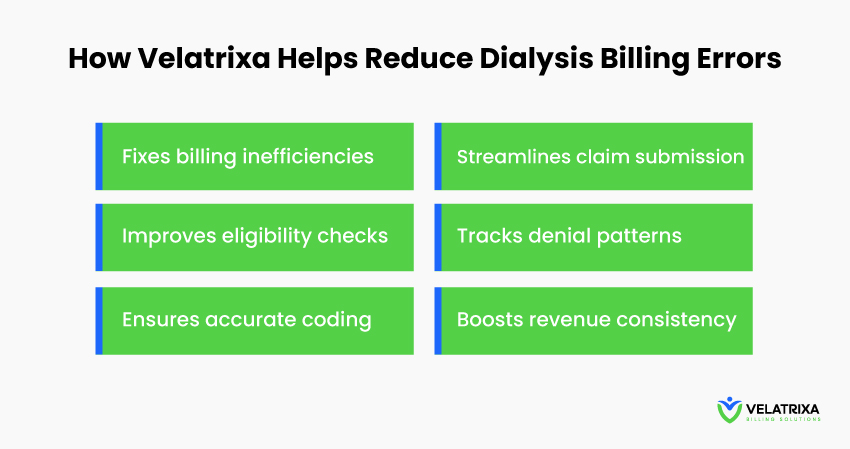
Dialysis revenue loss isn’t random; it’s the result of repeated inefficiencies embedded within the billing process. Velatrixa addresses these challenges by implementing structured, compliance-driven workflows that ensure accuracy at every stage of the revenue cycle. From real-time eligibility verification to precise ESRD coding and clean claim submission, every process is optimized to reduce errors and improve reimbursement outcomes. By leveraging data analytics and denial pattern tracking, Velatrixa identifies root causes and eliminates them, preventing recurring issues rather than simply correcting them.
Velatrixa doesn’t just manage billing; we transform it into a predictable, efficient, and revenue-driven system.
Conclusion
The analysis of 1,000 dialysis claims reveals a critical truth: Revenue loss is not caused by isolated mistakes; it is driven by repeated, unaddressed billing errors. In a high-frequency billing environment, small inefficiencies quickly escalate into significant financial challenges. The solution isn’t increasing claim volume; it’s improving process consistency.
If your dialysis claims are consistently delayed, denied, or underpaid, the problem isn’t external; it’s operational. Partner with Velatrixa to eliminate billing inefficiencies, reduce denials, and take control of your dialysis revenue.