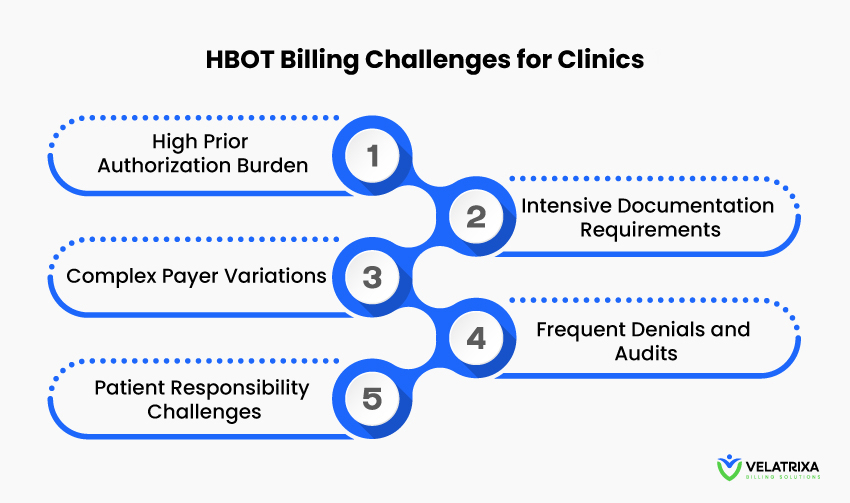
Hyperbaric Oxygen Therapy (HBOT) is a high-value specialty service that treats chronic wounds, diabetic foot ulcers, radiation injuries, and decompression sickness. Yet, despite its clinical benefits, HBOT billing remains complex, and even minor errors can result in denied claims, delayed payments, and lost revenue. Studies indicate that 20–30% of HBOT claims are denied on first submission, costing practices thousands of dollars annually.

Effective HBOT billing goes beyond simply submitting claims; it requires structured workflows, accurate documentation, proactive prior authorization management, and strategic denial prevention. Practices that optimize HBOT billing experience:

  • Higher clean claim acceptance rates and fewer denials
  • Faster reimbursements and reduced billing cycles
  • Improved cash flow, enabling predictable budgeting
  • Operational efficiency, allowing staff to focus on patient care

In 2026, HBOT billing is not just an administrative function; it is a strategic revenue lever. Clinics leveraging technology, automation, and payer-specific insights recover more revenue, reduce errors, and maintain financial stability.

Understanding HBOT Billing Complexity

HBOT billing is unique due to session-based therapy, variable treatment durations, and stringent payer requirements. Complexity has grown in 2026 because of:

  1. Evolving Payer Rules: Commercial payers and Medicare increasingly enforce prior authorizations, detailed documentation, and medical necessity criteria.
  2. High-Frequency Treatments: Treatment plans often include 20–40 sessions per patient, requiring precise time-based billing.
  3. Multiple Place-of-Service Codes: Services delivered in offices, hospitals, or outpatient centers are reimbursed differently.
  4. Intense Claim Scrutiny: Payers audit HBOT claims closely due to their high reimbursement per session.

Even small errors in CPT codes, missing documentation, or expired authorizations can trigger denials and delay revenue collection.

Essential HBOT Billing Codes and Documentation Standards

Accurate coding is the foundation of clean HBOT claims. Errors here account for most denials. Key codes include:

Code Type Code Description Notes
CPT 99183 Physician or qualified professional supervision per session Document clinical supervision and patient vitals
HCPCS G0277 HBOT per 30-minute interval (facility) Bill in exact increments, based on session duration
ICD-10 E11.621 Diabetic foot ulcer Must match payer-approved indications
POS 11 / 22 Office / Hospital outpatient Correct POS ensures accurate reimbursement

Common errors: unsupported diagnosis, incorrect units, and mismatched POS codes.

Strategies for Effective Prior Authorization (PA) in HBOT Billing

Prior authorization remains one of the most critical and time-intensive aspects of HBOT billing, and mismanagement can significantly delay reimbursement or trigger claim denials. Clinics that implement structured PA workflows consistently achieve faster approvals, higher reimbursement rates, and fewer administrative setbacks.

Effective strategies begin with pre-visit verification, where staff confirm patient eligibility, coverage limits, and payer-specific PA requirements before treatment begins. Submissions must be comprehensive, including documentation of failed conservative therapies, the physician’s rationale for HBOT, and detailed records of wound progression or clinical indicators supporting medical necessity.

Leveraging automated tracking systems is another key step. Digital tools can log submission dates, monitor follow-up actions, and alert staff to upcoming PA expirations, reducing the risk of missed deadlines. Additionally, assigning dedicated coordinators, whether in-house or through outsourced RCM partners, ensures consistent oversight and timely communication with payers, preventing unnecessary delays.

Without confirmed prior authorization, treatments, particularly those billed to commercial payers, are frequently denied or reimbursed at lower rates, emphasizing the importance of a proactive, organized approach. Clinics that integrate these strategies into their workflow not only reduce de

Enhancing Patient Experience Through Billing Transparency

Transparent billing practices are a cornerstone of effective HBOT revenue management. When patients clearly understand their coverage, costs, and treatment requirements, clinics experience fewer disputes, faster payments, and stronger compliance with documentation requirements.

Effective strategies include pre-treatment financial counseling, clear communication about prior authorization needs, and outlining potential co-pays or deductibles. Encouraging patients to provide timely documentation and consent forms ensures claims are submitted accurately, reducing delays and denials.

Technology can further improve transparency. Patient portals, automated notifications, and digital statements allow patients to track insurance approvals, treatment schedules, and outstanding balances in real time. Clinics using these tools report improved patient satisfaction and a measurable reduction in claim disputes, translating directly into healthier cash flow.

Prioritizing billing transparency is not only a patient-centric approach but also a revenue-protecting strategy. Educated patients are more engaged in their care process, which supports compliance, minimizes claim rejections, and strengthens overall financial performance.

Financial Consequences of HBOT Billing Errors

Billing errors in hyperbaric oxygen therapy (HBOT) can have an immediate and measurable impact on a clinic’s revenue. Even small mistakes incorrect coding, missing documentation, or unverified prior authorizations can result in delayed payments, claim denials, and reduced reimbursement rates.

  1. Denied Claims Delay Cash Flow
    Claims submitted with incomplete documentation or unsupported medical necessity are frequently denied, pushing payments into high-risk aging categories. Each denied claim requires staff follow-up, rework, and resubmission, increasing operational workload while slowing cash inflows. Practices that fail to address denials promptly can see revenue backlog accumulate, sometimes by 10–20% of total monthly billings.
  2. Downcoding Reduces Expected Reimbursement
    Using incorrect CPT or HCPCS codes or mismatched diagnosis codes can trigger downcoding. In HBOT, where per-session charges often exceed hundreds of dollars, downcoding across multiple sessions compounds losses, significantly impacting profitability.
  3. Underpayments Accumulate Over Time
    Even partially paid claims, if untracked or unreconciled, quietly erode revenue. Small underpayments across dozens of patients can add up to tens of thousands of dollars per month. Without a robust tracking system, these losses often go unnoticed until financial reviews reveal gaps in revenue.
  4. Operational and Compliance Risks
    Beyond financial impact, billing errors can increase audit exposure and payer scrutiny. Repeated denials or inconsistencies in documentation may trigger external audits, delaying reimbursements further and requiring additional administrative resources to resolve compliance issues.

Accurate coding, thorough documentation, and proactive claim monitoring are essential to protect revenue in HBOT practices. Clinics that implement standardized billing workflows, automated verification, and staff training consistently see higher first-pass claim acceptance, faster reimbursements, and reduced financial risk.

Essential HBOT Billing Codes and Documentation Standards

Accurate coding and comprehensive documentation are the backbone of successful HBOT billing. Mistakes in this area are among the most common causes of claim denials, delayed reimbursements, and revenue loss. Clinics that master coding and documentation standards maximize reimbursement, minimize denials, and maintain regulatory compliance.

Code Type Code Description Documentation Requirements / Best Practices
CPT 99183 Physician or qualified professional supervision of HBOT per session Document supervision time, clinical rationale, and session notes. Ensure each session is supported by medical necessity.
HCPCS G0277 Hyperbaric oxygen therapy per 30-minute interval (facility) Record exact session duration, oxygen levels, and compression cycles. Bill correct units based on actual treatment time.
ICD-10 E11.621 Diabetic foot ulcer Include failed conservative therapy documentation, wound progression notes, and physician justification. Use payer-approved indications only.
ICD-10 T79.A Traumatic injury with tissue damage Provide detailed injury description, treatment history, and objective outcome measures. Ensure consistency with HBOT indication.
POS 11 Office-based service Verify payer rules for facility vs. non-facility billing. Ensure accurate entry to prevent rejections.
POS 22 Outpatient hospital Record service location accurately, matching documentation and billing software entries.

Key Takeaways:

  • Accurate CPT/HCPCS coding tied to correct ICD-10 diagnoses is critical for first-pass claim acceptance.
  • POS codes must reflect the treatment setting to comply with payer rules.
  • Detailed documentation of medical necessity, session details, and progress tracking reduces denials and maximizes reimbursement.

Common HBOT Billing Denials

  • Lack of Prior Authorization – Claims submitted without confirmed PA are frequently denied or reimbursed at reduced rates.
  • Incorrect CPT/HCPCS Coding – Using wrong or mismatched procedure codes (e.g., G0277, 99183) leads to automatic rejections.
  • Unsupported Diagnosis – ICD-10 codes that don’t align with payer-approved indications trigger denials.
  • Incomplete Documentation – Missing physician notes, wound progression, or failed conservative therapy documentation delays approvals.
  • Incorrect Units or Session Totals – Billing for more or fewer sessions than performed can cause claim adjustments or denials.
  • POS/Location Errors – Submitting an incorrect Place of Service (e.g., POS 11 vs. POS 22) can result in claim rejection.
  • Expired Authorizations – PA approvals that lapse before treatment completion are a common cause of denials.

Avoiding HBOT Denials in 2026: Best Practices to Improve Reimbursement and Reduce Claim Rejections

In 2026, avoiding denials in HBOT billing requires a proactive and structured approach. With high-value claims, strict payer scrutiny, and evolving compliance requirements, even minor gaps in medical billing documentation, coding, or prior authorization can result in delayed payments or lost revenue. Clinics that implement optimized revenue cycle management (RCM) workflows consistently achieve higher clean claim rates, faster reimbursements, and improved cash flow.

To reduce HBOT claim denials and strengthen your billing performance, focus on these proven best practices:

  • Verify Medical Necessity Before Claim Submission
    Establishing medical necessity is critical in hyperbaric oxygen therapy billing. Ensure documentation clearly supports failed conservative therapy, wound severity, and clinical justification aligned with payer guidelines. Claims without strong medical necessity are among the top causes of denials in medical billing.
  • Ensure Accurate Time-Based Billing and Unit Reporting
    HBOT services are billed in 30-minute increments using HCPCS codes like G0277, making accurate time tracking essential. Errors in unit calculation or session duration often lead to underpayments, downcoding, or claim rejections, directly impacting reimbursement.
  • Maintain Complete and Compliant Clinical Documentation
    Detailed documentation including physician supervision, wound measurements, treatment logs, and patient progress is essential for clean claim submission. Incomplete or inconsistent records are a leading contributor to insurance claim denials and audit risks.
  • Strengthen Prior Authorization (PA) Management Workflows
    Efficient prior authorization in medical billing is key to avoiding delays. Verify coverage, track authorization limits, and monitor expiration dates throughout the treatment cycle. Missing or expired authorizations are one of the most common reasons for HBOT billing denials, especially with commercial payers.
  • Implement Coding Accuracy and Pre-Submission QA Checks
    Validate CPT codes (99183), HCPCS codes (G0277), ICD-10 diagnosis codes, and POS codes before claim submission. A strong internal quality assurance process improves first-pass claim acceptance rates and reduces costly rework in the billing cycle.
  • Stay Updated on Payer Policies and Billing Guidelines
    Payer requirements for HBOT billing and coding continue to evolve. Regular staff training, policy monitoring, and updates on Medicare and commercial payer guidelines help maintain compliance and prevent avoidable denials.

By implementing these HBOT billing best practices, clinics can significantly reduce denial rates, accelerate reimbursement timelines, and optimize their overall healthcare revenue cycle management. A well-structured billing workflow not only improves financial performance but also ensures long-term sustainability in a high-complexity specialty like hyperbaric oxygen therapy.

How Technology Is Transforming HBOT Billing Efficiency in 2026

In 2026, technology is no longer optional in HBOT billing and coding it’s a critical driver of accuracy, efficiency, and revenue optimization. As payer requirements become more complex and claim volumes increase, relying on manual processes leads to errors, delays, and revenue leakage. Clinics that leverage advanced healthcare revenue cycle management (RCM) tools consistently achieve faster reimbursements, lower denial rates, and improved operational efficiency.

Modern technology solutions are reshaping how HBOT billing is managed:

  • EHR Integration for Accurate Documentation
    Integrated Electronic Health Record (EHR) systems automatically capture treatment details such as session duration, wound measurements, and physician notes. This ensures accurate medical billing documentation, reduces manual entry errors, and strengthens medical necessity support for HBOT claims.
  • Automated Claim Submission and Real-Time Tracking
    Advanced billing platforms streamline claim submission in medical billing by automatically validating data before submission. Real-time tracking allows clinics to monitor claim status, identify delays, and take immediate action, reducing accounts receivable (AR) days.
  • AI-Powered Coding and Denial Prevention
    Artificial intelligence is transforming medical coding accuracy by analyzing past claims, identifying coding patterns, and flagging potential errors before submission. AI-driven tools help reduce HBOT claim denials, improve first-pass acceptance rates, and optimize reimbursement outcomes.
  • Real-Time RCM Dashboards and Analytics
    Data-driven dashboards provide visibility into key performance indicators such as denial rates, reimbursement trends, and payer behavior. These insights enable clinics to make informed decisions, optimize workflows, and strengthen overall revenue cycle performance.
  • Automation in Prior Authorization Workflows
    Automated systems simplify prior authorization management by tracking submissions, monitoring approval status, and sending alerts for expirations. This reduces missed approvals, minimizes delays, and ensures compliance with payer requirements.

By adopting these technologies, HBOT clinics can significantly reduce administrative burden, improve billing accuracy, and accelerate cash flow. In an increasingly complex billing environment, leveraging automation and AI is essential for maintaining a competitive and financially stable practice.

The Future of HBOT Billing in 2026: Key Trends Shaping Revenue Cycle Performance

HBOT billing is evolving rapidly, driven by technology, stricter payer oversight, and changing reimbursement models. Clinics that adapt to these trends are better positioned to reduce denials, accelerate reimbursements, and protect revenue.

Here are the most impactful HBOT billing trends in 2026:

1. AI-Driven Billing & Denial Prevention

Artificial intelligence is transforming medical billing workflows by identifying coding errors, predicting denials, and automating claim scrubbing before submission. AI-enabled systems can reduce denial rates by up to 40–45% and significantly improve clean claim rates.

2. Stricter Documentation & Medical Necessity Requirements

Payers are tightening clinical documentation standards, requiring detailed proof of medical necessity, treatment progression, and diagnosis alignment. Incomplete or inconsistent records remain the leading cause of HBOT claim denials, especially for high-value therapies.

3. Rising Denial Rates & Payer Scrutiny

Across healthcare, denial rates continue to rise due to evolving payer rules and automated audits. HBOT claims are particularly vulnerable because of high reimbursement values and multi-session treatment plans, with denial rates often exceeding 20% without optimized workflows.

4. Expansion of Telehealth & Hybrid Care Models

Telehealth is now a permanent part of care delivery, impacting billing workflows, POS coding, and documentation requirements. Incorrect modifiers, POS codes, or eligibility verification in hybrid care models are major contributors to denials in 2026.

5. Shift Toward Value-Based & Data-Driven Billing

Healthcare is gradually moving from fee-for-service to value-based reimbursement models, requiring stronger alignment between clinical outcomes, documentation, and billing accuracy. Practices leveraging analytics and KPI tracking outperform others in revenue recovery and AR management.

HBOT billing is no longer just about coding correctly, it’s about leveraging technology, ensuring airtight documentation, and staying ahead of payer changes. Clinics that embrace these trends can reduce denials, improve cash flow, and build a more resilient revenue cycle in 2026.

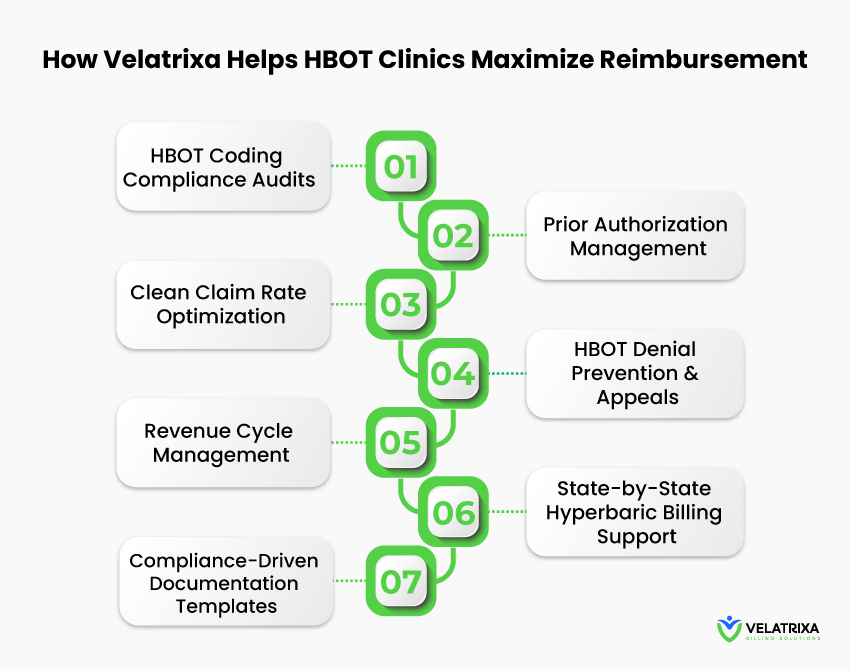
How Velatrixa Helps HBOT Clinics Maximize Reimbursement

Velatrixa empowers HBOT clinics to take control of their billing with a precision-driven, results-focused approach to revenue cycle management. From ensuring accurate CPT, HCPCS, and ICD-10 coding to managing complex prior authorizations and preventing costly denials, our team streamlines every stage of the HBOT billing process. We leverage advanced analytics, payer-specific insights, and structured workflows to improve clean claim rates, accelerate reimbursements, and recover underpaid or denied claims. By reducing administrative burden and eliminating revenue leakage, Velatrixa enables clinics to maintain consistent cash flow, stay compliant with evolving payer requirements, and focus on delivering high-quality patient care without financial uncertainty.

Conclusion

HBOT billing in 2026 is no longer just about submitting claims; it’s about precision, compliance, and proactive revenue management. With high-value treatments, strict payer requirements, and increasing audit scrutiny, even small inefficiencies can lead to significant financial loss. Clinics that implement structured workflows, accurate documentation, and denial prevention strategies consistently achieve faster reimbursements and stronger cash flow. Optimizing your HBOT billing process is not optional, it’s essential for sustainable growth and financial stability.

Ready to eliminate denials and maximize your HBOT reimbursement? Partner with Velatrixa today and transform your billing into a predictable, high-performing revenue engine.

Nearly 15% of medical claims are denied on first submission, and a significant portion is never recovered, costing billions annually across the healthcare system. For family medicine practices, where providers handle everything from preventive care to chronic disease management, even minor billing errors can translate into substantial financial losses.

In 2026, billing complexity is higher than ever. Stricter payer requirements, detailed documentation standards, and multi-service coding demands create challenges that can delay reimbursements, increase administrative workload, and erode revenue. Without a streamlined billing process, practices often face:

  • Higher denial rates and delayed payments
  • Lost revenue from coding and documentation gaps
  • Increased administrative burden from rework and appeals

Family medicine billing is no longer just an operational task; it is a critical revenue driver. This guide explores essential CPT codes, common billing mistakes, denial risks, emerging trends, and practical revenue cycle management (RCM) strategies to help practices improve accuracy, reduce denials, and maintain cash flow.

What Is Family Medicine Billing?

Family medicine billing is the process of accurately coding, submitting, and managing insurance claims for services provided in primary care settings. It involves the use of CPT codes, ICD-10 diagnosis codes, and detailed clinical documentation to ensure providers receive timely and accurate reimbursement.

Family medicine billing services cover a wide spectrum of care, including preventive visits, chronic disease management, acute illness treatment, and routine check-ups. Because family physicians treat patients across all age groups and conditions, billing requires a multi-service coding approach aligned with payer-specific guidelines and medical necessity requirements.

An effective family practice billing workflow includes insurance eligibility verification, prior authorizations, accurate code selection, claim submission, payment posting, and denial management. Each step directly impacts revenue cycle performance and reimbursement timelines.

Industry data highlights the importance of getting this process right:

  • Up to 15% of medical claims are denied on first submission, often due to coding or documentation errors
  • Over 20–30% of claims require rework, increasing administrative costs and slowing cash flow
  • Practices lose 5–7% of annual revenue due to preventable billing inefficiencies

With increasing payer scrutiny and evolving regulations in 2026, even minor errors in coding, modifier usage, or documentation can lead to claim denials, underpayments, or delayed reimbursements. This makes optimized family medicine billing services essential for improving clean claim rates, reducing denials, and maintaining consistent cash flow.

Why Accurate Family Medicine Billing Is Non-Negotiable

In 2026, accurate family medicine billing is no longer optional; it’s a critical driver of revenue, compliance, and operational efficiency. With primary care practices managing preventive care, chronic disease management, acute care, and wellness visits, even minor errors in CPT coding, ICD-10 selection, or documentation can have a significant financial impact.

  • Nearly 15% of family medicine claims are denied on first submission, translating into thousands of dollars lost per month for medium-sized practices
  • 5–7% of annual revenue is lost due to preventable coding or documentation errors
  • Up to 30% of staff time is consumed correcting billing errors and managing denials, reducing focus on patient care
  • Practices that implement accurate billing protocols can increase clean claim rates by 20–25%, significantly improving revenue flow.

Key Reasons Accurate Billing Matters

Accurate billing goes beyond avoiding denials; it directly impacts cash flow, compliance, and practice efficiency. Implementing precise coding, thorough documentation, and consistent workflows ensures that your family medicine practice captures every dollar earned while reducing administrative headaches.

1. Reduce Claim Denials and Accelerate Cash Flow

Denials caused by minor coding mistakes, missing modifiers, or insufficient documentation can delay payments by 30–45 days on average. Accurate billing ensures faster claim approval, fewer resubmissions, and predictable cash flow. For example, submitting E/M visits with proper modifiers and documentation can reduce rejections by up to 50%.

2. Protect Against Compliance Risks and Audits

Insurance providers, Medicare, and Medicaid have strict coding and documentation requirements. Inaccuracies can trigger payer audits, fines, or underpayments, costing practices tens of thousands annually. Accurate billing keeps your practice audit-ready and compliant.

3. Maximize Reimbursements and Recover Lost Revenue

Accurate coding ensures every service provided is billed correctly. Studies show that even a 1–2% improvement in billing accuracy can recover $50,000–$100,000 annually for a medium-sized family practice. Proper billing also reduces missed opportunities in chronic care management, preventive services, and vaccination claims, which are common revenue leaks.

4. Improve Operational Efficiency and Reduce Staff Burnout

Billing errors increase administrative workload, forcing staff to spend hours on claim corrections, payer follow-ups, and appeals. By implementing accurate billing practices, staff can redirect their focus to patient care, scheduling, and clinical documentation, improving both staff satisfaction and patient experience.

5. Maintain Patient Satisfaction and Trust

Billing errors not only impact revenue, but they can also frustrate patients. Incorrect charges, delayed statements, or denied claims can erode patient trust. Accurate billing ensures transparent and timely patient statements, which enhances overall patient satisfaction and retention.

For Example

Consider a family medicine practice with 2,000 monthly claims:

  • A 15% denial rate could mean 300 claims rejected initially, requiring staff to rework claims and coordinate with payers.
  • With an average reimbursement of $150 per claim, these denials represent $45,000 at risk each month.
  • Implementing accurate billing practices can reduce denials by half, potentially recovering $22,500 monthly in lost revenue over $270,000 annually.

In short, every denied claim, delayed payment, or missed modifier directly impacts your revenue. Accurate family medicine billing is the most effective lever to protect your practice’s financial health, reduce administrative burden, and improve patient satisfaction in 2026.

Why Family Medicine Billing Is Complex in 2026

Family medicine billing has become increasingly complex in 2026 due to evolving payer requirements, diverse service offerings, and heightened regulatory scrutiny. Unlike specialty practices, family medicine providers manage a wide spectrum of care, from preventive visits and chronic disease management to acute illness treatment and wellness exams. This diversity creates unique billing challenges that can directly impact revenue.

Key Factors Driving Complexity

Family medicine billing in 2026 is more challenging than ever. A combination of diverse services, evolving payer rules, and high claim volumes creates unique hurdles that can directly impact revenue and operational efficiency. Below are the key factors driving this complexity.

1. Broad Range of Services

Family medicine practices handle patients of all ages and conditions, including preventive care, chronic disease management, pediatric care, geriatric care, and acute illnesses. Each type of visit requires its own CPT and ICD-10 codes, and misclassifying even one visit can lead to a denied claim or underpayment. The sheer variety of services makes billing far more complex than in specialty practices.

2. Increasingly Complex Coding Requirements

Coding in family medicine is rarely straightforward. Chronic care management, multi-problem E/M visits, and preventive services often involve time-based or service-specific CPT codes. For example, chronic care management (99490) requires a minimum of 20 minutes of documented care per patient per month, while preventive visits use age-based codes (99381–99397). Errors in code selection or documentation remain a leading cause of the 11–15% first-time claim denial rate.

3. Stricter Payer Scrutiny in 2026

Insurance companies and government payers have tightened documentation requirements for preventive care, chronic disease management, and telehealth services. Claims are now routinely reviewed for proper coding, modifier usage (-25, -59, -50), medical necessity documentation, and prior authorizations. Failing to meet these requirements can result in delayed payments, claim denials, or reduced reimbursements.

4. High Volume of Claims and Administrative Burden

Family medicine practices often submit hundreds to thousands of claims monthly. Even a small error rate of 2–3% can translate into significant financial losses. According to Experian Health, administrative inefficiencies and billing errors account for 5–7% of lost revenue annually, with staff spending up to 30% of their time correcting claim denials. Managing this volume efficiently is a constant challenge.

5. Evolving Telehealth and Regulatory Changes

With telemedicine becoming a core part of primary care, billing complexity has increased. Telehealth visits require separate CPT codes, proper modifier usage, and detailed documentation to meet payer guidelines. Practices that fail to adapt to these changes risk losing reimbursement for virtual care, a growing revenue stream in 2026.

Family medicine billing is complex because it combines diverse services, evolving payer rules, high claim volume, and telehealth requirements. Without accurate coding, robust documentation, and proactive revenue cycle strategies, practices face higher denial rates, lost revenue, and administrative burnout. Optimizing billing processes in 2026 isn’t optional it’s essential to protect your practice’s financial health.

Top Revenue Risks in Family Medicine Billing

Even small mistakes in family medicine billing can have a big impact on revenue. Identifying and addressing the most common risks ensures your practice maximizes reimbursements and minimizes claim denials.

1. Modifier Errors (-25, -59, -50)

Modifiers clarify whether a procedure is separate from another service or performed bilaterally. Misusing modifiers like -25, -59, or -50 is a leading cause of claim denials in family medicine. For example, billing an E/M visit with a procedure without the proper -25 modifier can result in up to 15% of claims being denied on first submission. Proper staff training and consistent review can significantly reduce these costly errors.

2. Medical Necessity Documentation Gaps

Insurance payers require detailed documentation proving that each service is medically necessary. Missing or incomplete notes for preventive care, chronic care, or vaccinations can lead to rejections, delayed payments, or underpayment. Practices that implement structured documentation templates can reduce denials by 20–30%.

3. Missed Global Period Rules

Some procedures in family medicine, such as minor surgical interventions or post-op follow-ups, fall under global periods. Billing separately for services covered under a global period can trigger denials, while failing to capture billable post-op care results in lost revenue opportunities. Keeping a detailed schedule of global periods ensures accurate billing and maximizes reimbursement.

4. Prior Authorization Failures

High-cost treatments, imaging, and specialist referrals often require prior authorization. Failing to secure authorization can result in denied claims and delayed payments, which directly impacts cash flow. Practices that implement an automated prior authorization workflow can reduce claim rejections and accelerate reimbursements.

5. Incorrect CPT or ICD-10 Code Selection

Family medicine billing covers a wide range of services, each with its specific CPT and ICD-10 codes. Incorrect code selection is a top reason for claim denials, leading to lost revenue and additional administrative work. Using updated code books, staff training, and billing software with alerts can help ensure correct coding.

6. Insurance Eligibility Gaps

Submitting claims for patients with inactive or incorrect insurance information is a frequent cause of denials. Regular verification of patient coverage before appointments helps reduce claim rejections and improves clean claim rates by up to 25%.

Common Family Medicine Billing Mistakes (and How to Avoid Them)

Even the most experienced family medicine practices can fall into subtle billing traps that add up to thousands of dollars in lost revenue. Understanding the most common mistakes and how to prevent them is essential to improving reimbursements, reducing denials, and keeping your practice financially healthy.

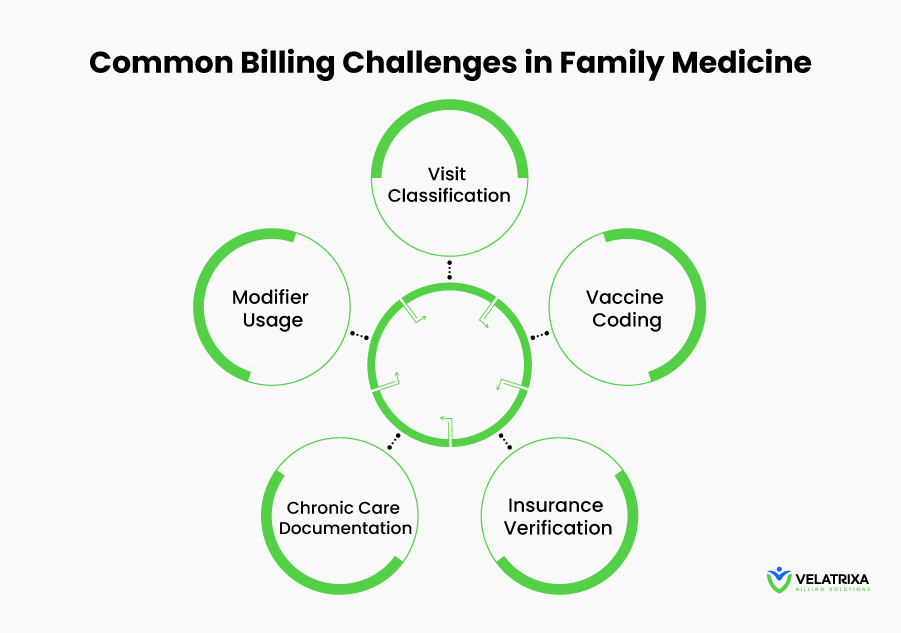
1. Incorrect Visit Classification

One of the simplest errors with the biggest impact is coding the wrong type of visit. For instance, labeling a preventive wellness check as a problem-focused visit can trigger denials or underpayment. In fact, up to 10% of first-time claim denials are caused by visit classification errors. Using structured visit checklists and standardized coding protocols helps staff classify visits correctly every time.

2. Improper Modifier Usage

Modifiers like -25, -59, and -50 tell payers whether a procedure is separate or related to another service. Misusing them can lead to denied or reduced claims. For example, failing to append -25 when billing an E/M visit alongside a procedure often causes rejections. Regular staff training and automated claim alerts can prevent these costly mistakes.

3. Outdated Vaccine Coding

Vaccine codes are constantly updated, and using outdated CPT or ICD-10 codes for flu shots, pediatric immunizations, or adult vaccines can delay or reduce reimbursement. Practices that update code books annually and double-check payer requirements see a significant drop in claim rejections.

4. Poor Chronic Care Documentation

Chronic care management (like CPT 99490) requires detailed documentation of care plans, patient progress, and time spent. Inadequate notes can easily lead to denied claims. Implementing structured templates, EMR reminders, and clear care logs ensures compliance and smooth reimbursement.

5. Insurance Eligibility Gaps

Submitting claims without confirming patient coverage is a top reason for denials. Practices that verify insurance eligibility, update patient information, and track prior authorizations can reduce denials by up to 25% while speeding up cash flow.

6. Missing Medical Necessity Documentation

Payers increasingly scrutinize whether services were medically necessary. Missing documentation for preventive exams, chronic care, or problem-focused visits can result in delays, denials, and additional administrative work. Clear, consistent documentation practices not only protect revenue but also keep your practice compliant.

Benefits of Outsourcing Family Medicine Billing

Managing family medicine billing in-house can be time-consuming, error-prone, and costly. Outsourcing to a specialized billing provider allows practices to focus on patient care while experts handle the complex, ever-changing world of coding, claims, and reimbursements.

1. Higher Clean Claim Rates

Specialized billing teams ensure that claims are accurately coded, complete, and compliant with payer requirements. Practices that outsource typically see clean claim rates increase by 20–30%, meaning fewer denials and faster reimbursements.

2. Faster Insurance Reimbursements

Outsourced billing providers have dedicated teams for claim submission, follow-ups, and payer communications. This ensures that claims are processed promptly, reducing the average reimbursement time and improving your practice’s cash flow.

3. Reduced Administrative Workload

Handling billing in-house can take staff away from patient care. Outsourcing frees your team from tedious billing tasks, allowing them to focus on improving patient experiences and maintaining quality care.

4. Expert Compliance with Payer Guidelines

Keeping up with changing CPT, ICD-10, and payer-specific rules is challenging. Billing experts stay updated on all coding updates, telehealth regulations, and documentation requirements, ensuring that your practice remains compliant and avoids costly audits or penalties.

5. Efficient Denial Management

Denied claims can quickly pile up, draining revenue and staff resources. Outsourced billing providers track, analyze, and appeal denials, recovering revenue that might otherwise be lost. This systematic approach helps practices maximize reimbursements while reducing administrative stress.

6. Scalability for Growing Practices

Whether your patient volume increases or you add new services, outsourced billing teams can scale operations quickly without the need for hiring or training additional staff. This flexibility allows practices to grow confidently without worrying about revenue cycle bottlenecks.

Key Family Medicine CPT & ICD-10 Codes

Accurate coding is the backbone of family medicine billing. Using the right CPT and ICD-10 codes ensures proper reimbursement, reduces denials, and demonstrates compliance with payer requirements.

Common Family Medicine CPT Codes (2026)

Procedure CPT Code Notes
Preventive Visit 99381–99397 Age-based codes for wellness exams and check-ups
Chronic Care Management 99490 Requires 20 minutes of documented care per month
Flu Shot 90686, 90674 Quadrivalent, cell-based vaccines
Pediatric Immunizations 90460–90461 Ensure correct vaccine types and dosages
Geriatric Exam 99397 Preventive visit for patients 65+
Health Risk Assessments 96160, 96161 Includes patient and caregiver assessments

Tip: Using outdated or incorrect CPT codes for preventive care or chronic care management can lead to denied claims or delayed reimbursement. Keeping your coding manual and EMR updated is critical.

Essential ICD-10 Codes

Accurate diagnosis coding not only justifies medical necessity but also protects your revenue. Key codes commonly used in family medicine include:

  • E11.9 – Type 2 diabetes without complications
  • I10 – Essential hypertension
  • Z00.00 – General adult medical examination
  • R10.9 – Abdominal pain, unspecified

Stat Insight: Studies show that incorrect ICD-10 coding contributes to up to 12% of first-time claim denials in primary care (RevCycle Intelligence, 2023).

Why This Matters

Selecting the correct CPT and ICD-10 codes is not just a compliance requirement—it directly impacts your revenue cycle. Accurate coding:

  • Prevents denials and underpayments
  • Ensures faster reimbursement
  • Supports proper documentation for audits
  • Reduces administrative burden for staff

By mastering the most common codes for preventive care, chronic disease management, immunizations, and geriatric care, family medicine practices can maximize reimbursements while minimizing claim delays.

Emerging Family Medicine Billing Trends in 2026

Family medicine billing is evolving quickly in 2026, and staying ahead of emerging trends is critical for practices aiming to maximize reimbursements and minimize denials. From updated Medicare guidelines to growing telehealth services and stricter commercial payer rules, understanding these trends helps practices adapt proactively and protect revenue.

Trend Description Impact on Practices
Medicare Preventive Care Updates New CPT codes and documentation standards for wellness visits Requires accurate coding to avoid denials and secure full reimbursement
Stricter Commercial Payer Rules Tighter chronic care documentation and follow-up requirements Increased need for compliance to prevent claim rejections
Telehealth Expansion Updated reimbursement models and coding for virtual visits Practices must track telehealth services carefully to ensure payment
Rising Payer Audits & Claim Scrutiny More audits focused on documentation and coding accuracy Higher risk of denials; proactive RCM strategies essential
Focus on Chronic Care Management Emphasis on time-based services, care plans, and patient outcomes Accurate documentation critical for maximizing reimbursements

Key Takeaway: In 2026, family medicine practices must stay current with coding updates, payer policies, and emerging reimbursement models. Practices that implement proactive RCM strategies, maintain precise documentation, and leverage technology for claims management are best positioned to reduce denials, accelerate reimbursements, and optimize financial performance.

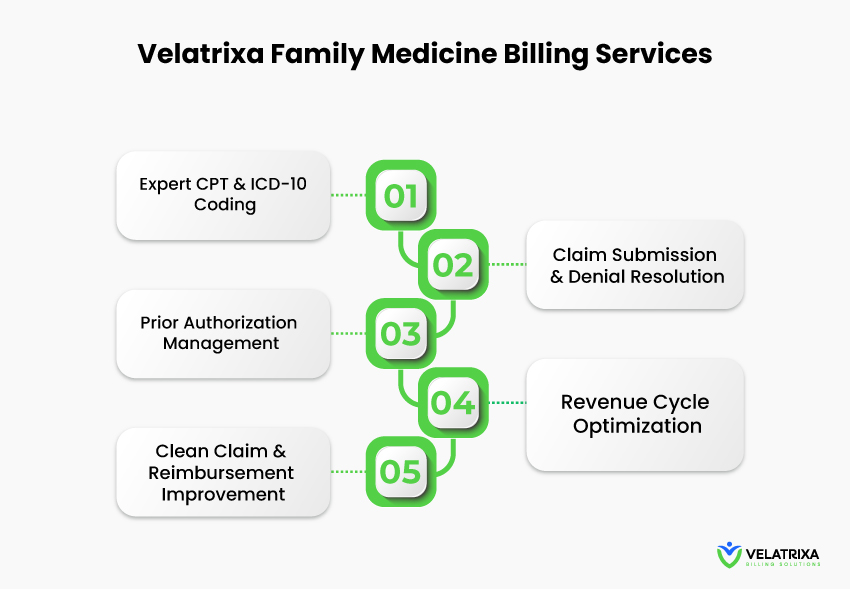
How Velatrixa Supports Family Medicine Practices

Family medicine billing is complex, and even small errors can cost practices thousands in lost revenue each month. Velatrixa simplifies the process with expert end-to-end revenue cycle management, from accurate CPT and ICD-10 coding to claim submission, denial resolution, and prior authorization support. Our team helps practices recover lost revenue, reduce denials, and accelerate reimbursements while keeping them fully compliant with ever-changing payer rules.

By outsourcing to Velatrixa, practices often see clean claim rates improve by 20–30%, faster cash flow, and reduced administrative stress, freeing staff to focus on patient care. Our solutions scale with your practice, handling higher patient volumes or new services without extra hiring. With Velatrixa, billing complexity becomes a revenue-generating advantage, allowing family medicine practices to maximize reimbursements, minimize claim delays, and operate confidently in 2026’s evolving healthcare landscape.

Conclusion

Accurate family medicine billing is essential to protect revenue, reduce denials, and maintain operational efficiency. Practices managing preventive care, chronic conditions, and acute visits rely on precise coding, strong documentation, and proactive RCM. Partnering with a specialized billing provider like Velatrixa streamlines operations, improves reimbursements, and allows teams to focus on quality patient care.

Ready to streamline your billing? Schedule a free billing assessment with Velatrixa today and uncover hidden revenue your practice may be losing.

In today’s complex healthcare landscape, ensuring that your acupuncture practice is properly credentialed and enrolled with insurance payers is essential for maintaining a steady revenue stream. Insurance credentialing for acupuncturists can be a detailed and time-consuming process, often leading to billing delays and claim denials if not handled correctly.

As more insurance companies begin covering acupuncture services for pain management, musculoskeletal disorders, and integrative treatments, providers must ensure they meet all payer credentialing requirements before submitting claims.

At Velatrixa, we understand the unique challenges acupuncture practices face with insurance enrollment, credentialing compliance, and acupuncture billing regulations. Our goal is to help acupuncture clinics streamline credentialing so practitioners can focus on delivering effective patient care while maintaining a healthy revenue cycle.

This guide explains the acupuncturist credentialing process step by step, common billing challenges, denial prevention strategies, and how professional acupuncturist credentialing services can accelerate approvals in 2026.

What Is Acupuncturist Credentialing and Why Does It Matters

Insurance credentialing is the process through which healthcare providers are verified and approved by insurance companies to provide medical services and receive reimbursement.

During the Acupuncturist credentialing process, insurance payers review a provider’s professional background, qualifications, and compliance status to determine whether they meet the insurer’s network participation standards.

Credentialing verification typically includes confirmation of:

  • State acupuncture license
  • Education and accredited acupuncture training
  • National board certification (NCCAOM)
  • Clinical experience and work history
  • Malpractice insurance coverage
  • National Provider Identifier (NPI)
  • Compliance and exclusion checks
  • Professional references

Insurance companies rely on credentialing to ensure that providers meet quality care and patient safety standards before allowing them to treat insured patients.

Acupuncturist Credentialing verification commonly includes background checks through databases such as:

  • National Practitioner Data Bank (NPDB)
  • Office of Inspector General (OIG) exclusion list
  • National Plan and Provider Enumeration System (NPPES)

For acupuncture providers, credentialing is especially important as insurance coverage for integrative medicine and alternative therapies continues expanding.

Common insurance-covered acupuncture services include:

  • Chronic pain management
  • Back and neck pain treatment
  • Migraine and headache therapy
  • Post-surgical pain support
  • Stress and anxiety management
  • Musculoskeletal therapy
  • Fertility support treatments

Without proper credentialing, acupuncturists may be unable to bill insurance payers or receive reimbursement for services provided.

Why Credentialing Is Critical for Acupuncture Practices

Credentialing plays a vital role in both financial stability and regulatory compliance for acupuncture clinics.

A properly credentialed acupuncture practice can:

  • Participate in insurance networks
  • Submit clean claims without eligibility rejections
  • Expand access to insured patients
  • Maintain compliance with healthcare regulations
  • Increase patient trust and credibility

However, when credentialing is incomplete or inaccurate, acupuncture practices may experience:

  • Claim denials due to provider ineligibility
  • Delayed reimbursements
  • Reduced patient access to insurance coverage
  • Compliance risks
  • Revenue cycle disruptions

As insurance coverage for acupuncture continues growing in 2026, credentialing accuracy will become even more critical for maintaining consistent reimbursement.

Challenges Faced by Acupuncturists in Insurance Credentialing

While credentialing is essential, the process can be complex and time-consuming for acupuncture clinics.

Many acupuncture providers encounter several common challenges.

Lengthy Credentialing Timelines

Insurance credentialing approvals can take 60 to 120 days, depending on the payer and application accuracy. These delays can significantly impact revenue, particularly for new acupuncture providers joining a clinic.

Typical credentialing timelines include:

Credentialing Step Average Time
CAQH profile setup 1–3 days
Medicare enrollment 45–60 days
Medicaid enrollment 30–90 days
Commercial payer credentialing 60–120 days
Final contract approval 30–60 days

If credentialing is not started early, practices may face months of unpaid services or limited patient access.

Limited Insurance Coverage for Acupuncture

Unlike many traditional medical specialties, acupuncture insurance coverage varies widely across states and payers.

Some insurers may require:

  • Specific documentation for medical necessity
  • Referrals from primary care physicians
  • Approved acupuncture CPT codes

Understanding these payer-specific requirements is essential for avoiding billing issues.

Credentialing Errors and Application Rejections

Small documentation inconsistencies can cause significant delays.

Common credentialing mistakes include:

  • Incomplete CAQH profiles
  • Expired acupuncture licenses
  • Missing NPI documentation
  • Incorrect provider taxonomy codes
  • Inconsistent provider information across applications

These issues can lead to rejected applications and extended approval timelines.

Re-Credentialing Requirements

Credentialing is not a one-time process.

Most insurance payers require providers to re-credential every two to three years.

Missing a re-credentialing deadline may result in:

  • Temporary network termination
  • Claim denials
  • Loss of reimbursement eligibility

Maintaining an organized credentialing tracking system is critical for avoiding interruptions.

Step-by-Step Acupuncturist Credentialing Process

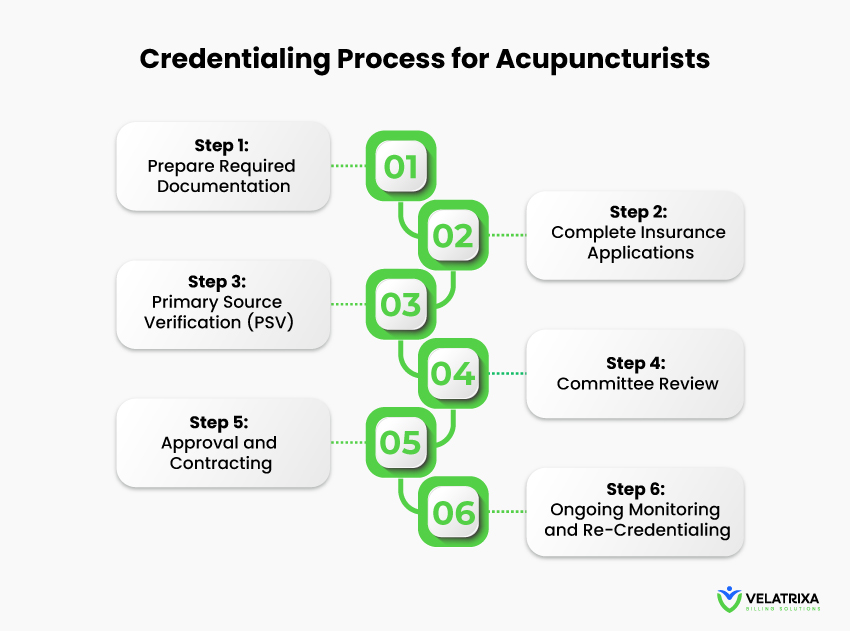
Step-by-step acupuncturist credentialing process, payer enrollment and approval workflow

Credentialing for acupuncture providers involves several stages that must be completed accurately.

Below is a simplified breakdown of the process.

Step 1: Medicare and Medicaid Provider Enrollment

Government healthcare programs are often the first step in credentialing.

Medicare Enrollment

Medicare currently covers acupuncture for certain conditions, particularly chronic lower back pain.

Providers must enroll through the Medicare Provider Enrollment system and submit documentation including:

  • CMS-855I provider enrollment form
  • CMS-855R reassignment of benefits form
  • NPI verification
  • Practice ownership information

Once approved, providers receive a Medicare PTAN (Provider Transaction Access Number).

Medicaid Enrollment

Medicaid acupuncture coverage varies by state but typically requires:

  • State acupuncture license verification
  • NPI confirmation
  • Compliance documentation
  • Medicaid provider application

Completing Medicaid enrollment allows acupuncture providers to treat patients within state insurance programs.

Step 2: Commercial Insurance Credentialing

Commercial payer credentialing allows acupuncture providers to bill private insurance companies.

Applications are typically submitted to insurers such as:

  • Aetna
  • Cigna
  • UnitedHealthcare
  • Blue Cross Blue Shield

Required documentation usually includes:

  • State acupuncture license
  • NCCAOM certification
  • DEA registration (if applicable)
  • Malpractice insurance
  • Updated curriculum vitae
  • Clinic affiliation information

Once credentialing is approved, providers receive network participation contracts outlining reimbursement rates.

Step 3: CAQH Profile Setup and Management

The CAQH ProView system is widely used by insurance companies to streamline credentialing verification.

A properly maintained CAQH profile includes:

  • Education and training history
  • Professional work experience
  • Licenses and certifications
  • Malpractice coverage information
  • Practice location details

Providers must re-attest their CAQH profile every 120 days to keep their information active.

Failure to maintain CAQH profiles is one of the most common causes of credentialing delays.

Step 4: Acupuncture Billing Setup and CPT Coding

Before submitting claims, acupuncture practices must establish compliant billing procedures.

Common acupuncture CPT codes include:

  • 97810 – Initial acupuncture treatment without electrical stimulation
  • 97811 – Additional acupuncture treatment sessions
  • 97813 – Acupuncture with electrical stimulation
  • 97814 – Additional sessions with electrical stimulation

Accurate coding and documentation are critical for avoiding insurance claim denials.

Step 5: Provider Network Enrollment and Contracting

After credentialing verification is complete, providers finalize payer contracts.

These agreements define:

  • Reimbursement rates
  • Covered acupuncture services
  • Billing requirements
  • Network participation terms

Understanding these contract terms helps acupuncture practices maximize reimbursement and prevent billing issues.

Acupuncturist Credentialing Application Checklist

Preparing credentialing documents in advance can significantly accelerate approvals.

Essential Acupuncture credentialing documents include:

Provider Identity Information

  • Full legal name
  • Date of birth
  • Government identification
  • Social Security number (for enrollment)

Provider Identification

  • National Provider Identifier (NPI)
  • NPI confirmation from NPPES

Professional Licensing

  • Active state acupuncture license
  • License verification documentation
  • License expiration dates

Education and Training

  • Acupuncture school diploma
  • Certification documentation
  • Training completion dates

Board Certification

  • NCCAOM certification status
  • Certification renewal documentation

Professional Work History

  • Updated curriculum vitae
  • Previous practice affiliations

Malpractice Insurance

  • Current malpractice policy
  • Coverage limits
  • Claims history

Compliance Verification

  • NPDB self-query
  • OIG exclusion check
  • HIPAA compliance documentation

Having these documents prepared can reduce credentialing approval timelines significantly.

Credentialing Timeline Overview

Acupuncturist credentialing timelines vary depending on the payer and documentation completeness.

Typical approval timelines include:

Credentialing Step Average Time
CAQH profile setup 1–3 days
Medicare enrollment 45–60 days
Medicaid enrollment 30–90 days
Commercial payer credentialing 60–120 days
Contract finalization 30–60 days

It is recommended that acupuncture providers begin credentialing at least 3-4 months before accepting insured patients.

The Insurance Enrollment Process for Acupuncturists

Once you are credentialed, you can start the insurance enrollment process, which is equally important for billing and reimbursement.

1. Verify Insurance Eligibility

Before providing services, always verify the insurance coverage of your patients. This step ensures that they are eligible for acupuncture treatments under their plan.

2. Submit Claims

After providing treatment, submit claims to the insurance company. Ensure that claims are accurate, using the correct CPT and ICD-10 codes for the services rendered. Claims can be submitted electronically or through paper forms, depending on the insurer’s preferences.

3. Track Claims and Follow-Up

It’s essential to track the status of your claims to ensure timely processing. Follow up on any denied or delayed claims promptly to avoid long payment cycles.

4. Reconcile Payments

Once payments are received, post them in your system and reconcile any discrepancies between what was billed and what was paid. Accurate reconciliation helps ensure that your practice maintains financial transparency.

5. Patient Billing

After insurance payments are applied, bill patients for any outstanding balance. Offer flexible payment options to maintain patient satisfaction.

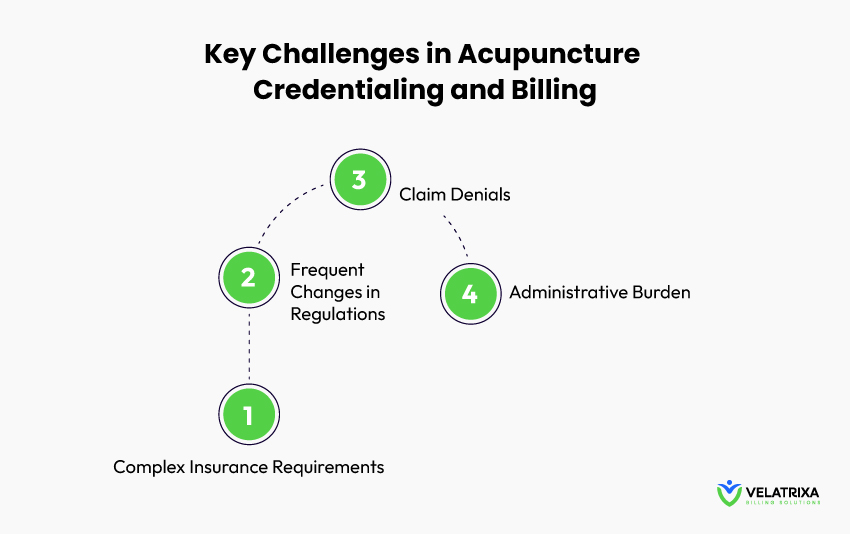
Key Challenges in Acupuncture Credentialing and Billing

Acupuncturists face a variety of challenges when it comes to credentialing and billing, including:

1. Complex Insurance Requirements: 

Each insurance provider has its own requirements for acupuncturist credentialing and billing. Managing these differences can be time-consuming and overwhelming.

2. Frequent Changes in Regulations:

Health insurance regulations, particularly Medicare credentialing requirements, change frequently, and staying updated on these changes is essential to avoid errors.

3. Claim Denials: 

Incorrect coding, missing documentation, and administrative errors often lead to claim denials, delaying reimbursements.

4. Administrative Burden: 

Handling credentialing and billing in-house requires significant time and effort, which could otherwise be spent on patient care and improving clinical practices.

The Benefits of Outsourcing Credentialing and Billing

Outsourcing credentialing and billing tasks to specialized providers like Velatrixa offers several key advantages:

  • Expertise and Compliance: Outsourcing ensures that Acupuncturist credentialing and billing processes are handled by professionals who are up-to-date on industry regulations, ensuring compliance and reducing errors.
  • Improved Efficiency: By outsourcing these tasks, you streamline your operations, leading to faster reimbursements and improved cash flow.
  • Cost Savings: Outsourcing eliminates the need for additional in-house staff, saving overhead costs related to training, software, and administrative tasks.
  • Focus on Patient Care: Outsourcing these processes frees up your time to focus on patient care, ensuring that you can deliver high-quality treatments without distraction.

Conclusion

Insurance credentialing is one of the most important administrative processes for acupuncture practices. Proper credentialing ensures providers can participate in insurance networks, receive reimbursement for treatments, and remain compliant with healthcare regulations. However, the credentialing process can be complex and time-consuming when managed internally.

By partnering with experienced acupuncturist credentialing professionals like Velatrixa, acupuncture practices can streamline provider enrollment, reduce claim denials, and ensure faster approvals across Medicare, Medicaid, and commercial insurance payers.

With expert credentialing support, acupuncturists can focus on delivering high-quality patient care while maintaining a stable and efficient revenue cycle.

Nursing home care is a cornerstone of the U.S. healthcare system, supporting millions of older adults and individuals with chronic conditions. These facilities provide long-term care, rehabilitation after hospital stays, and specialized support for residents with complex medical needs. However, in 2026, managing nursing home billing has become more complex than ever. With multiple payers, evolving federal and state regulations, and pressure from audits and denials, revenue cycle management (RCM) is a critical determinant of financial stability for skilled nursing facilities (SNFs).

This guide explains how nursing home billing works in 2026, explores Medicare Part A and B, PDPM payment structures, consolidated billing, Medicaid reimbursement challenges, and the trends shaping the RCM landscape. It also highlights strategies to optimize revenue and reduce errors, providing actionable insights for nursing home administrators and staff.

Understanding Nursing Home Billing in 2026

Unlike acute care hospitals, nursing homes manage prolonged stays and multiple payer streams simultaneously, making nursing home medical billing uniquely complex. A single resident may transition between:

  • Medicare Part A for post-hospital rehabilitation
  • Medicare Part B for outpatient therapy or physician services
  • Medicaid for long-term custodial care
  • Medicare Advantage (MA) plans with unique authorization and documentation requirements
  • Private pay, which often covers services not reimbursed by insurance

Each payer has unique billing rules, documentation requirements and timelines. Facilities must navigate complex coding systems, case mix scoring, bundled services, and audits to secure timely reimbursement.

The financial stakes are high. Medicaid covers approximately 60-63% of residents nationwide, yet reimbursement often falls short of the actual cost of care. Medicare provides coverage for shorter post-acute stays and Medicare Advantage plans are growing rapidly, bringing additional administrative complexity.

The Growing Complexity of Nursing Home Billing in 2026

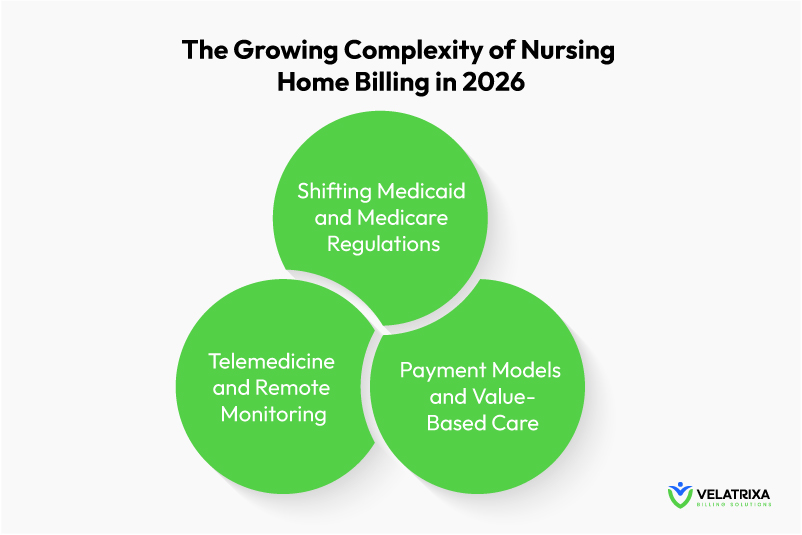
Growing complexity of nursing home billing in 2026 including Medicare, Medicaid, PDPM, and compliance challenges
In 2026, nursing home billing requires precise documentation, PDPM accuracy, and strict Medicare and Medicaid compliance to protect reimbursement.
  • Shifting Medicaid & Medicare Regulations: Medicaid and Medicare are the primary payers for nursing home residents, but both programs are frequently updated. In 2026, new eligibility rules, service coverage, and reimbursement rates will be introduced, impacting billing processes. For instance, Medicaid varies by state, making it challenging for nursing homes to keep up with the latest changes. These regulations impact everything from service categorization to billing codes and reimbursement rates. With the introduction of ICD-11 and Value-Based Care (VBC) models, staying compliant and ensuring accurate billing can overwhelm in-house teams without specialized knowledge.

  • Telemedicine & Remote Monitoring: As telemedicine gains traction in healthcare, nursing homes must adapt to new billing requirements for virtual consultations and remote monitoring services. Improper coding or billing can lead to claim denials or underpayments, so nursing homes must stay up to date on payer-specific telehealth billing guidelines to ensure proper reimbursement.

  • Payment Models & Value-Based Care: The shift towards Value-Based Care (VBC) in 2026 means nursing homes are reimbursed based on patient outcomes rather than the volume of services. This makes billing more complex, as nursing homes must track patient satisfaction, clinical outcomes, and quality measures as part of their billing process. A robust billing system is now required to capture both the quantity and quality of services provided.

Why Nursing Home Billing Matters in 2026

Billing is not just an administrative task it is central to financial sustainability. Facilities that fail to manage billing effectively risk:

  • Prolonged accounts receivable (AR) cycles that strain cash flow

  • Denied or underpaid claims leading to revenue loss

  • Audit exposure due to improper coding or documentation

  • Operational challenges including staffing disruptions and limited investment in technology

Understanding the regulatory environment, payer requirements, and emerging trends is critical for nursing homes to maximize revenue and minimize compliance risk.

Patient-Driven Payment Model (PDPM)

The Patient-Driven Payment Model (PDPM) is the framework for Medicare Part A reimbursement in skilled nursing facilities (SNFs), designed to replace the old therapy-minute-based payment system. Unlike previous models, PDPM focuses on patient characteristics, complexity, and clinical needs, rather than the sheer volume of therapy services provided. This shift emphasizes accurate documentation, comprehensive assessments, and precise coding to ensure SNFs receive proper reimbursement for the care delivered.

Under PDPM, Medicare Part A payments are divided into five case-mix adjusted components, each reflecting a different aspect of patient care. These include Physical Therapy (PT), Occupational Therapy (OT), Speech-Language Pathology (SLP), Nursing and Non-Therapy Ancillaries (NTA). Each component is scored based on the resident’s medical diagnoses, functional status, comorbidities, and cognitive abilities, as recorded in the Minimum Data Set (MDS). For example, a resident with chronic heart failure and diabetes may have an NTA score of 3. If only one comorbidity is captured in the MDS, the facility could lose $200 to $300 per day in reimbursement. Additionally, functional status assessments directly impact PT and OT payments, making accurate scoring and documentation critical.

PDPM payment calculation is determined through several factors:

  • Base Rate: Set by CMS according to facility type and geographic location.

  • Case Mix Index (CMI): Reflects patient complexity based on MDS assessments, ICD-10 diagnoses, comorbidities, functional scores, and cognitive status.

  • Variable Per Diem Adjustment: Adjusts the payment over the course of the resident’s stay, accounting for changes in care intensity and needs.

Despite its structured methodology, PDPM presents key challenges for SNFs. Accurate ICD-10 coding, timely and correct MDS completion, proper comorbidity capture, and precise functional and cognitive scoring are essential. Even small errors in documentation can lead to significant revenue loss, costing hundreds of dollars per resident per day.

To mitigate these risks and optimize PDPM reimbursement, facilities should adopt several best practices:

  • Ensure timely MDS submissions on Day 1, Day 8, and Day 30 to accurately capture the patient’s condition.

  • Cross-check ICD-10 codes with all comorbidities to ensure complete case-mix scoring.

  • Track therapy minutes for reporting and compliance purposes, even though PDPM no longer bases payment solely on therapy volume.

By prioritizing accurate documentation, proactive assessment, and careful coding, SNFs can fully leverage PDPM to secure appropriate reimbursement while minimizing compliance risks.

Tips for avoiding common PDPM mistakes:

  • Ensure timely MDS submission (Day 1, Day 8, Day 30)

  • Cross-check ICD-10 codes with comorbidities

  • Track therapy minutes for reporting even if not payment-driving

Medicare Part A vs Part B: Billing Differences

Understanding the distinction between Medicare Part A and Part B is critical:

Feature Medicare Part A Medicare Part B
Coverage Post-hospital skilled care Outpatient therapy, physician services
Duration Up to 100 days per benefit period Ongoing as needed
Billing Single bundled claim Individual claims for each service
Payment Model PDPM per diem Fee-for-service
Consolidated Billing Required Not required

Incorrectly billing Part A vs Part B can lead to denied claims and recoupments, making this distinction vital.

Consolidated Billing: What Nursing Homes Need to Know

Consolidated billing requires SNFs to bill Medicare Part A for most services provided during a covered stay. The facility is financially responsible for:

  • Therapy services (PT, OT, SLP)

  • Laboratory and diagnostic tests

  • Ancillary services

  • Durable Medical Equipment (DME)

  • Certain pharmacy services

Exclusions: Emergency services, some dialysis services, and high-cost chemotherapy drugs.

Common Errors:

  • Outside providers billing directly

  • Incorrect revenue codes

  • Failure to include bundled services

  • Misclassifying excluded services

Consolidated billing compliance is a frequent audit focus and a major source of financial risk for nursing homes.

Medicaid Reimbursement Challenges

Medicaid is the primary payer for long-term residents, yet reimbursement often falls below the cost of care. Facilities face challenges such as:

  • State-specific fee schedules

  • Retroactive eligibility changes

  • Slow payment cycles (30–90+ days)

  • Managed Medicaid complexity

  • Documentation and revalidation requirements

Without active management, Medicaid AR can age rapidly, causing cash flow issues and increased write-offs.

Key Nursing Home Billing Challenges in 2026

1. Multi-Payer Complexity

Nursing home billing requires managing multiple payer streams with distinct rules:

  • Medicare Part A: Covers post-hospital skilled care under the Patient-Driven Payment Model (PDPM).

  • Medicare Part B: Covers outpatient therapy and physician services not included in Part A.

  • Medicaid: State-administered programs cover long-term custodial care. Payment varies widely by state and is often below the actual cost.

  • Medicare Advantage: Managed care plans have plan-specific authorization, documentation, and billing rules.

  • Private Pay: Direct payment by residents or their families for services not covered by insurance.

Facilities must reconcile claims across these payers while tracking compliance, billing deadlines, and eligibility, making nursing home billing uniquely complex compared to other healthcare settings.

2. Fragmented Billing Streams

Nursing home billing differs from acute care in several ways:

  • Room & Board: Typically covered by Medicaid or private pay.

  • Therapy Services: PT, OT, and SLP services require precise documentation.

  • Ancillary Services: Laboratory, imaging, and durable medical equipment (DME) must be properly coded and billed.

  • Physician Services: Often billed separately under Medicare Part B.

Accurate tracking across these streams is essential to avoid denials, delays, and lost revenue.

2026 Trends Shaping Nursing Home Billing

In 2026, nursing home billing is shaped by several emerging trends that every skilled nursing facility (SNF) must understand to maintain accurate reimbursement and optimize cash flow. Medicare Advantage (MA) plans are expanding rapidly, requiring medical billers to navigate preauthorization processes, plan-specific documentation, and distinct billing workflows to avoid denials and delays. At the same time, telemedicine and remote monitoring have become integral to long-term care, demanding precise coding for virtual consultations and remote patient services in compliance with Medicare and Medicaid guidelines.

Advanced AI and automation tools are transforming revenue cycle management (RCM), enabling billers to perform predictive denial analytics, automated claim scrubbing, eligibility verification, and accounts receivable (AR) prioritization. By reducing manual errors and accelerating claim submission, these technologies directly improve cash flow while freeing staff to focus on complex cases and high-risk accounts. Meanwhile, the adoption of Value-Based Care (VBC) is reshaping how SNFs are reimbursed, tying payments to clinical outcomes, patient satisfaction, and quality metrics. Skilled medical coders must now integrate clinical and financial data to ensure that all eligible services are captured accurately, maximizing revenue while maintaining compliance.

Key focus areas for nursing home billing and coding include:

  • Medicare Advantage Growth: Mastering plan-specific authorizations, documentation, and workflows to prevent claim denials.

  • Telehealth Billing Compliance: Accurately coding virtual consultations and remote monitoring services in line with federal and state payer rules.

  • AI and Automation in RCM: Leveraging predictive analytics, automated claim scrubbing, eligibility checks, and AR prioritization to streamline the revenue cycle.

  • Value-Based Care Integration: Tracking clinical outcomes, quality measures, and patient satisfaction to ensure correct VBC reimbursement.

By staying ahead of these trends, medical billers and coders can protect SNF revenue, minimize denials, and optimize the complex multi-payer billing environment in 2026, turning regulatory challenges into opportunities for operational efficiency and financial growth.

How Nursing Home Billing Services Help

Professional SNF billing services improve revenue cycle management by providing:

  • PDPM Optimization: Ensuring accurate MDS scoring and ICD-10 coding.

  • Consolidated Billing Compliance: Preventing audit exposure and improper vendor billing.

  • Medicaid AR Management: Dedicated follow-up reduces the risk of aging and underpayment.

  • Denial Management: Root cause analysis prevents repeated errors.

  • Medicare Advantage Workflow Management: Handles preauthorization and documentation.

  • Analytics & Reporting: Provides transparency for decision-making and KPI monitoring.

Facilities that outsource billing often reduce AR by 15-30% and denials by 30-40%, while improving cash flow and compliance.

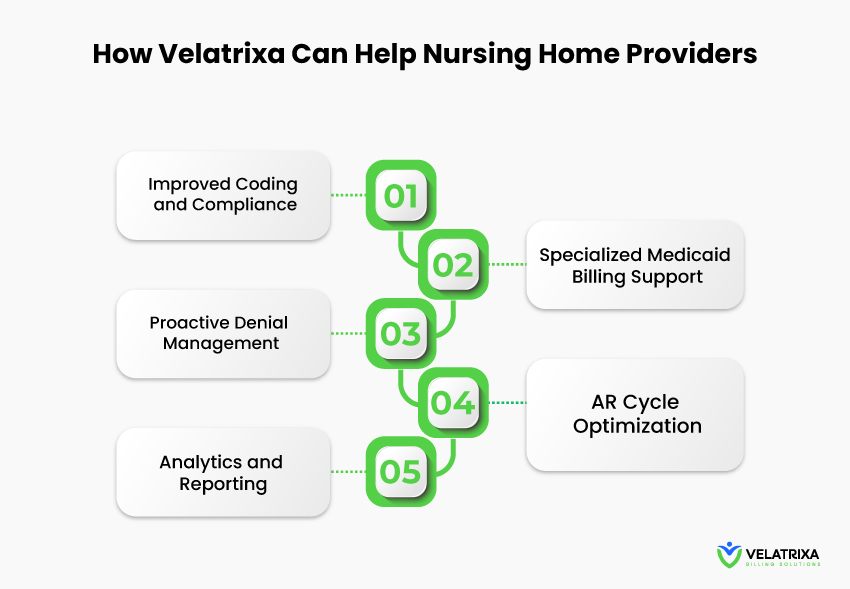
How Velatrixa Can Help Nursing Home Providers

Velatrixa nursing home billing services supporting long-term care providers with revenue cycle management and compliance

While nursing home billing in 2026 is more complex than ever, Velatrixa helps facilities streamline every stage of the revenue cycle. For example, a 120-bed SNF struggling with delayed Medicaid payments and high denial rates partnered with Velatrixa, resulting in faster reimbursements, reduced denials, and stabilized cash flow. With expertise in coding, PDPM compliance, AR optimization, and real-time analytics, Velatrixa ensures nursing homes capture the revenue they deserve while focusing on quality resident care.

Conclusion: 

Nursing home billing in 2026 presents significant challenges, but by outsourcing to experts, providers can streamline their revenue cycle, reduce errors, and improve cash flow. Velatrixa offers the expertise needed to navigate billing complexities, ensuring your facility is reimbursed promptly and accurately.

Contact Velatrixa today for a consultation and discover how we can help streamline your revenue cycle management.

Emergency room (ER) physicians are among the most critical healthcare professionals in the U.S. delivering life-saving care under unpredictable circumstances. Yet, when it comes to getting paid for those services, many find themselves caught in an equally unpredictable system: out-of-network billing.

Unlike in-network billing, where reimbursement terms are pre-defined by payer contracts, out-of-network (OON) billing occurs when a provider delivers care to a patient covered by an insurance plan with which the provider has no direct agreement. This situation is especially common in emergency medicine, where providers are required by law to treat patients regardless of their network status.

While the No Surprises Act (NSA) was introduced to protect patients from unexpected medical bills, it has simultaneously placed a heavy administrative and financial burden on providers. As emergency room groups navigate the ever-changing reimbursement landscape, many are asking: How can we ensure compliance while still getting paid fairly and on time?

This blog dives deep into the evolving landscape of out-of-network emergency billing, key challenges ER providers face, and practical solutions to improve financial performance and compliance in 2025.

The State of Emergency Room Billing in 2025

Emergency care remains essential, but underpaid

Emergency departments are the backbone of the U.S. healthcare system, with over 145 million ER visits annually according to the CDC. Yet, despite the demand, emergency medicine reimbursement remains among the most volatile sectors in healthcare.

A 2024 report from the American College of Emergency Physicians (ACEP) revealed:

  • Over 60% of emergency physician groups had at least one major payer terminate or fail to renew contracts in the past two years.

  • Denials for emergency services have increased by 22% since 2022.
  • Out-of-network disputes now account for nearly 30% of all payer-provider conflicts in emergency medicine.

These numbers highlight a troubling reality: while emergency care is indispensable, billing for it has become a compliance and revenue nightmare.

The No Surprises Act and Its Impact on ER Providers

What the Act changed

The No Surprises Act (NSA), implemented in January 2022, protects patients from receiving surprise medical bills for emergency and certain non-emergency services from out-of-network providers. Instead of patients being billed the difference, providers must now negotiate directly with payers.

While the intent was patient protection, the financial responsibility shifted squarely onto providers. Payers determine a “Qualifying Payment Amount (QPA)” — often much lower than actual service costs — leaving providers with underpayments and limited recourse.

How the Independent Dispute Resolution (IDR) process works — and fails

In theory, the NSA’s Independent Dispute Resolution (IDR) process allows providers to challenge unfair payments. However, the process has been plagued with delays, backlogs, and inconsistent rulings.
According to CMS data (April 2025):

  • The average IDR case takes 120+ days to resolve.

  • Over 450,000 IDR disputes have been filed since 2022, but fewer than half have been processed.

  • Many decisions favor payers due to unclear QPA transparency.

This has left many ER providers waiting months for payment or accepting lower reimbursements to maintain cash flow.

Key Challenges in Out-of-Network Emergency Billing

Key Challenges in Out-of-Network Emergency Billing

1. Unpredictable Reimbursement Rates
Out-of-network reimbursements lack consistency and transparency. Each payer applies its own methodology to determine payment amounts, which often vary based on region, payer policy, and claim specifics. As a result, many emergency physicians experience reductions of up to 40% compared to pre-No Surprises Act (NSA) payments, significantly cutting into margins and operational sustainability.

2. High Denial and Downcoding Rates
Emergency room (ER) claims are frequently subjected to denials or downcoding due to alleged issues such as “lack of medical necessity,” “duplicate submissions,” or “incorrect coding.” According to a 2024 HFMA report, one in every four ER claims faces partial or complete denial, forcing providers to spend valuable time on appeals and rework that delay reimbursement and increase administrative costs.

3. Administrative Overload
The introduction of the NSA’s Independent Dispute Resolution (IDR) process has intensified the administrative burden for ER billing teams. From preparing documentation to managing payer communication and appeals, billing teams often spend 20–25 hours each week on out-of-network claim disputes—time that could be better spent improving patient care and operational efficiency.

4. Cash Flow Disruptions
Because of slow payer responses and lengthy dispute resolution timelines, many practices experience severe interruptions in their cash flow. Inconsistent payments and extended delays can leave providers struggling to meet payroll or operational expenses, sometimes forcing them to rely on credit lines just to maintain day-to-day operations.

5. Compliance Complexity
The No Surprises Act has introduced a new layer of compliance demands. Providers must now manage extensive documentation, including good faith estimates, patient notifications, and detailed dispute submissions. Failure to maintain complete records can result in penalties or delayed payments, making compliance management a continuous and resource-intensive challenge.

The Financial Toll on Emergency Room Practices

The impact of these challenges is more than administrative — it’s financial.
According to Becker’s Hospital Review (2024):

  • Revenue loss from underpayments in emergency medicine averages 15–20% annually.

  • The average out-of-network reimbursement dropped 17% post-NSA implementation.

  • 60% of ER groups have faced cash flow delays longer than 60 days due to payer disputes.

This means hundreds of thousands of dollars are at stake for physician groups and hospitals every year — money that should have been rightfully reimbursed.

How Emergency Room Providers Can Overcome Out-of-Network Billing Challenges

1. Conduct Regular Payer Reimbursement Audits
Out-of-network reimbursements lack consistency and transparency. Each payer applies its own methodology to determine payment amounts, which often vary based on region, payer policy, and claim specifics. As a result, many emergency physicians experience reductions of up to 40% compared to pre-No Surprises Act (NSA) payments, significantly cutting into margins and operational sustainability.

2. Master the IDR Process
Although complex, the IDR process remains a critical recourse for fair payment. Providers should:

  • Track filing deadlines (typically 30 business days post-payment or denial).

  • Maintain comprehensive claim documentation.

  • Partner with legal or RCM experts experienced in IDR filings.

Some providers have recovered 20–30% higher payments through well-documented IDR cases.

3. Improve Coding Accuracy
Emergency room coding involves complex CPTs, modifiers, and time-based codes. Errors can easily trigger denials.
Investing in AAPC-certified coders ensures claims are coded accurately — improving clean claim rates and compliance.

4. Leverage Technology and Automation
AI-driven billing platforms can:

  • Flag underpayments in real time.

  • Automate appeals submission.

  • Track payer behavior for recurring issues

Automation not only reduces manual workload but also shortens the revenue cycle.

5. Outsource to Specialized Billing Partners
For many ER groups, outsourcing out-of-network billing to an experienced RCM partner can dramatically improve results.
Professional billing firms manage:

  • Eligibility verification and benefits analysis

  • Accurate claim coding and submission

  • Payer negotiation and follow-up

  • NSA compliance documentation

On average, outsourced RCM solutions increase collections by 25–40% and reduce denials by up to 70% compared to in-house billing teams.

Case Insight: The Real Impact of Strategic OON Billing Management

A multi-location emergency physician group in California struggled with over $500,000 in underpaid claims after insurers reduced QPA rates post-NSA.
After engaging a specialized billing partner:

  • Their claim clean rate improved from 82% to 98%.

  • Denials dropped by 65%.

  • The group recovered $280,000 through payer appeals and IDR filings within four months.

This case demonstrates that strategic out-of-network billing isn’t about fighting insurers — it’s about using data, compliance, and persistence to ensure fair reimbursement.

Policy Outlook: What’s Next for Out-of-Network Billing in 2025

The regulatory landscape continues to evolve.
CMS has announced updates to NSA enforcement and dispute resolution expected to take effect in late 2025:

  • A new digital IDR portal to speed up dispute handling.

  • Clearer QPA transparency rules requiring payers to disclose rate methodologies.

  • Revised timelines for payment and negotiation, reducing waiting periods for providers.

While these changes are promising, healthcare providers must stay proactive — keeping documentation thorough and processes compliant to take full advantage of upcoming reforms.

Best Practices for Sustainable ER Revenue Cycle Management

Strategy Impact on Revenue
Denial Prevention Reduces rework and increases first-pass payment rates
Data Analytics Identifies underpayment trends and payer behavior
Documentation Excellence Strengthens IDR and appeal success
Payer Relationship Management Improves negotiation outcomes
Continuous Compliance Audits Minimizes legal and financial risk

The Bigger Picture: Aligning Care, Compliance, and Compensation

Emergency room physicians dedicate their careers to saving lives, often making split-second decisions under extreme pressure.
They deserve a billing process that values their expertise and ensures timely, fair reimbursement.

Yet, the reality is that the current system often penalizes them for doing their job.
By implementing smarter revenue strategies, leveraging automation, and collaborating with experienced RCM partners like Velatrixa, providers can regain control over their financial outcomes.

In 2025, success in emergency billing won’t come from avoiding complexity — it will come from mastering it.

Conclusion

The challenges of out-of-network billing for emergency room providers are not going away soon.
Between payer negotiations, NSA compliance, and complex coding, the system can feel overwhelming.
However, providers who adapt through technology, compliance awareness, and strategic partnerships can transform billing from a point of frustration into a source of financial stability.

Emergency medicine will always be unpredictable.

Your revenue shouldn’t be — partner with Velatrixa for reliable, compliant out-of-network billing solutions.

In the healthcare world, billing can be one of the most challenging aspects for small medical practices. Whether you’re running a solo practice or a small clinic, accurate medical billing is essential to ensure you’re paid on time and in full for the services you provide. Unfortunately, it’s not uncommon for small practices to face billing errors, delayed payments, or even denials, which can significantly impact cash flow.

In this blog, we’ll explore the importance of medical billing for small practices and provide tips on how to improve the process, avoid common errors, and maintain a steady revenue stream. Let’s dive in!

What is Medical Billing for Small Practices?

Medical billing refers to the process of submitting claims to health insurance companies for services provided to patients. This involves coding services, submitting claims, following up on payments, and ensuring that practices receive timely reimbursements. Effective medical billing is crucial to maintaining the financial health of small practices, ensuring timely payments, and maintaining patient trust.

The Growing Need for Efficient Medical Billing Solutions

According to a 2024 MGMA report, 60% of small practices face difficulties in managing their revenue cycle, and 40% report frequent issues with claim denials. As the healthcare industry continues to evolve, so too do the complexities of medical billing. Small practices are increasingly turning to outsourced medical billing services to streamline operations and improve financial outcomes.

Velatrixa’s all-in-one solutions empower
Your independent practice to boost revenue
So you can focus more on patient care and less on paperwork.

Explore Velatrixa®

Key Steps to Optimize Medical Billing for Small Practices

There are several key steps you should use to improve medical billing for small practices. 

1. Streamline Patient Registration and Insurance Verification

Efficient billing begins at the patient registration stage. Ensuring that patient information is accurate and up to date, and verifying insurance coverage at the time of the visit, can prevent delays in the billing process and reduce the risk of claim denials.

2. Use Automated Coding Systems

Utilizing coding software for medical services is vital to ensure accuracy and compliance with insurance providers. By automating coding, you minimize the risk of errors that can lead to denied claims and delayed payments.

3. Ensure Timely Claim Submission

Once services are coded, claims should be submitted electronically to insurance companies. The faster claims are submitted, the quicker practices can expect payment. Timeliness is key to ensuring a steady cash flow for your practice.

4. Regular Payment Posting and Follow-ups

Once payments are received, it’s essential to post them promptly. Regular monitoring and follow-up on outstanding claims ensure that no payments are missed, and any discrepancies are promptly addressed.

5. Effective Denial Management

Denied claims are a major issue for small practices. Establishing an efficient denial management system and consistently appealing denials can help recover lost revenue and reduce the impact of future denials.

6. Implement Transparent Patient Billing

Make sure that patients receive clear, accurate billing statements. Providing accessible online payment options and flexible payment plans helps enhance patient satisfaction and reduces the chances of payment disputes.

Why Efficient Medical Billing is Crucial for Small Practices

Improved Cash Flow Management

Accurate and timely billing ensures that your practice receives payment promptly, which is essential for covering operational expenses and ensuring consistent cash flow.

Enhanced Patient Satisfaction

A clear, easy-to-understand billing process builds trust with your patients. Patients are more likely to pay on time when they fully understand their charges and payment options.

Regulatory Compliance

Adhering to billing standards and regulations like HIPAA and PCI-DSS not only helps you avoid penalties but also ensures the security and privacy of patient data.

Outsourcing vs. In-House Medical Billing

The decision between outsourcing billing to a specialized company or managing it in-house is an important one. Below is a comparison to help determine the best option for your practice.

Feature Outsourced Billing In-House Billing
Cost Lower overhead and no software costs High staffing, software, and IT expenses
Expertise Access to skilled professionals Limited expertise, training needed
Cash Flow Faster claims processing, fewer denials Slower reimbursements, more denials
Scalability Flexible management of workloads Limited scalability, especially during peak periods
Technology Access to advanced billing tools High upfront costs for billing systems
Administrative Burden Reduced burden on practice staff Ongoing administrative tasks

Affordable Medical Billing Software with Pricing, Features, and Compliance Details

Software Name Features & Functionality Pricing Compliance
athenahealth (athenaCollector) Integrated RCM, EHR, scheduling, patient portal, reporting, analytics; real-time eligibility, denial resolution. Subscription-based; typically per provider/month, starts around $140/month, billed annually, with transparent pricing and no hidden fees. Industry-compliant (HIPAA, regulatory updates, denial monitoring via payer rules engine).
DrChrono Mobile-first EHR + billing + RCM + scheduling + e-prescribing + telehealth + customizable dashboards. Paid tiers; multiple plans (Apollo, Apollo-Plus, etc.); pricing upon request. ONC certified, Meaningful Use Stage 3, EPCS, HIPAA-compliant.
RXNT Cloud-based practice management with EHR, billing, scheduling, e-prescribing, patient portal and claim automation. Paid – transparent subscription; estimated ~$110–319/provider/month depending on features. ONC-certified; HIPAA compliance implied via standard RCM practices. (No explicit source found.)
Kareo Billing Billing-focused platform with eligibility checks, claims submission, reporting, dashboards. Paid – subscription model; sources cite approximately $374/provider/month plus setup fees. Compliance implied with integration of EHR + Billing; specifics not detailed.
NextGen Office Cloud-based EMR + billing + scheduling + RCM + AI dashboards + eligibility tools. Paid – single-tier basic plan (~$300/month) per provider. Likely HIPAA-compliant and industry-standard; no explicit certifications noted.
Compulink Healthcare Solutions Full EHR + billing + auto payment processing + patient portal and claims tracking. Paid – pricing not disclosed; quote-based. Implicit compliance (industry-standard); details not specified.
CureMD Cloud/on-premises EHR + RCM + claims scrubbing + AI scribe + telehealth + patient portal. Paid – approximately $195–395/provider/month. HIPAA-compliant; billing accuracy tools; implicit regulatory compliance.
AllegianceMD All-in-one EHR & billing with AI-powered automation and patient portal. Not publicly disclosed; consult vendor. Not explicitly detailed; likely HIPAA compliance.
PracticeSuite Modular EHR and billing with eligibility checks and coding validation; free and paid tiers. Paid and free tiers; specific pricing not detailed. Compliance assumed, but specifics not cited.
CollaborateMD Cloud-based billing & PM, fast claims processing, simple interface. Paid – pricing not disclosed. Not detailed; standard compliance assumed.

Seamless Medical Billing Integration

Connect your billing system with ERP, CRM, or practice software—HIPAA-compliant, accurate, and efficient. Streamline workflows and keep data flowing smoothly.

Integrate Now

Overcoming Common Billing Challenges for Small Practices

Medical billing remains a challenge for many small practices. Some of the most common obstacles include:

1. Administrative Overload

Many physicians spend a significant amount of their time on administrative tasks, including billing. This detracts from time spent providing quality patient care.

2. Staffing Challenges

Small practices often face difficulties recruiting and retaining skilled billing professionals, which leads to high turnover and increased training costs.

3. Complex Billing Requirements

As the healthcare system moves toward value-based care, billing requirements have become more complex. Staying compliant with evolving regulations can be a struggle for small practices.

4. Financial Strain

Investing in advanced billing systems can be costly, and many small practices find it challenging to allocate resources between patient care and technology upgrades.

Effective Solutions for Improving Medical Billing

1. Invest in Medical Billing Software

Affordable and user-friendly software can automate tasks such as claim submission, payment posting, and reporting, reducing the risk of manual errors and improving overall efficiency.

2. Train Your Billing Staff Regularly

Continuous education and training on coding, insurance policies, and billing practices will reduce errors and streamline processes.

3. Outsource to Specialized Medical Billing Companies

Outsourcing can save your practice time, reduce costs, and improve billing accuracy. Partnering with an experienced company like Health Quest can allow you to focus on patient care while experts handle the billing.

4. Foster Clear Patient Communication

Providing patients with clear, timely bills and multiple payment options can significantly improve patient satisfaction and ensure timely payments.

The Benefits of Outsourcing Medical Billing

Cost-Efficiency

Outsourcing medical billing eliminates the need for in-house billing staff and expensive technology investments. The typical cost of outsourcing ranges from 4% to 10% of collections, making it a cost-effective solution for many small practices.

Expert Support and Compliance

Medical billing service providers employ certified coders and specialists who stay up-to-date with industry changes, ensuring that your practice remains compliant with all regulations.

Advanced Technology

Outsourced billing companies use the latest technologies, such as electronic health records (EHR), automated coding algorithms, and billing analytics, which improve accuracy and efficiency.

Focus on Patient Care

By outsourcing your billing, you can focus more on patient care rather than administrative tasks, ultimately improving patient outcomes and satisfaction.

Choosing the Right Medical Billing Service Provider

When evaluating potential billing partners, small practices should consider the following:

  • Pricing Transparency: Ensure there are no hidden costs and compare fee structures.
  • Experience and Specialization: Look for billing companies with expertise in your medical specialty.
  • Technology: Assess the strength and compatibility of their billing systems with your practice’s needs.
  • Security and Compliance: Confirm HIPAA compliance and the provider’s data security protocols.
  • Customer Support: Ensure ongoing support is available to address any issues or questions.

Data Security and Compliance

The security of patient data is a top priority in medical billing. Health Quest implements robust data security practices, including:

  • End-to-End Encryption: Ensuring data security during transmission.
  • Multi-Factor Authentication (MFA): Adding an additional layer of protection for system access.
  • HIPAA Compliance: Guaranteeing full compliance with patient data protection regulations.

Comparing the Top Medical Billing Solutions for Small Practices: 

When selecting a medical billing service, it’s important to consider your practice’s specific needs.

Feature Velatrixa CloudRCM Health Quest
Service Model Personalized, practice-specific billing solutions Technology-driven, cloud-based billing and RCM services Comprehensive end-to-end billing and revenue cycle management
Technology Approach Customized solutions tailored to practice needs Utilizes advanced technology for automation and efficiency Integrates advanced tools for seamless billing processes
Specialization Focus on small and independent practices Expertise in handling billing for various specialties Specializes in comprehensive billing services for small practices
Compliance & Security Ensures adherence to industry regulations and standards Implements robust security measures and compliance protocols Maintains strict compliance with healthcare regulations and data security
Client Support Offers dedicated support with a personalized approach Provides responsive customer service and support channels Delivers ongoing support and consultation to clients
Pricing Structure Transparent and tailored pricing models Offers competitive pricing with clear terms Provides cost-effective solutions with transparent pricing

Final Thoughts: 

Efficient medical billing is essential for the financial stability of small practices. By adopting advanced billing solutions, outsourcing, and staying compliant with industry standards, small practices can optimize their revenue cycle, reduce administrative burdens, and focus more on delivering quality patient care.

Velatrixa: Simplifying Medical Billing for Small Practices

Managing medical billing can be overwhelming for small practices, often leading to delays, errors, and denied claims. Velatrixa specializes in streamlining the billing process, ensuring accurate coding, timely reimbursements, and efficient denial management.

Outsource your billing to Velatrixa and reduce administrative burdens while enhancing your practice’s cash flow. Our expert team ensures compliance, improves accuracy, and maximizes your reimbursements, allowing you to focus on patient care and business growth.

Mixed Martial Arts (MMA) is one of the most physically demanding and dangerous professional sports in the world. UFC (Ultimate Fighting Championship), the largest and most recognized MMA promotion globally, showcases fighters who push their bodies to the limit every time they step into the octagon. But when injuries inevitably occur, a critical question arises:

Does the UFC pay the medical bills of its fighters?

As a medical billing professional, understanding how sports organizations like the UFC handle fighter healthcare is essential. In this blog, we explore fighter contracts, injury classifications, coverage limitations, and recent data to clarify what is and isn’t covered by the UFC—and what fighters and healthcare providers need to know. We’ll also outline how medical billing companies can play a critical role in navigating injury claims, insurance gaps, and reimbursement challenges.

Understanding the UFC Fighter Contract

When a fighter signs with the UFC, they typically agree to a contract that outlines the terms of compensation, number of fights, bonuses, and medical provisions. According to ESPN and former UFC fighters, most contracts include:

  • Base Pay (e.g., $12,000 to show, $12,000 to win)
  • Performance and Fight Night Bonuses
  • Coverage of medical care only during official UFC events or fight-related activities

Importantly, fighters are classified as independent contractors, not employees, which means they do not receive employee health benefits such as long-term health insurance or a retirement plan.

Does the UFC Cover Medical Bills?

Yes—but only under certain conditions.

Covered Situations:

  1. Injuries sustained during official UFC fights
  2. Injuries during UFC-sanctioned media or promotional events
  3. Pre-fight and post-fight medical exams and hospitalizations
  4. Some injuries during official UFC training camps (at UFC’s discretion)

Fighters receive coverage for:

  • Hospital visits
  • Imaging (MRI, CT scans)
  • Surgeries
  • Physical therapy
  • Rehabilitation sessions
  • Immediate post-fight care (stitches, wound care, etc.)

According to the UFC’s 2024 Health Policy Report:

The average per-event injury treatment cost ranges from $10,000 to $40,000 depending on severity.

Not Covered:

  • Injuries sustained outside UFC events (e.g., personal training, sparring in another gym)
  • Long-term care (e.g., CTE-related issues)
  • Preventive health services or chronic condition treatment
  • Off-season healthcare

This limitation creates significant out-of-pocket risks for fighters, especially lower-tier athletes who lack supplemental insurance.

How Much Does UFC Actually Pay for Injuries?

The actual dollar amount depends on the injury. Based on case studies from 2022–2024:

  • ACL surgery (training camp injury): $28,000 (covered)
  • Broken orbital bone (fight night): $15,500 (covered)
  • Concussion follow-up care: $6,200 (partially covered if reported immediately)
  • Rehab + therapy (8 weeks): $5,000 (covered under UFC’s event-related plan)

While the UFC does cover medical treatment costs directly related to sanctioned events, this does not include long-term health insurance or retirement coverage.

What Insurance Do UFC Fighters Have?

In 2011, UFC introduced a fighter injury insurance policy through Zuffa, LLC. This includes up to $50,000 annual coverage for event-related injuries, with UFC footing the bill (no premium required by fighters).

However, fighters are still urged to purchase personal health insurance to cover gaps such as:

  • Family coverage
  • Dental and vision
  • Long-term injuries
  • Mental health and psychiatric care

The gap between fight-specific insurance and year-round coverage leaves many athletes vulnerable. As of 2025, over 65% of UFC roster fighters do not carry comprehensive personal health insurance, according to Pro Athlete Law Group.

Medical Billing Challenges for UFC Fighters and Clinics

Healthcare providers treating UFC athletes must often navigate:

  • Unclear coverage timelines
  • Non-standardized claim procedures
  • Third-party preauthorization from UFC’s medical coordinators

Medical billing services can support fighters and clinics by:

  • Verifying eligibility and UFC policy limits
  • Coding fight-related injuries correctly using CPT and ICD-10 standards
  • Submitting claims to UFC representatives or appropriate insurance vendors
  • Managing denial appeals or coordination of benefits (COB)

For sports medicine clinics, outpatient surgery centers, and rehab facilities, outsourcing to a professional medical billing company ensures streamlined revenue cycle management, faster reimbursements, and accurate documentation.

Recent Legal and Legislative Moves (2024–2025)

California’s MMA Fighter Pension Law

In 2023, California passed legislation to establish a pension fund for MMA fighters. Funded by ticket surcharges and memorabilia sales:

  • $1 per event ticket contributes to the fund
  • Fighters must meet eligibility thresholds (age + bout minimums)

UFC Lawsuit Over Fighter Classification

In an ongoing antitrust lawsuit (Le v. UFC), fighters argue they are misclassified as contractors to avoid providing full employment benefits. A 2025 decision is pending and could reshape how fighters are compensated and insured.

Stats That Highlight the Risk

  • 77.8% of UFC fighters (2016–2018) sustained facial fractures or concussions
  • In 2021, 145 of 409 UFC fights ended in knockouts (≈ 35%)
  • Average U.S. healthcare cost per person (2023): $13,493
  • Typical UFC base pay for a new fighter: $24,000 per fight (win included)
  • Less than 18% of fighters receive full-time health benefits outside the UFC

Source: ESPN, Redwood Bark, MMAFighting, CDC Health Expenditure Report 2024

Conclusion

While the UFC does offer short-term medical coverage for injuries sustained during official events, it does not provide long-term health insurance or retirement benefits to its fighters. The limited nature of coverage puts a significant burden on the athletes, especially those lower in the rankings or those who train independently.

From a healthcare and billing perspective, the key is understanding the boundaries of UFC’s liability, staying aligned with billing codes relevant to sports injuries, and educating fighters on the value of securing comprehensive health plans. As MMA grows, so does the responsibility to ensure fighters are medically—and financially—protected, not just during fight night but beyond.

Need Help with Medical Billing for Athletes or Sports Clinics?

At Velatrixa, we specialize in helping healthcare providers, sports medicine facilities, and athletic programs manage their revenue cycle with precision. Whether you’re treating UFC fighters or managing complex injury claims, our expert team handles:

  • Sports-related medical billing services
  • Injury coding and payer negotiation
  • Claim submission, appeals, and patient billing

Contact us today via Velatrixa.com and let’s take the hassle out of your medical billing process.