

Table of Contents
ToggleDelayed credentialing can block reimbursements, slow patient flow, and strain cash flow for behavioral health practices. In 2026, insurers are tightening scrutiny, extending enrollment timelines, and enforcing stricter compliance across Medicare, Medicaid, and commercial networks. For therapists, psychiatrists, psychologists, PMHNPs, ABA providers, addiction centers, and telehealth practices, credentialing is now a revenue-critical function rather than back-office paperwork. Payers demand accurate CAQH data, active licenses, valid malpractice coverage, and ongoing recredentialing before granting network access. Even minor mismatches can delay approvals for months.
This guide breaks down the credentialing process, common delays, and how Velatrixa streamlines behavioral health provider enrollment and reduces bottlenecks.
Why Behavioral Health Credentialing Matters
Behavioral health credentialing is the insurance approval process that verifies a provider’s license, training, and compliance before allowing in-network billing.
Behavioral health credentialing is what stands between a provider and the ability to actually get paid by insurance companies. It’s the process insurers use to confirm that a therapist, psychiatrist, psychologist, PMHNP, or treatment center is properly licensed, trained, and compliant before allowing in-network participation.
When credentialing is done right, it unlocks steady reimbursements, stronger patient access, more referrals, and predictable practice growth. When it’s delayed or incomplete, everything slows down, billing stalls, patients hesitate due to higher costs, and revenue becomes inconsistent.
Without active credentialing, providers are forced out-of-network, which directly reduces patient volume and limits long-term growth potential. On the operational side, delays ripple through the entire revenue cycle, longer A/R days, stuck claims, disrupted schedules, and unpredictable cash flow.
As behavioral health demand continues to surge in 2026, credentialing has shifted from paperwork to a critical revenue driver that determines how quickly care can actually reach patients.
What Are Behavioral Health Credentialing Services?
Behavioral health credentialing services handle the entire process of getting mental health providers approved by insurance companies so they can bill in-network and receive reimbursement. Instead of navigating multiple payer portals, complex documentation, and follow-ups, these services manage the full enrollment lifecycle from start to finish.
This includes CAQH setup and maintenance, insurance panel applications, Medicare and Medicaid enrollment, provider contracting, EFT/ERA setup, and ongoing recredentialing. It also involves tracking payer requirements, correcting application errors, and ensuring provider data stays consistent across all systems.
Because every insurance company has different rules, timelines, and documentation standards, credentialing quickly becomes time-consuming and error-prone for behavioral health practices. A single missed update or incomplete form can delay approvals for weeks or even months.
Credentialing services simplify this by streamlining provider enrollment, reducing administrative burden, and accelerating in-network approval so providers can start billing faster and focus on patient care instead of paperwork.
Behavioral Health Providers Who Need Credentialing
Every behavioral health provider who wants to bill insurance must go through credentialing before becoming in-network. Without it, reimbursement simply doesn’t happen—no matter how experienced or qualified the provider is.
This includes therapists such as LPCs, LMFTs, LCSWs, and LMHCs who need active licensure, verified clinical hours, and malpractice coverage. Psychiatrists require additional verification like medical licensure, residency history, and DEA registration for medication management services.
Psychologists must validate doctoral education, supervised training, and specialty qualifications. PMHNPs are credentialed through advanced practice licensure, national certification, and prescribing authority requirements.
Specialized providers like ABA therapists, addiction treatment centers, and telehealth behavioral health practices face even more layered enrollment rules, often varying by state and payer.
No matter the specialty, insurance companies require complete verification before granting network access. Credentialing ensures providers are eligible to treat insured patients and receive timely reimbursement across Medicare, Medicaid, and commercial plans.
Behavioral Health Credentialing Timeline by Provider Type
| Provider Type | Avg Timeline |
|---|---|
| Therapist | 60–120 days |
| Psychiatrist | 60–150 days |
| PMHNP | 90–150 days |
| ABA Provider | 90–180 days |
| Addiction Treatment | 120–180 days |
Behavioral Health Credentialing Process: Step-by-Step Guide (2026)
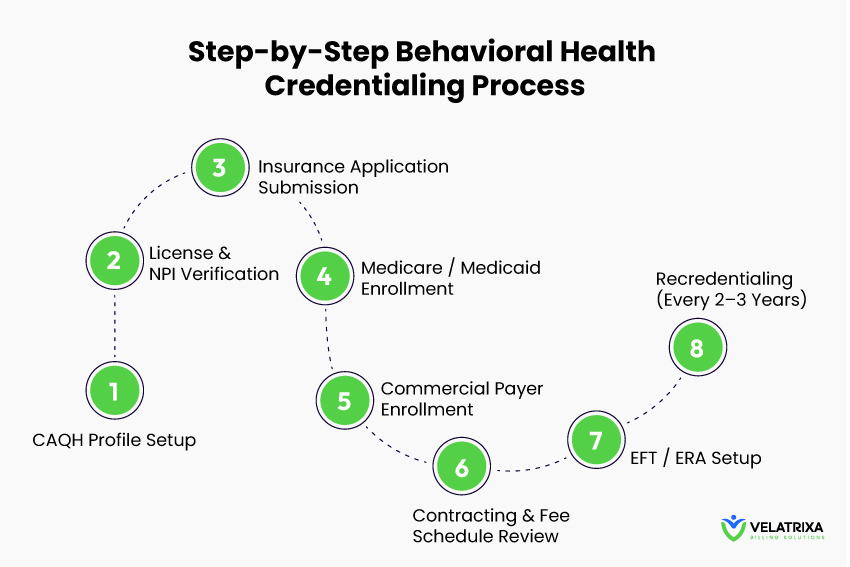
Behavioral health credentialing follows a structured sequence before a provider can start billing insurance companies. While each payer has its own variations, the overall process stays largely the same across Medicare, Medicaid, and commercial networks.
1. CAQH Profile Setup
Most commercial payers use CAQH ProView as a centralized provider data platform.
Providers must:
- complete all profile sections
- upload current documents
- authorize payer access
- re-attest regularly
Expired CAQH profiles are one of the most common causes of credentialing delays.
2. NPI and License Verification
Insurance companies verify:
- Type 1 and Type 2 NPIs
- state licenses
- DEA registrations
- certifications
- work history
- malpractice coverage
Any inconsistencies across records can trigger manual review.
3. Medicare Enrollment
Behavioral health providers enrolling in Medicare typically complete:
- PECOS enrollment
- CMS-855 applications
- EFT enrollment
- PTAN assignment
Medicare enrollment timelines vary based on provider type and application completeness.
4. Medicaid Enrollment
Medicaid enrollment is state-specific and often more complex than commercial credentialing.
Requirements may include:
- background checks
- fingerprinting
- site inspections
- MCO enrollment
- state-specific documentation
5. Commercial Payer Enrollment
Providers apply to insurance companies such as:
- Aetna
- Cigna
- Optum
- Blue Cross Blue Shield
- UnitedHealthcare
- behavioral health carve-out networks
Commercial payers often require committee review before approval.
6. Contracting and Fee Schedule Review
After credentialing approval, providers receive participation agreements outlining:
- reimbursement rates
- billing requirements
- claim submission policies
- authorization rules
- network participation terms
Careful contract review is critical before signing.
7. EFT and ERA Enrollment
Electronic Funds Transfer (EFT) and Electronic Remittance Advice (ERA) enrollment help streamline reimbursements and payment processing.
8. Recredentialing and Ongoing Maintenance
Most insurance companies require recredentialing every 2–3 years.
Providers must maintain:
- active licenses
- updated malpractice coverage
- current CAQH profiles
- accurate provider directory information
Behavioral Health Credentialing Requirements Checklist
| Required Document | Purpose |
| State License | Verifies legal authority to practice |
| NPI Number | Provider identification |
| DEA Registration | Required for prescribing providers |
| Malpractice Insurance | Risk management verification |
| CAQH Profile | Centralized provider data |
| W-9 Form | Tax reporting |
| Resume/CV | Work history verification |
| Board Certification | Specialty qualification |
| Government ID | Identity verification |
| EFT Information | Payment processing |
Medicare vs Medicaid vs Commercial Credentialing
| Payer Type | Average Timeline | Key Requirements |
|---|---|---|
| Medicare | 60–120 Days | PECOS, CMS enrollment |
| Medicaid | 90–180 Days | State enrollment, MCO approval |
| Commercial Insurance | 90–150 Days | CAQH, contracting, committee review |
Medicare Credentialing
Medicare credentialing is federally controlled and highly structured. It focuses on strict provider screening, license verification, and ongoing compliance checks through CMS systems like PECOS.
Because it’s centralized, requirements are consistent but accuracy is critical. Even small errors in enrollment data can delay approval or trigger rework in the system.
Medicaid Credentialing
Medicaid credentialing is state-based, which means rules, timelines, and requirements vary widely depending on location. Many providers must also enroll with multiple Managed Care Organizations (MCOs), adding extra layers of review.
Behavioral health Medicaid enrollment is especially detailed for:
- Addiction treatment programs
- Community mental health centers
- ABA providers
- Telehealth behavioral health services
Each of these may require additional documentation, background checks, or program-specific approvals depending on the state.
Commercial Insurance Credentialing
Commercial payer credentialing is driven less by federal structure and more by network needs. Insurance companies evaluate whether there is demand for providers in a specific region or specialty before approving enrollment.
Key influencing factors include:
- Network demand in the area
- Panel availability (open vs closed networks)
- Geographic coverage gaps
- Behavioral health provider shortages
In many behavioral health markets, insurance panels are frequently closed or limited, making timing and positioning critical for approval.
Common Credentialing Delays and Denials
Behavioral health credentialing rarely fails because of one major issue it usually slows down due to small, preventable errors that compound across the process. In 2026, with tighter payer controls and higher application volumes, even minor inconsistencies can delay approvals for weeks or months.
Common Problems Include:
- expired CAQH attestations
- incomplete applications
- outdated malpractice insurance
- work history gaps
- mismatched provider addresses
- missing signatures
- inactive licenses
- closed insurance panels
- delayed payer responses
- telehealth licensing issues
Even minor inconsistencies can significantly extend enrollment timelines.
Telehealth Credentialing for Behavioral Health Providers
Telehealth has reshaped behavioral health delivery, but credentialing hasn’t become simpler it’s actually more complex. Providers offering virtual care must now meet both payer requirements and state-specific licensing rules before they can bill insurance.
However, telehealth credentialing introduces additional complexities including:
- multi-state licensing
- payer telehealth enrollment rules
- virtual care compliance
- place-of-service coding requirements
- telehealth consent documentation
Behavioral health organizations expanding virtually must carefully manage state-specific payer enrollment requirements.
Why Behavioral Health Practices Outsource Credentialing Services
Credentialing is not a one-time task it’s a continuous cycle of applications, follow-ups, updates, and revalidations across multiple payers. For behavioral health practices, this quickly becomes time-intensive and easy to mismanage without dedicated support.
Most delays happen because payer responses are slow, requirements constantly change, and follow-ups are inconsistent. When internal teams are already handling billing, scheduling, and patient care, credentialing often gets pushed down the priority list resulting in stalled approvals and delayed revenue.
Outsourcing behavioral health credentialing services helps eliminate these bottlenecks. Dedicated specialists manage payer communication, track application status, correct errors early, and ensure CAQH and enrollment data stay accurate across all systems.
For growing practices, especially those adding providers or expanding into telehealth, outsourcing also ensures faster enrollment timelines, fewer denials, and smoother scaling across Medicare, Medicaid, and commercial insurance networks.
Why Choose Velatrixa for Behavioral Health Credentialing Services
Velatrixa is built for one purpose removing the delays, confusion, and revenue loss that come with behavioral health credentialing. Instead of treating enrollment as paperwork, we manage it as a structured revenue pipeline that determines how fast providers can start billing.
We support therapists, psychiatrists, psychologists, PMHNPs, ABA providers, addiction treatment centers, and telehealth practices with end-to-end credentialing and provider enrollment across Medicare, Medicaid, and commercial insurance networks.
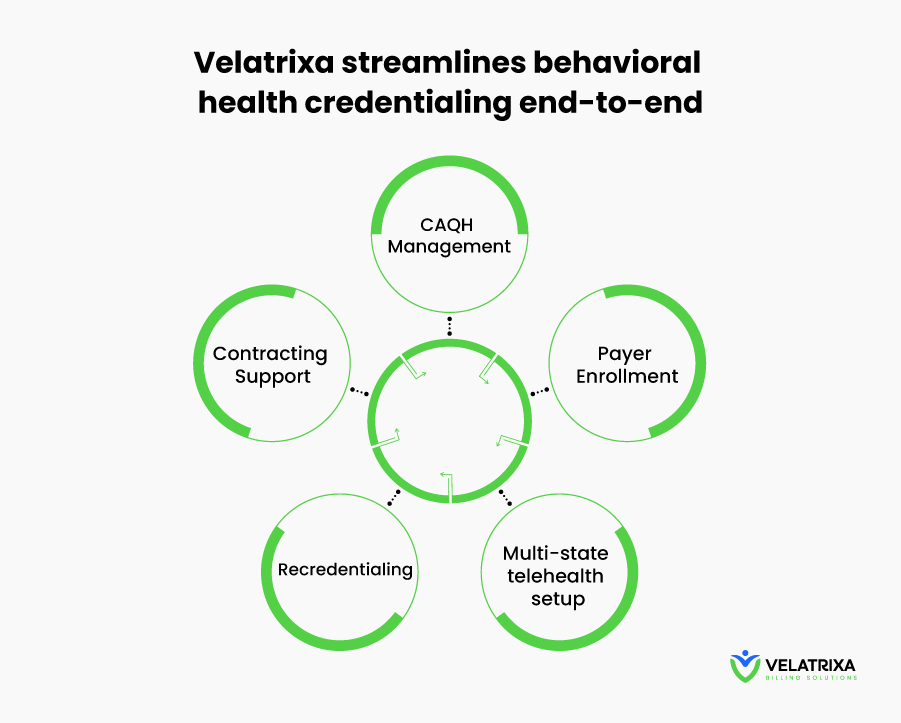
Our process covers CAQH management, payer enrollment, contracting, recredentialing, EFT/ERA setup, and multi-state telehealth credentialing. Every application is tracked, verified, and followed up proactively to prevent unnecessary delays or rework.
What sets Velatrixa apart is execution consistency accurate submissions, structured follow-ups, and reduced turnaround time across insurance panels. The focus is simple: faster approvals, fewer denials, and smoother onboarding so behavioral health providers can focus on patient care instead of payer systems.
Final Thoughts
Behavioral health credentialing directly impacts how quickly providers can join insurance networks and receive reimbursements. In 2026, tighter payer rules and longer enrollment cycles mean even minor errors can delay approvals and disrupt cash flow.
For therapists, psychiatrists, psychologists, PMHNPs, ABA providers, addiction centers, and telehealth practices, accurate and timely credentialing is essential to stay in-network and maintain consistent revenue.
Every week spent in credentialing delays is lost revenue, delayed reimbursements, and missed patient intake. Velatrixa accelerates behavioral health credentialing across Medicare, Medicaid, and commercial insurance networks, so your providers get approved faster and start billing sooner.
Start your credentialing with Velatrixa today and move in-network without unnecessary delays.