Mental health services are in higher demand than ever, yet many psychiatry practices continue to struggle with delayed reimbursements, claim denials, authorization challenges, and growing administrative burdens. Seeing more patients does not always translate into stronger revenue when billing inefficiencies quietly impact cash flow behind the scenes. From behavioral health carve-outs and psychotherapy documentation requirements to telepsychiatry billing regulations, psychiatry practices face reimbursement challenges that many other specialties rarely encounter.
A claim denied the first time often requires significant time and resources to correct and resubmit. For psychiatry providers managing high patient volumes, even a small increase in denial rates can create substantial revenue leakage and operational strain. This guide explores how psychiatry billing services help providers reduce denials, improve collections, maintain compliance, and strengthen financial performance in 2026.
What Are Psychiatry Billing Services?
Psychiatry billing services are specialized revenue cycle management solutions designed specifically for psychiatrists, psychiatric nurse practitioners (PMHNPs), behavioral health clinics, and mental health organizations. Unlike general medical billing, psychiatry billing involves a unique combination of evaluation and management services, psychotherapy, medication management, telehealth billing, and behavioral health payer requirements. Each of these elements affects how claims are submitted, reviewed, and reimbursed.
Effective psychiatry billing services manage the entire reimbursement process, helping providers reduce administrative burden while improving financial outcomes.
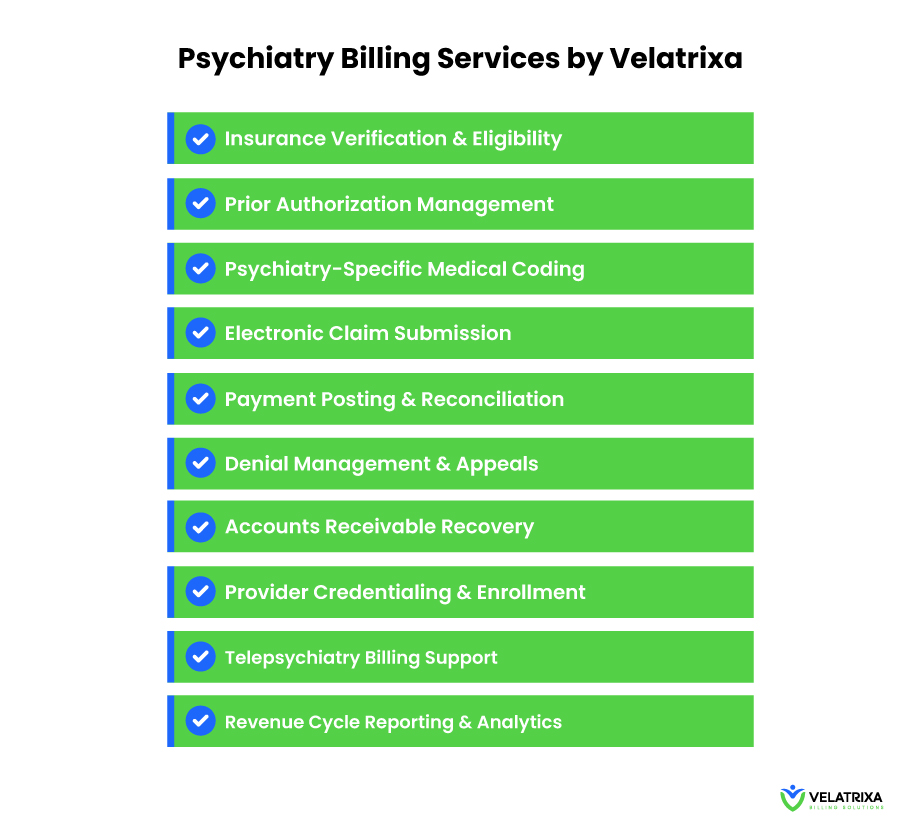
Services typically include:
- Insurance verification
- Benefits eligibility checks
- Prior authorization management
- Medical coding
- Charge entry
- Claim submission
- Payment posting
- Denial management
- Appeals processing
- Accounts receivable follow-up
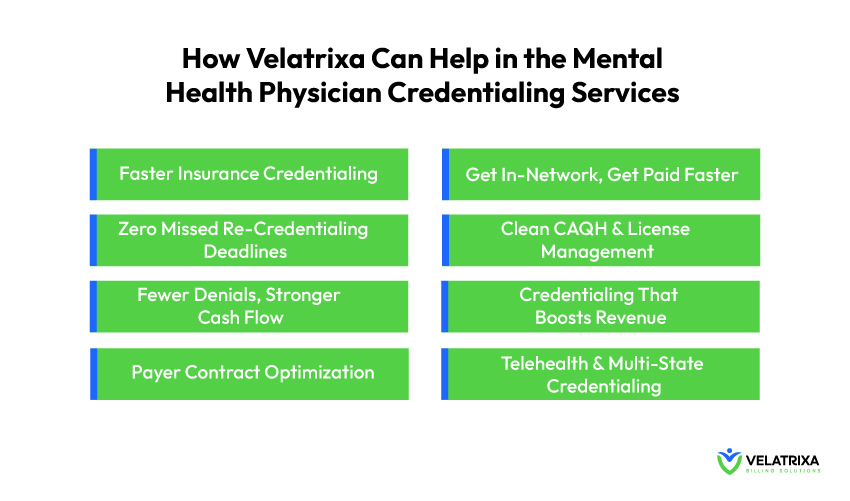
- Provider credentialing
- Revenue cycle reporting
The ultimate goal is to ensure providers receive accurate and timely reimbursement while maintaining compliance and focusing on patient care.
Why Psychiatry Billing Is Different From Other Medical Specialties
Psychiatry billing is often viewed as a straightforward extension of therapy billing, but the reality is far more complex. Psychiatric providers frequently deliver medication management, psychotherapy, clinical evaluation, treatment planning, and risk assessment during the same encounter. Each service has specific coding, documentation, and reimbursement requirements that must be accurately captured to avoid denials.
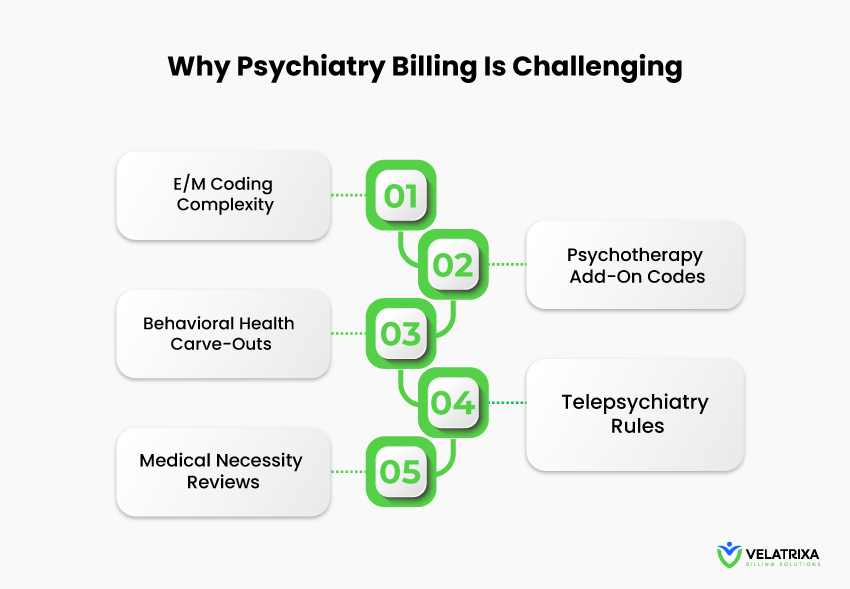
Several factors make psychiatry billing uniquely challenging.
-
Evaluation and Management (E/M) Coding
Most psychiatry follow-up visits involve medication monitoring and clinical decision-making. Selecting the correct E/M code requires accurate documentation of medical decision-making complexity, patient risk factors, and treatment management. Incorrect E/M coding remains one of the most common reasons for underpayments and denials.
-
Psychotherapy Add-On Services
Many psychiatrists provide psychotherapy alongside medication management during the same appointment. These services require the use of psychotherapy add-on codes and supporting documentation that clearly distinguishes the psychotherapy component from the E/M service. Failure to document appropriately can result in denied reimbursement.
-
Behavioral Health Carve-Outs
Behavioral health benefits are frequently administered separately from medical benefits. A patient may have medical coverage through one payer while mental health services are managed by another organization. Identifying these carve-outs during eligibility verification is critical for preventing billing errors.
-
Telepsychiatry Requirements
The continued growth of virtual care has introduced additional billing requirements involving telehealth modifiers, place-of-service codes, and payer-specific reimbursement policies. Providers must stay current with changing telehealth regulations to ensure compliance and reimbursement accuracy.
-
Medical Necessity Reviews
Psychiatric claims are commonly reviewed for medical necessity. Documentation must clearly support the diagnosis, treatment plan, patient progress, and clinical rationale for services rendered.
Common Psychiatry Billing Challenges
Even highly successful psychiatry practices face revenue cycle challenges that affect cash flow and operational efficiency. Many of these issues originate long before a claim is submitted, making proactive revenue cycle management essential.
Claim Denials Due to Coding Errors
Incorrect CPT code selection, inadequate documentation, and diagnosis coding errors can result in denied claims and delayed reimbursement.
Common coding-related issues include:
- Incorrect E/M code selection
- Missing psychotherapy documentation
- Inaccurate diagnosis coding
- Modifier errors
- Insufficient time documentation
Authorization Problems
Many psychiatric services require prior authorization before treatment begins. Missing or expired authorizations can lead to complete claim denial regardless of medical necessity.
Common authorization-dependent services include:
- Transcranial Magnetic Stimulation (TMS)
- Intensive Outpatient Programs (IOP)
- Partial Hospitalization Programs (PHP)
- Inpatient psychiatric admissions
Credentialing Delays
Provider enrollment and credentialing delays can create significant reimbursement challenges. Claims submitted before credentialing is finalized may be denied or delayed, impacting practice cash flow.
Aging Accounts Receivable
Without consistent claim follow-up, unpaid balances can accumulate quickly. High A/R aging often indicates underlying billing workflow issues that require immediate attention.
Telehealth Billing Errors
Incorrect modifiers, place-of-service codes, or documentation deficiencies continue to generate avoidable denials for telepsychiatry services.
Is Your Psychiatry Practice Performing Above or Below Industry Benchmarks?
Many psychiatry practices focus primarily on patient volume while overlooking key revenue cycle performance indicators. However, tracking financial and operational benchmarks can provide valuable insight into the overall health of a practice. Comparing performance against industry standards helps identify revenue leakage before it becomes a major problem.
The following benchmarks can help evaluate the effectiveness of your revenue cycle management process:
| KPI | Industry Benchmark |
| Clean Claim Rate | 95%+ |
| First-Pass Claim Acceptance Rate | 90%–95% |
| Net Collection Rate | 95%+ |
| Claim Denial Rate | Below 5% |
| Days in Accounts Receivable | 30–40 Days |
| A/R Over 90 Days | Less Than 15% |
| Authorization-Related Denials | Less Than 2% |
If your denial rate exceeds 5%, claims remain unpaid beyond 40 days, or a large portion of A/R is aging past 90 days, there may be opportunities to improve coding accuracy, eligibility verification, authorization workflows, and payer follow-up processes.
Essential Psychiatry Billing Codes for 2026
Accurate coding plays a critical role in maximizing reimbursement and maintaining compliance. While psychiatry providers may use numerous CPT codes, a relatively small group accounts for the majority of billing activity. Understanding these codes and their documentation requirements helps reduce denials and improve claim acceptance rates.
| CPT Code | Service Description | Common Use | Billing Risk |
| 90791 | Psychiatric Diagnostic Evaluation | Initial Assessment | Missing documentation |
| 90792 | Psychiatric Diagnostic Evaluation with Medical Services | Initial Psychiatric Evaluation | Medical necessity concerns |
| 99213 | Established Patient E/M | Medication Follow-Up | Incorrect MDM selection |
| 99214 | Established Patient E/M | Moderate Complexity Visit | Documentation deficiencies |
| 99215 | Established Patient E/M | High Complexity Visit | Insufficient supporting detail |
| 90832 | Psychotherapy (30 Minutes) | Individual Therapy | Time documentation errors |
| 90834 | Psychotherapy (45 Minutes) | Standard Therapy Session | Documentation gaps |
| 90837 | Psychotherapy (60 Minutes) | Extended Therapy Session | Time validation issues |
| 90833 | Psychotherapy Add-On | E/M + Therapy | Modifier/documentation errors |
| 90836 | Extended Psychotherapy Add-On | E/M + Therapy | Missing psychotherapy notes |
| 90838 | Long Psychotherapy Add-On | E/M + Therapy | Unsupported time requirements |
Accurate coding should always be supported by thorough clinical documentation that clearly demonstrates medical necessity and treatment goals.
Telepsychiatry Billing in 2026
Telepsychiatry has become a permanent component of modern mental healthcare delivery. Patients increasingly expect convenient virtual access to psychiatric services, and many practices now rely heavily on telehealth encounters as part of their care model. However, telehealth reimbursement continues to evolve, creating new compliance and billing considerations.
Successful telepsychiatry billing requires attention to:
- Appropriate telehealth modifiers
- Place-of-service requirements
- State licensing regulations
- Medicare telehealth guidelines
- Commercial payer policies
- Audio-only billing rules
- Documentation standards
Failure to comply with telehealth billing requirements can result in denied claims, reimbursement delays, and compliance concerns.
Common Psychiatry Billing Denials and How to Prevent Them
Denials remain one of the most significant barriers to maximizing reimbursement. While some denials are unavoidable, many result from preventable billing errors, missing documentation, or workflow inefficiencies. Understanding denial patterns allows practices to implement corrective actions and improve reimbursement outcomes.
| Denial Code | Common Cause |
| CO-50 | Medical necessity not adequately supported |
| CO-97 | Bundling or coding conflicts |
| CO-4 | Missing or incorrect modifier |
| CO-B7 | Credentialing issue |
| CO-204 | Missing authorization |
| CO-29 | Timely filing exceeded |
For example, CO-50 denials often occur when documentation fails to justify the level of service billed. Similarly, CO-204 denials frequently result from authorization breakdowns during scheduling or registration. Monitoring denial trends and implementing corrective workflows can significantly improve collection rates.
Why More Psychiatry Practices Are Outsourcing Billing
The increasing complexity of psychiatry reimbursement has made in-house billing more challenging than ever. Staffing shortages, evolving payer requirements, and growing administrative responsibilities have pushed many providers to seek specialized billing support. As a result, outsourcing has become a strategic solution for improving both operational efficiency and financial performance.
Benefits of outsourcing psychiatry billing include:
-
Reduced Denial Rates
Experienced psychiatry billing specialists understand payer requirements, behavioral health billing guidelines, and documentation expectations. Their expertise helps reduce preventable denials and improve clean claim performance.
-
Faster Reimbursements
Accurate claim submission and proactive payer follow-up accelerate reimbursement cycles and improve cash flow.
-
Improved Compliance
Dedicated billing teams stay informed about coding updates, payer policy changes, and regulatory requirements, helping practices maintain compliance.
-
Increased Revenue Capture
Optimized coding, denial management, and accounts receivable recovery help practices collect revenue that might otherwise be lost.
How to Choose a Psychiatry Billing Company
Choosing the right billing partner can have a direct impact on practice profitability and operational performance. Not all billing companies understand the complexities of psychiatry reimbursement, making specialty-specific experience an important consideration.
When evaluating a billing partner, consider:
- Psychiatry-specific expertise
- Knowledge of E/M and psychotherapy coding
- Telepsychiatry billing experience
- Credentialing support
- Denial management processes
- Reporting transparency
- HIPAA compliance
- Revenue cycle performance metrics
A qualified billing company should function as an extension of your practice and contribute to long-term financial success.
How Velatrixa Helps Psychiatry Practices Improve Revenue Performance
Many billing companies focus primarily on claim submission. At Velatrixa, our focus extends beyond processing claims; we focus on financial outcomes. Our goal is to help psychiatry practices reduce denial rates, improve collections, accelerate reimbursements, and strengthen overall revenue cycle performance.
We understand the challenges psychiatry providers face, including behavioral health carve-outs, telehealth reimbursement complexities, authorization requirements, documentation compliance, and payer-specific billing rules. Our team works proactively to identify revenue leakage and implement strategies that improve financial performance.
Whether you operate a solo psychiatry practice, a behavioral health clinic, or a multi-provider mental health organization, Velatrixa provides the expertise and support needed to optimize reimbursement and reduce administrative burden.
Conclusion
Psychiatry billing is one of the most specialized areas of medical billing, requiring expertise in E/M coding, psychotherapy services, telepsychiatry reimbursement, authorization management, and behavioral health payer requirements. Even minor billing errors can create significant revenue loss, delayed payments, and increased administrative workload.
Practices that invest in specialized revenue cycle management are better positioned to reduce denials, improve reimbursement accuracy, and strengthen long-term financial performance. As reimbursement requirements continue to evolve in 2026, partnering with experienced psychiatry billing professionals can help providers focus less on administrative challenges and more on delivering exceptional patient care.
If your psychiatry practice is struggling with claim denials, reimbursement delays, credentialing challenges, or growing accounts receivable, Velatrixa can help. Contact our team today to learn how our specialized psychiatry billing services can improve cash flow, optimize collections, and support sustainable practice growth.