Credentialing is a critical yet overwhelming process for healthcare providers, and in 2026, it’s more important than ever. With evolving regulations and expanding telehealth services, providers, especially mental health professionals, are facing increased challenges to stay compliant. In today’s rapidly changing healthcare landscape, failing to navigate credentialing properly can lead to payment delays, claim denials, and operational disruptions. Don’t let outdated credentialing hold your practice back. Stay ahead of the curve and secure timely reimbursements in 2026.
What is Medical Credentialing and Why Does It Matter for Mental Health Providers?
Credentialing is the process of verifying a healthcare provider’s qualifications and confirming they meet the requirements set by insurance companies, hospitals, and state regulations. It’s the gateway for mental health professionals to get reimbursed for the services they provide.
In a nutshell, if a mental health provider is not properly credentialed, they cannot:
- Join insurance networks like Aetna, Cigna, UnitedHealthcare, or Medicare.
- Bill insurers for the services they provide to patients.
- Receive timely payments for their work.
While credentialing is typically an ongoing process (especially with re-credentialing every few years), its importance cannot be overstated in 2026, given the shifting regulations and the growing need for mental health services across the U.S.
2026 Updates: How New Regulations Are Impacting Mental Health Credentialing
The year 2026 has brought several updates and changes to the credentialing landscape for mental health providers. Here are some key updates that mental health professionals should be aware of:
1. CMS and Medicare/Medicaid Reforms
The Centers for Medicare & Medicaid Services (CMS) has tightened regulations regarding Medicare and Medicaid enrollment, particularly around telehealth services. Providers offering telehealth must be enrolled separately for these services, even if they are already credentialed for in-person visits. This makes the credentialing process more complex, especially for providers serving multi-state populations.
2. Telehealth Credentialing Continues to Grow
The pandemic’s impact on telehealth is still being felt in 2026. Mental health providers who offer remote services must ensure they are credentialed to deliver telehealth care across multiple states. However, telehealth credentialing is not as straightforward as in-person care providers may need different credentials depending on the insurance companies and the states in which they practice.
3. Multi-State Licensure for Mental Health Providers
With the growing demand for mental health services and the rise of telehealth, many providers are now offering services across state lines. This requires multi-state licensure and proper credentialing with insurance companies in each state where services are being provided.
The Key Types of Credentialing Services for Mental Health Providers
For mental health providers in 2026, understanding the different types of credentialing services is critical. Here are the three main types of credentialing you’ll need to consider:
1. Payer Credentialing (Insurance Credentialing)
Payer credentialing is the process through which insurance companies verify a provider’s qualifications and approve them to join their network. This process involves submitting necessary documents such as your license, education, training, malpractice history, and board certifications to insurance companies like Aetna, Blue Cross Blue Shield, and Medicare.
In 2026, the payer credentialing process has become more stringent, with insurers requiring detailed documentation, including verification of your telehealth qualifications.
2. Hospital Credentialing and Privileging
For mental health providers who want to work within hospitals or healthcare systems, hospital credentialing is essential. This process involves verifying your qualifications and confirming that you meet the hospital’s standards for providing patient care.
With updated CMS regulations in 2026, hospitals have become more rigorous in their privileging procedures, requiring providers to demonstrate their competency through peer reviews, training logs, and specialty certifications.
3. Ongoing Credentialing and Verification
Credentialing is not a one-time event; it’s an ongoing process that includes re-credentialing, license renewals, and regular updates to your CAQH and PECOS profiles. In 2026, real-time verification systems have been introduced, allowing both providers and insurance companies to ensure that credentials are continuously up-to-date.
Challenges Faced by Mental Health Providers in 2026: Why Credentialing Can Be So Complex
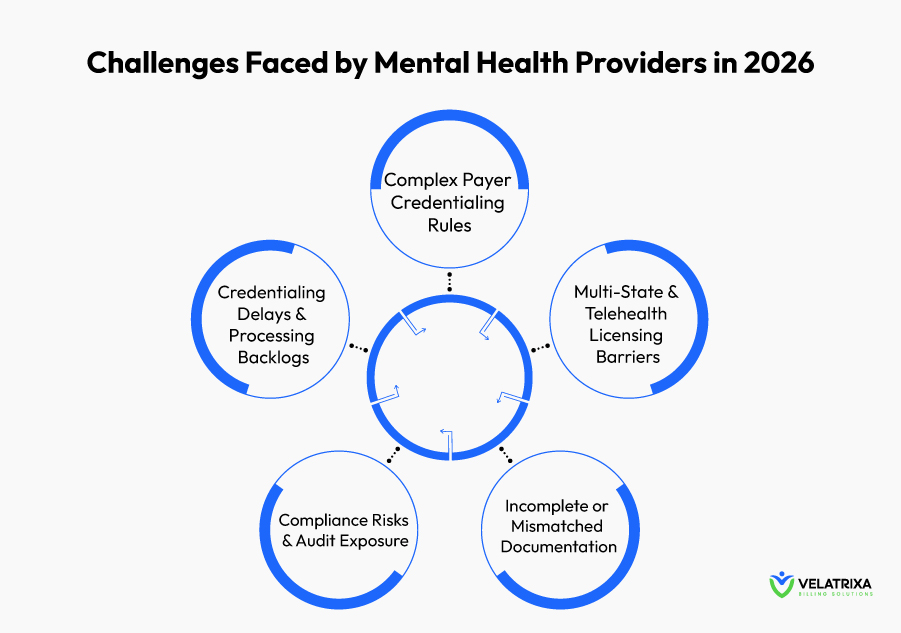
Credentialing is an essential step for providers to join insurance networks and ensure timely reimbursement. However, many providers face a variety of challenges in navigating the credentialing process, particularly with the evolving 2026 regulations. Here are some of the most common issues:
1. Increasingly Complex Payer Requirements
Insurance companies have more stringent and detailed credentialing processes than ever. With each insurer having its own set of rules, mental health professionals, primary care physicians, specialists, and even telehealth providers often struggle to keep track of the paperwork, updates, and deadlines.
2. Multi-State Licensing and Telehealth Regulations
As telemedicine continues to expand, telehealth providers face unique credentialing challenges. In 2026, providers who wish to deliver services across state lines must obtain multi-state licensure and comply with different state regulations.
3. Credentialing Delays and Backlogs
Credentialing can be a lengthy process. On average, payer credentialing can take anywhere from 45 to 180 days, depending on the insurance provider. Delays are common, especially if applications are incomplete or require additional verification.
4. Compliance Risks and Audits
Healthcare providers face increasing regulatory scrutiny. In 2026, Medicare, Medicaid, and private insurers have tightened compliance checks, and any errors or missed deadlines could result in penalties, audit risks, and network deactivation.
5. Inconsistent Documentation and Information Mismatches
One of the most common reasons for delays in credentialing is inconsistent or incomplete documentation. Name mismatches, expired licenses, and incorrect NPI information can all delay the process.
Step-by-Step Guide to the Credentialing Application Process
Understanding the credentialing application process is essential for healthcare providers in 2026. While the process can seem complex, breaking it down into clear steps can make it easier to navigate. Here’s a simplified step-by-step guide:
Step 1: Gather and Verify Documentation
The first step in the credentialing process is gathering all necessary documents. This typically includes:
- Proof of licensure (state and federal)
- Board certifications (if applicable)
- Curriculum vitae (CV)
- Malpractice insurance information
- State-specific licenses and telehealth credentials (if applicable)
It’s crucial that this information is accurate and up-to-date to avoid delays.
Step 2: Complete the Credentialing Application
Once the documentation is gathered, providers need to fill out the application forms for each payer (insurance company) and hospital (if applicable). This includes:
- CAQH application (for commercial insurers)
- PECOS registration (for Medicare)
- Medicaid enrollment (depending on the state)
- Telehealth-specific applications (if applicable)
In 2026, the process may also require the completion of additional telehealth-specific forms or multi-state licensing applications for providers offering remote services.
Step 3: Submit the Application and Wait for Verification
The credentialing application is submitted for review by the insurance company or hospital. This step typically involves primary-source verification, meaning the payer will contact relevant parties (e.g., medical boards, schools, malpractice insurers) to verify the provider’s qualifications.
Step 4: Review and Approvals
Once verification is complete, the application will either be approved or denied. If approved, you’ll be added to the insurer’s or hospital’s network, and you can begin providing services and billing for them.
Step 5: Maintain Ongoing Credentialing
After initial credentialing, providers must keep their information up-to-date by completing re-credentialing processes every 1-3 years, depending on the insurer or hospital. Renew licenses, update CAQH profiles, and maintain a clean malpractice history.
How to Optimize Your Credentialing Process for 2026
Credentialing is more than just a formality; it’s a crucial process that impacts your ability to provide care and get paid. Here are some tips for optimizing your credentialing process in 2026:
1. Stay Proactive with Credentialing Updates
In 2026, credentialing is dynamic and requires ongoing monitoring. Ensure that your licenses, board certifications, and CAQH profiles are always up to date to avoid any unnecessary delays.
2. Leverage Telehealth Credentialing
As telehealth continues to grow, it’s important to understand the unique credentialing requirements for remote care. Ensure that you’re credentialed for telehealth services and comply with payer-specific rules for telemedicine.
3. Partner with Credentialing Experts
Navigating the credentialing process on your own can be overwhelming, especially with the added complexity of telehealth and multi-state licensure. Partnering with credentialing services can help you ensure that your practice stays compliant and gets credentialed faster.
State-Specific Considerations in the Credentialing Process
Each state has its own credentialing requirements, which can affect how quickly you get credentialed and which additional documents you might need to submit. Here are some important things to consider based on your state:
1. Multi-State Licensure for Telehealth Providers
If you’re offering telehealth services across state lines, you may need to apply for multi-state licensure and ensure that you meet the state-specific telehealth regulations.
2. Medicaid and Medicare Enrollment Variances
Each state has different rules for Medicaid enrollment, including timelines and application requirements. Additionally, states may have varying rules for Medicare enrollment, so it’s important to verify which state-specific rules apply to you.
3. State-by-State Credentialing Nuances
States like California and Texas have specific credentialing procedures for mental health professionals and may require additional documentation, such as peer reviews or specialized certifications. States with high demand for mental health services may have longer wait times for credentialing.
How Velatrixa Can Help in the Mental Health Physician Credentialing Services
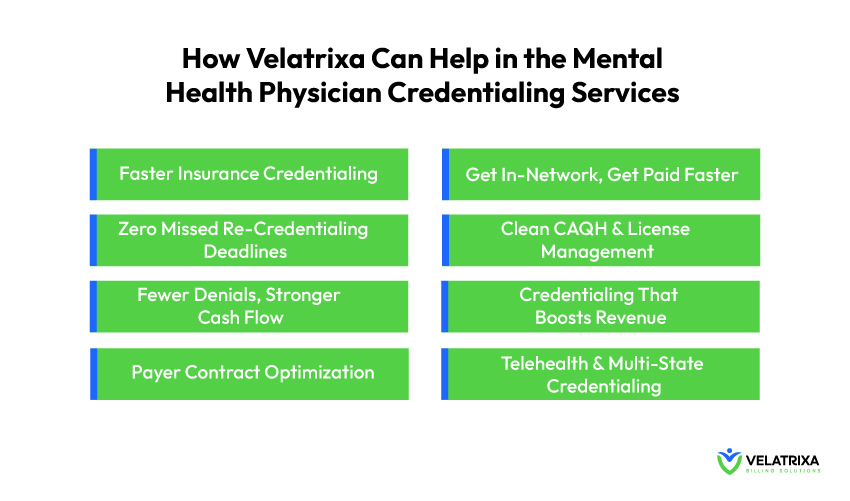
At Velatrixa, we understand the unique challenges faced by mental health providers in managing the credentialing process. That’s why we offer comprehensive, end-to-end credentialing services that take care of every aspect, from initial enrollment to ongoing compliance. Here’s how we help:
1. End-to-End Credentialing and Enrollment
We handle the entire credentialing process, ensuring that your practice is efficiently enrolled with insurance networks such as Medicare, Medicaid, and top commercial payers. From gathering the necessary documentation to submitting applications and tracking the approval process, we streamline every step to get you credentialed quickly and accurately.
2. Ongoing Re-Credentialing and Compliance Management
Credentialing doesn’t stop once you’re approved. Velatrixa manages your re-credentialing, ensuring your licenses, certifications, and profiles are always up to date. We set up automated reminders for renewals and ensure your practice stays compliant with ever-evolving regulations, so you never miss an important deadline.
3. Optimized Billing and Reimbursement Services
Credentialing and billing go hand-in-hand. Our services go beyond credentialing to include billing and reimbursement optimization. We ensure your claims are submitted on time and in full compliance, minimizing delays and denials. This way, you can focus on patient care while we handle the paperwork and ensure timely payments.
4. Expert Contract Negotiation for Better Reimbursement Rates
Our team works on your behalf to negotiate better contract terms with payers. We ensure that you’re receiving the maximum reimbursement possible by reviewing payer contracts, identifying opportunities for higher rates, and resolving any disputes or issues that may arise with insurance providers.
5. Tailored Credentialing Solutions for Telehealth and Multi-State Practices
With the rise of telehealth and the growing need for multi-state licensure, we offer customized credentialing solutions for practices that provide services across different states or through telemedicine. We help you navigate state-specific regulations and ensure that your credentials are in line with the requirements of each payer, so you can expand your reach without additional complexity.
Conclusion
Credentialing is a critical part of every mental health provider’s practice, but it doesn’t have to be complicated. With Velatrixa handling your credentialing, you can focus on providing excellent patient care while we take care of the paperwork. From initial credentialing to re-credentialing and ongoing compliance, Velatrixa is here to ensure that you’re always in-network, compliant, and reimbursed for the work you do.
Let’s get you credentialed today. Reach out to Velatrixa for your free consultation!