

Nursing home care is a cornerstone of the U.S. healthcare system, supporting millions of older adults and individuals with chronic conditions. These facilities provide long-term care, rehabilitation after hospital stays, and specialized support for residents with complex medical needs. However, in 2026, managing nursing home billing has become more complex than ever. With multiple payers, evolving federal and state regulations, and pressure from audits and denials, revenue cycle management (RCM) is a critical determinant of financial stability for skilled nursing facilities (SNFs).
This guide explains how nursing home billing works in 2026, explores Medicare Part A and B, PDPM payment structures, consolidated billing, Medicaid reimbursement challenges, and the trends shaping the RCM landscape. It also highlights strategies to optimize revenue and reduce errors, providing actionable insights for nursing home administrators and staff.
Understanding Nursing Home Billing in 2026
Unlike acute care hospitals, nursing homes manage prolonged stays and multiple payer streams simultaneously, making nursing home medical billing uniquely complex. A single resident may transition between:
- Medicare Part A for post-hospital rehabilitation
- Medicare Part B for outpatient therapy or physician services
- Medicaid for long-term custodial care
- Medicare Advantage (MA) plans with unique authorization and documentation requirements
- Private pay, which often covers services not reimbursed by insurance
Each payer has unique billing rules, documentation requirements and timelines. Facilities must navigate complex coding systems, case mix scoring, bundled services, and audits to secure timely reimbursement.
The financial stakes are high. Medicaid covers approximately 60-63% of residents nationwide, yet reimbursement often falls short of the actual cost of care. Medicare provides coverage for shorter post-acute stays and Medicare Advantage plans are growing rapidly, bringing additional administrative complexity.
The Growing Complexity of Nursing Home Billing in 2026
-
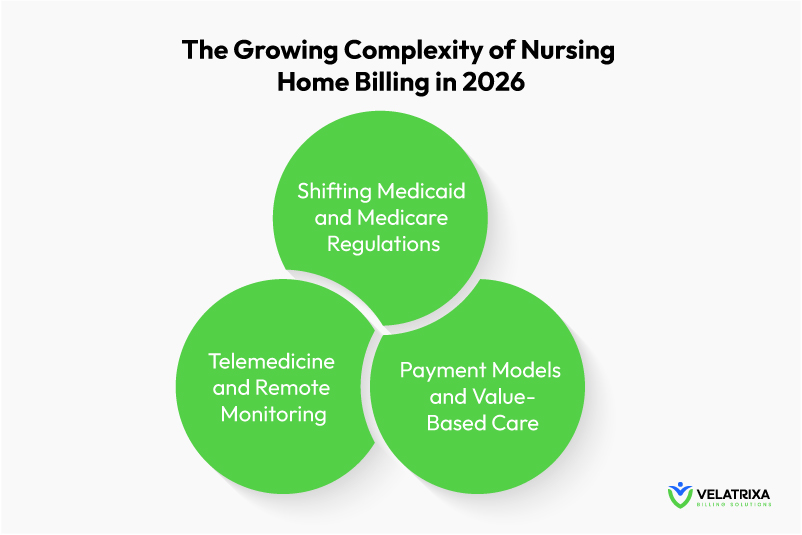
Shifting Medicaid & Medicare Regulations: Medicaid and Medicare are the primary payers for nursing home residents, but both programs are frequently updated. In 2026, new eligibility rules, service coverage, and reimbursement rates will be introduced, impacting billing processes. For instance, Medicaid varies by state, making it challenging for nursing homes to keep up with the latest changes. These regulations impact everything from service categorization to billing codes and reimbursement rates. With the introduction of ICD-11 and Value-Based Care (VBC) models, staying compliant and ensuring accurate billing can overwhelm in-house teams without specialized knowledge.
-
Telemedicine & Remote Monitoring: As telemedicine gains traction in healthcare, nursing homes must adapt to new billing requirements for virtual consultations and remote monitoring services. Improper coding or billing can lead to claim denials or underpayments, so nursing homes must stay up to date on payer-specific telehealth billing guidelines to ensure proper reimbursement.
-
Payment Models & Value-Based Care: The shift towards Value-Based Care (VBC) in 2026 means nursing homes are reimbursed based on patient outcomes rather than the volume of services. This makes billing more complex, as nursing homes must track patient satisfaction, clinical outcomes, and quality measures as part of their billing process. A robust billing system is now required to capture both the quantity and quality of services provided.
Why Nursing Home Billing Matters in 2026
Billing is not just an administrative task it is central to financial sustainability. Facilities that fail to manage billing effectively risk:
-
Prolonged accounts receivable (AR) cycles that strain cash flow
-
Denied or underpaid claims leading to revenue loss
-
Audit exposure due to improper coding or documentation
-
Operational challenges including staffing disruptions and limited investment in technology
Understanding the regulatory environment, payer requirements, and emerging trends is critical for nursing homes to maximize revenue and minimize compliance risk.
Patient-Driven Payment Model (PDPM)
The Patient-Driven Payment Model (PDPM) is the framework for Medicare Part A reimbursement in skilled nursing facilities (SNFs), designed to replace the old therapy-minute-based payment system. Unlike previous models, PDPM focuses on patient characteristics, complexity, and clinical needs, rather than the sheer volume of therapy services provided. This shift emphasizes accurate documentation, comprehensive assessments, and precise coding to ensure SNFs receive proper reimbursement for the care delivered.
Under PDPM, Medicare Part A payments are divided into five case-mix adjusted components, each reflecting a different aspect of patient care. These include Physical Therapy (PT), Occupational Therapy (OT), Speech-Language Pathology (SLP), Nursing and Non-Therapy Ancillaries (NTA). Each component is scored based on the resident’s medical diagnoses, functional status, comorbidities, and cognitive abilities, as recorded in the Minimum Data Set (MDS). For example, a resident with chronic heart failure and diabetes may have an NTA score of 3. If only one comorbidity is captured in the MDS, the facility could lose $200 to $300 per day in reimbursement. Additionally, functional status assessments directly impact PT and OT payments, making accurate scoring and documentation critical.
PDPM payment calculation is determined through several factors:
-
Base Rate: Set by CMS according to facility type and geographic location.
-
Case Mix Index (CMI): Reflects patient complexity based on MDS assessments, ICD-10 diagnoses, comorbidities, functional scores, and cognitive status.
-
Variable Per Diem Adjustment: Adjusts the payment over the course of the resident’s stay, accounting for changes in care intensity and needs.
Despite its structured methodology, PDPM presents key challenges for SNFs. Accurate ICD-10 coding, timely and correct MDS completion, proper comorbidity capture, and precise functional and cognitive scoring are essential. Even small errors in documentation can lead to significant revenue loss, costing hundreds of dollars per resident per day.
To mitigate these risks and optimize PDPM reimbursement, facilities should adopt several best practices:
-
Ensure timely MDS submissions on Day 1, Day 8, and Day 30 to accurately capture the patient’s condition.
-
Cross-check ICD-10 codes with all comorbidities to ensure complete case-mix scoring.
-
Track therapy minutes for reporting and compliance purposes, even though PDPM no longer bases payment solely on therapy volume.
By prioritizing accurate documentation, proactive assessment, and careful coding, SNFs can fully leverage PDPM to secure appropriate reimbursement while minimizing compliance risks.
Tips for avoiding common PDPM mistakes:
-
Ensure timely MDS submission (Day 1, Day 8, Day 30)
-
Cross-check ICD-10 codes with comorbidities
-
Track therapy minutes for reporting even if not payment-driving
Medicare Part A vs Part B: Billing Differences
Understanding the distinction between Medicare Part A and Part B is critical:
| Feature | Medicare Part A | Medicare Part B |
|---|---|---|
| Coverage | Post-hospital skilled care | Outpatient therapy, physician services |
| Duration | Up to 100 days per benefit period | Ongoing as needed |
| Billing | Single bundled claim | Individual claims for each service |
| Payment Model | PDPM per diem | Fee-for-service |
| Consolidated Billing | Required | Not required |
Incorrectly billing Part A vs Part B can lead to denied claims and recoupments, making this distinction vital.
Consolidated Billing: What Nursing Homes Need to Know
Consolidated billing requires SNFs to bill Medicare Part A for most services provided during a covered stay. The facility is financially responsible for:
-
Therapy services (PT, OT, SLP)
-
Laboratory and diagnostic tests
-
Ancillary services
-
Durable Medical Equipment (DME)
-
Certain pharmacy services
Exclusions: Emergency services, some dialysis services, and high-cost chemotherapy drugs.
Common Errors:
-
Outside providers billing directly
-
Incorrect revenue codes
-
Failure to include bundled services
-
Misclassifying excluded services
Consolidated billing compliance is a frequent audit focus and a major source of financial risk for nursing homes.
Medicaid Reimbursement Challenges
Medicaid is the primary payer for long-term residents, yet reimbursement often falls below the cost of care. Facilities face challenges such as:
-
State-specific fee schedules
-
Retroactive eligibility changes
-
Slow payment cycles (30–90+ days)
-
Managed Medicaid complexity
-
Documentation and revalidation requirements
Without active management, Medicaid AR can age rapidly, causing cash flow issues and increased write-offs.
Key Nursing Home Billing Challenges in 2026
1. Multi-Payer Complexity
Nursing home billing requires managing multiple payer streams with distinct rules:
-
Medicare Part A: Covers post-hospital skilled care under the Patient-Driven Payment Model (PDPM).
-
Medicare Part B: Covers outpatient therapy and physician services not included in Part A.
-
Medicaid: State-administered programs cover long-term custodial care. Payment varies widely by state and is often below the actual cost.
-
Medicare Advantage: Managed care plans have plan-specific authorization, documentation, and billing rules.
-
Private Pay: Direct payment by residents or their families for services not covered by insurance.
Facilities must reconcile claims across these payers while tracking compliance, billing deadlines, and eligibility, making nursing home billing uniquely complex compared to other healthcare settings.
2. Fragmented Billing Streams
Nursing home billing differs from acute care in several ways:
-
Room & Board: Typically covered by Medicaid or private pay.
-
Therapy Services: PT, OT, and SLP services require precise documentation.
-
Ancillary Services: Laboratory, imaging, and durable medical equipment (DME) must be properly coded and billed.
-
Physician Services: Often billed separately under Medicare Part B.
Accurate tracking across these streams is essential to avoid denials, delays, and lost revenue.
2026 Trends Shaping Nursing Home Billing
In 2026, nursing home billing is shaped by several emerging trends that every skilled nursing facility (SNF) must understand to maintain accurate reimbursement and optimize cash flow. Medicare Advantage (MA) plans are expanding rapidly, requiring medical billers to navigate preauthorization processes, plan-specific documentation, and distinct billing workflows to avoid denials and delays. At the same time, telemedicine and remote monitoring have become integral to long-term care, demanding precise coding for virtual consultations and remote patient services in compliance with Medicare and Medicaid guidelines.
Advanced AI and automation tools are transforming revenue cycle management (RCM), enabling billers to perform predictive denial analytics, automated claim scrubbing, eligibility verification, and accounts receivable (AR) prioritization. By reducing manual errors and accelerating claim submission, these technologies directly improve cash flow while freeing staff to focus on complex cases and high-risk accounts. Meanwhile, the adoption of Value-Based Care (VBC) is reshaping how SNFs are reimbursed, tying payments to clinical outcomes, patient satisfaction, and quality metrics. Skilled medical coders must now integrate clinical and financial data to ensure that all eligible services are captured accurately, maximizing revenue while maintaining compliance.
Key focus areas for nursing home billing and coding include:
-
Medicare Advantage Growth: Mastering plan-specific authorizations, documentation, and workflows to prevent claim denials.
-
Telehealth Billing Compliance: Accurately coding virtual consultations and remote monitoring services in line with federal and state payer rules.
-
AI and Automation in RCM: Leveraging predictive analytics, automated claim scrubbing, eligibility checks, and AR prioritization to streamline the revenue cycle.
-
Value-Based Care Integration: Tracking clinical outcomes, quality measures, and patient satisfaction to ensure correct VBC reimbursement.
By staying ahead of these trends, medical billers and coders can protect SNF revenue, minimize denials, and optimize the complex multi-payer billing environment in 2026, turning regulatory challenges into opportunities for operational efficiency and financial growth.
How Nursing Home Billing Services Help
Professional SNF billing services improve revenue cycle management by providing:
-
PDPM Optimization: Ensuring accurate MDS scoring and ICD-10 coding.
-
Consolidated Billing Compliance: Preventing audit exposure and improper vendor billing.
-
Medicaid AR Management: Dedicated follow-up reduces the risk of aging and underpayment.
-
Denial Management: Root cause analysis prevents repeated errors.
-
Medicare Advantage Workflow Management: Handles preauthorization and documentation.
-
Analytics & Reporting: Provides transparency for decision-making and KPI monitoring.
Facilities that outsource billing often reduce AR by 15-30% and denials by 30-40%, while improving cash flow and compliance.
How Velatrixa Can Help Nursing Home Providers
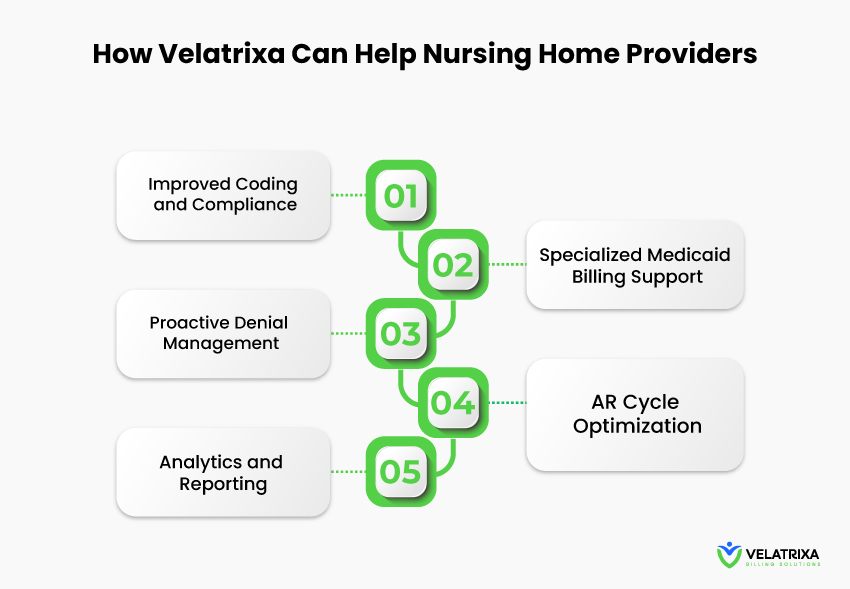
While nursing home billing in 2026 is more complex than ever, Velatrixa helps facilities streamline every stage of the revenue cycle. For example, a 120-bed SNF struggling with delayed Medicaid payments and high denial rates partnered with Velatrixa, resulting in faster reimbursements, reduced denials, and stabilized cash flow. With expertise in coding, PDPM compliance, AR optimization, and real-time analytics, Velatrixa ensures nursing homes capture the revenue they deserve while focusing on quality resident care.
Conclusion:
Nursing home billing in 2026 presents significant challenges, but by outsourcing to experts, providers can streamline their revenue cycle, reduce errors, and improve cash flow. Velatrixa offers the expertise needed to navigate billing complexities, ensuring your facility is reimbursed promptly and accurately.
Contact Velatrixa today for a consultation and discover how we can help streamline your revenue cycle management.