

Orthopedic billing is more complex than simply submitting CPT and ICD-10 codes. Small orthopedic practices must manage procedure-specific coding, documentation, prior authorization, payer policies, global surgery rules, claim edits, denials, underpayments, and aging accounts receivable—all while keeping clinical operations moving.
The financial impact can be significant. MGMA’s practice-operations benchmarking reported an 8% aggregate first-submission claim denial rate for single-specialty practices. More recently, an MGMA poll found that denials and appeals accounted for 48% of the revenue-cycle leakage identified by participating practices, making denial prevention a major financial priority.
For small orthopedic practices, the goal should not be to chase an unsupported industry-wide “average denial rate.” Instead, practices should measure their own denial rate, identify the root causes, and prevent recurring problems involving coding, authorization, eligibility, documentation, and payer requirements.
Why Is Orthopedic Billing Difficult for Small Practices?

Small orthopedic practices often have limited staff and resources, making complex orthopedic billing and revenue-cycle requirements harder to manage. From specialized coding and prior authorization to eligibility and documentation, several factors can affect claim accuracy and reimbursement.
1. Complex Orthopedic Coding
Orthopedic claims may involve multiple procedures, anatomical sites, laterality, modifiers, and payer-specific edits. Incorrect CPT, ICD-10-CM, or modifier selection can lead to denials and delayed reimbursement. CMS’s 2026 NCCI guidance includes global-surgery modifiers such as 24, 25, 57, 58, 78, and 79, which must be supported by appropriate documentation.
2. Prior Authorization Delays
Surgeries, advanced imaging, injections, therapy, and DME may require prior authorization. The AMA reports that 93% of physicians say prior authorization delays patient care. Verifying authorization requirements, approved services, dates, and supporting documentation before treatment can prevent avoidable denials.
3. Eligibility and Insurance Errors
Incorrect or outdated insurance information can cause otherwise accurate claims to fail. Practices should verify coverage, benefits, member information, network status, referrals, and authorization requirements before services are provided.
4. Documentation and Medical Necessity
Orthopedic documentation should clearly support the diagnosis, treatment, medical necessity, anatomical site, laterality, procedure performed, and relevant clinical findings. Complete documentation is especially important when payers request records or challenge a claim.
Common Orthopedic Claim Denial Causes
Rather than assuming every orthopedic practice has the same denial rate, practices should analyze their own denial data by payer, provider, procedure, diagnosis, location, and denial reason.
Common causes include:
| Denial Cause | Orthopedic Billing Risk | Prevention Strategy |
|---|---|---|
| Eligibility errors | Claim submitted to inactive or incorrect coverage | Verify benefits before service |
| Prior authorization | Required authorization missing or invalid | Check payer requirements before scheduling |
| Coding errors | Incorrect CPT, ICD-10-CM or modifier | Perform coding and documentation review |
| Medical necessity | Diagnosis does not support procedure | Match documentation and payer policy |
| Modifier errors | Incorrect use of 24, 25, 57, 58, 78 or 79 | Validate modifier against documentation |
| Global surgery issues | Services incorrectly billed during global period | Review global surgery rules |
| Missing documentation | Payer requests records or suspends payment | Submit complete supporting documentation |
| Timely filing | Claim submitted after payer deadline | Monitor claim submission dates |
| Coordination of benefits | Incorrect primary payer | Verify COB information |
| Underpayments | Payer reimburses below expected amount | Compare payment against contract terms |
When Should a Small Orthopedic Practice Outsource Billing?
Outsourcing may make sense when:
- Claims are frequently rejected or denied.
- A/R is aging faster than the practice can work it.
- Staff spend too much time on payer follow-up.
- Prior authorization is delaying procedures.
- Coding expertise is limited.
- Billing staff turnover is affecting collections.
- Providers cannot easily see billing performance.
- Underpayments are not being consistently identified.
- The practice lacks resources for ongoing payer and regulatory updates.
- Administrative work is taking time away from patient-facing operations.
The best decision should be based on measurable revenue-cycle performance rather than simply comparing the monthly cost of a billing company with one employee’s salary.
How to Reduce Orthopedic Claim Denials
A practical orthopedic denial-prevention strategy should focus on the entire revenue cycle rather than waiting until a claim is denied.
Before the Patient Visit
- Verify eligibility and benefits.
- Confirm referral requirements.
- Check authorization requirements.
- Confirm network status.
- Collect accurate demographic information.
Before Claim Submission
- Validate CPT and ICD-10-CM coding.
- Confirm laterality.
- Review modifiers.
- Check global surgery implications.
- Confirm authorization information.
- Review medical necessity.
- Ensure documentation supports the services billed.
After Submission
- Monitor claim acceptance.
- Track payer responses.
- Correct rejected claims promptly.
- Categorize denials by root cause.
- Appeal valid denials with supporting documentation.
- Identify recurring payer or workflow problems.
The objective is not simply to work more denials. It is to identify why they occurred and eliminate the underlying process failure.
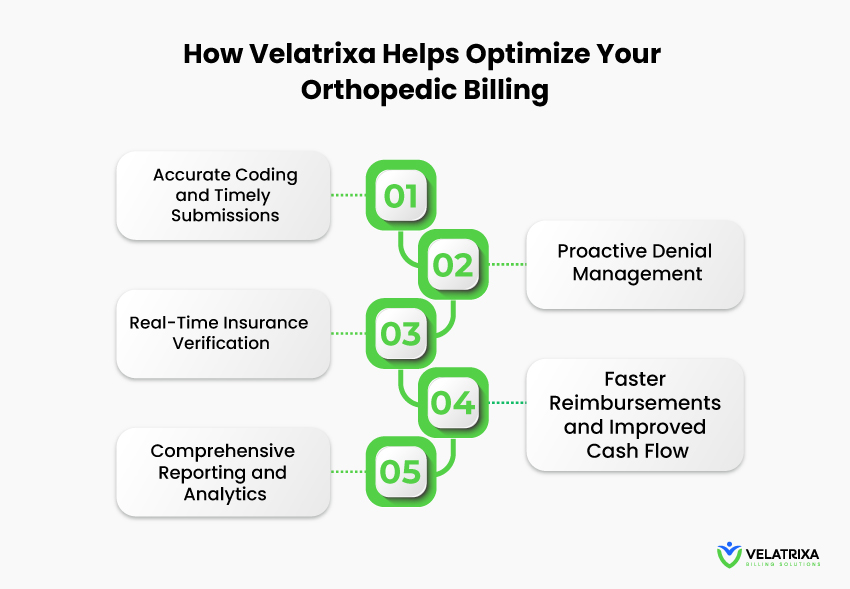
How Velatrixa Supports Orthopedic Medical Billing
Orthopedic practices need a billing process built around the realities of musculoskeletal care. Velatrixa connects front-end verification, orthopedic coding, claim submission, denial resolution, A/R recovery, and payment analysis into one coordinated workflow. We review coding and documentation, validate insurance and authorization requirements, investigate unpaid or denied claims, and monitor reimbursement patterns to uncover avoidable revenue leakage. With clear RCM reporting and ongoing account follow-up, your practice gets greater visibility into what is being billed, what is being paid, and where revenue may be getting stuck.